


By Mike Telin
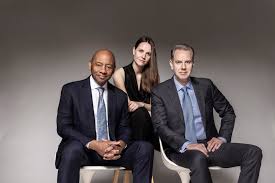 “We’re all excited about what this combination brings forward,” saxophonist Timothy McAllister said during a Zoom conversation. “I think there’s a mutual love and the three of us are providing a safe space for each of us to be who we are. It’s just a celebration of music and friendship.”
On Tuesday, March 3 at 7:30 pm at Akron’s E.J. Thomas Hall, Tuesday Musical continues its season with the Marsalis-McAllister-Ames Trio. Branford Marsalis and Timothy McAllister, saxophones, and Liz Ames, piano. Tickets are available online.
Mike Telin: How did you and Liz and Branford come together as a trio?
Timothy McAllister: I’ve known Branford for 20 years, and Liz has known him for probably a decade or more. About five years ago — it was right after the pandemic — Liz was associated with a small foundation that was committed to suicide prevention and awareness, particularly among college-age students. This was following a tragic suicide of a saxophone student of one of my former students who teaches at West Virginia University. The foundation was planning a December benefit and they wanted to feature Liz, their son’s teacher, and they asked me to play. We just came up with this cockamamie idea of trying to bring in a headliner that would be a big draw for the fundraiser.
During the pandemic Liz, Branford and I started talking about projects that we’d like to do so we thought, why not try out some of the repertoire we’ve been talking about at this fundraiser. We asked Branford if he wanted to come to Ann Arbor, and he said yes. We had to clear it with his agent, and they thought it was a great idea. We raised $10K that evening
MT: About the Akron program. How did the Michael Daugherty commission come about?
TM: About two years ago the University Musical Society series at the University of Michigan wanted to bring Branford’s jazz quartet to Ann Arbor. His jazz quartet had never been featured, and he himself had never been presented in a recital or chamber music situation. So the UMS asked, what if they brought him in for a week-long residency? One evening would feature the jazz quartet, and they wanted our trio to be part of a chamber music component.
I was able to get them to commission Michael Daugherty for a large-scale piece for the program.
MT: Tell me about Kansas City Confidential.
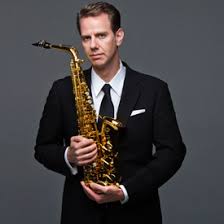 TM: It’s quite a beautiful virtuosic piece. It draws on the middle ground world of what Branford and I both represent — he’s a jazz musician by nature and I’m a classical musician by nature. And what we do is informed by both sides coming from a different perspective.
There’s a lot of, I’m not going to say cliché, but there’s a lot of little references to period-style music like Django Reinhardt and dance hall music before it blossomed into what we know jazz to be. And Michael Daugherty found the sweet spot that displays our virtuosity in both of our comfort zones. Branford’s playing soprano and tenor, and I’m playing alto and baritone and we’re constantly swapping our roles. And Liz, at one point even plays the harmonica.
MT: It’s nice to see Sally Beamish’s music on the program.
TM: She arranged her Divertimenti for us. She’s a wonderful English composer. She arranged one of the movements that we premiered at the Trio’s debut concert, so we inquired into the viability of her arranging the rest of the movements for our instrumentation. She took a look at it and worked it out, so we will be giving the full premiere of this version.
She came to a concert we played back in Manchester, England in early November, and we spent the weekend hanging out and just having a great time. I think that’s the most rewarding part of any collaboration of people who specialize in new music. It’s that camaraderie with the composers. I think that at least half of the motivation is to make that connection and build the sense of community around contemporary music.
MT: The program also includes some duos.
TM: Branford and Liz will play Samuel Barber’s Nuvoletta, and Liz and I will open the second half with Wynton Marsalis’s Book, Book, Nova that was written for Liz and me, that is a tribute to Branford. It’s a short piece — five minutes — and has three sections that are a little chronicle of their childhood growing up in New Orleans. It opens with this kind of call to church in New Orleans. Then it goes to a boogie woogie stride movement, and ends in a bebop movement called “Breaks for Branford.”
We also have a Debussy set which is my tribute to Branford, because his first classical recording was an entire album of transcriptions he did with the English Chamber Orchestra.
I think he tends to dismiss it now. He sees it as a kind of primordial version of his classical playing, and yet I saw it as the flip opposite when I was growing up as a young player. To see a jazz icon branch into a classical project was just further validation that classical saxophone mattered. And it was the first classical saxophone music I remember hearing — it was in a shopping mall, the Debussy Arabesque No. 1 with Branford.
MT: How do you describe this program to audiences?
TM: I don’t think the audience knows exactly what to expect from this program. But I feel that people who might be disappointed that it’s not a jazz gig or people who are wanting something more classical, they’re going to get a little bit of everything in this program. And show the diversity of the saxophone and what it’s capable of doing.
Published on ClevelandClassical.com February 28, 2026
Click here for a printable copy of this article
