


By Mike Telin
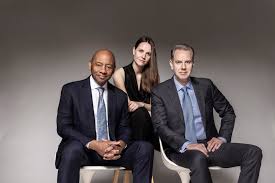 On Tuesday, March 3 at 7:30 pm at Akron’s E.J. Thomas Hall, Tuesday Musical continues its season with the Marsalis-McAllister-Ames Trio — Branford Marsalis and Timothy McAllister, saxophones, and Liz Ames, piano. Tickets are available online.
I caught up with Branford Marsalis by phone in Durham, North Carolina. I began by asking him to share his recollection of how the trio met.
Branford Marsalis: I met Liz through her former husband who is a saxophonist. I went to a saxophone conference after I’d met her, and was just amazed at the volume of music that she could learn on the fly. If you’ve ever been to something like the North American Saxophone Alliance, you know that the pianists have to play something like twenty-five pieces in three days. And Liz had this massive volume of music that she walked around with, going from rehearsal room to rehearsal room, rehearsing with saxophonists from all over the country. I was just amazed by that. It left an impression on my mind. Wow, she’s amazing.
And I met Timothy when he was the professor of saxophone at Arizona State University. I needed a practice room so I called a friend in North Carolina. He said, Call McAllister. So I called him out of the blue and said, I need a practice room. He called me right back and said, Come on over. And that’s when we first met, and we just hit it off after that.
Mike Telin: How did this project come about?
BM: I think it was Tim’s idea. He said, Hey, we should play some gigs, me, you, and Liz. I told him that I’d love to do it.
Tim picked most of the material — I always defer to him. If we were playing in a jazz trio, he’d defer to me. We talked about what to play and what not to play. He’s done a marvelous job of promoting the saxophone through commissions. He’s commissioned two of the most famous American composers, so he knows what he’s doing.
He came up with most of the program but I added a couple of things and Liz added some things, and off we went.
MT: Could I get your thoughts on a couple of the pieces? First, Michael Daugherty’s Kansas City Confidential.
BM: I’ve known Michael for a while as well and all three, Liz, Tim, and Michael, teach at the University of Michigan. But Tim came up with the idea of asking Michael to write a piece for us. When Michael started writing it I was playing with the Detroit Symphony. He came, and we sat around and talked about ideas and he came up with this marvelous piece of music.
MT: I understand that you’ve known composer Sally Beamish for a while as well.
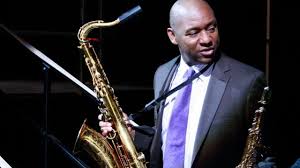 BM: Sally’s a great friend. I was playing a symphonic concert in Rotterdam in the early aughts, and they asked, what would you like to play? I heard a saxophonist from the UK named John Hall playing this piece of Sally’s called The Imagined Sound of Sun on Stone. And I thought it would be a good piece to play. So I ordered it from the publishing company in Scotland and they contacted her, because, you know, it’s all small community stuff.
She’s English but was living in Scotland at the time, and she asked what I was doing? I said that I’m playing it in July. That’s all I said, and I played the piece — in my opinion, not very well — and at the end of the concert, when I was coming back to retrieve my music stand, a woman was just standing at the front of the stage and said that was very nice. My name’s Sally. And Sally’s a popular name so I didn’t assume it was Sally Beamish. So I started to walk away, and I turned around and said, Are you Sally Beamish? She goes, Yes. She came backstage, and we sat in this venue for two hours talking about music and possibilities and all these things, and we just hit it off.
She’s an adventurous composer but still is able to maintain a melodic construct throughout. It’s not all harmonic devices. She’s incredible and I really love her writing.
She wrote this piece, Divertiment for a string quartet and she said, I think I can finagle it and make it a thing for two saxophones and a piano, which she did.
MT: You also have some Debussy on this program.
BM: We have three different pieces. The first I played on this Classical record 30-something years ago. I guess when Tim was a young kid he heard it. He said it made him want to play the saxophone. I said, I really can’t believe that.
So I’ll play the Arabesque No.1, and Tim and fleshed out Clair de Lune. And then there’s the Rhapsodie for Saxophone, arranged for two saxes and piano.
You know, the woman who commissioned it was the Florence Foster Jenkins of the saxophone. She was married to a very wealthy man, and she commissioned Debussy to write a piece which he refused to write. She actually took a boat to Paris to get him to finish the piece.
What Debussy did brilliantly was make it into essentially a chamber piece where the melody passes around from instrument to instrument. It’s quite beautiful the way he orchestrates it. I’ve played it a couple of times, and although there’s not a lot for the saxophone, what is there is quite beautiful. So my solution has been to put the saxophone in the middle of the orchestra and make it into a full chamber piece, because to me, that’s what it is anyway.
MT: You and Liz will begin the program with Samuel Barber’s Nuvoletta.
BM: I really love Barber and this is an incredible piece of music. We were playing something else, and I didn’t really like it, so I said, you know what, let’s find a Barber song. And Liz and I came upon Nuvoletta.
MT: How do you describe a program as eclectic as this to an audience?
BM: My experience has been, having played in classical settings and pop music settings and jazz settings, that the audiences are all pretty much the same. What they want is music that has a very strong melody, a great beat, a great pulse. Because even when the musicians are playing without a modern American rhythm section, there still needs to be a pulse.
We’re all committed to music, and we love playing together. And I think that will come across to the audience. Because, I mean, ironically, the operative verb for concert-going in our country is see, not hear.
My father used to say, you know, a lot of people hear music with their eyes, so you have to exude a certain kind of charisma and confidence. You just can’t be up there looking fragile. So we’re all fairly confident in what we do, and we all are reverential to the music, so I think that they’ll hear that, and they’ll see it.
MT: Speaking of your brother, you have a piece by him on this program as well.
That’s a funny piece. The title Book Book Nova is a nickname that was given to me by a childhood friend in 1969-1970. My mother would call me Bookie because I read a lot.
So Brian was his name — he heard it and started calling me, “Hey, what’s up, Book Book Nova?” To this day, I have no idea what it means. I think it just rhymed for him. So Wynton from time to time calls me Book Book Nova. It’s really cool and I look forward to hearing it.
Published on ClevelandClassical.com February 28, 2026
Click here for a printable copy of this article
