

by Daniel Hathaway
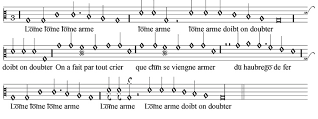 In an open letter to Cleveland Chamber Choir patrons, artistic director Gregory Ristow wrote:
“Our upcoming concert, La Fleur de la Renaissance, celebrates the new approach to harmony that emerged in the 1400s in the northern reaches of the French empire…To my ears, this is where Western classical choral singing as we know it began. To return to this music is to come back to the source, to explore consonance and dissonance in their purest forms, to delight in how these composers wrote glorious melodies for each part of the ensemble, while also allowing them to come together to form beautifully resonant sonorities.”
On Friday, May 8 at Trinity Cathedral, Cleveland, and Saturday, May 9 at First Lutheran Church in Lorain, the Cleveland Chamber Choir will present “The Flower of the Renaissance,” a compendium of works by six composers in the form of a Roman Catholic Mass that explore this new style. Both performances begin at 7:30.
The program also demonstrates the popular practice among Renaissance composers of embedding pre-existing material in new pieces, something that would come to be regarded as plagiarism in modern times, but were meant as tributes back in the day. Ristow has constructed his imaginary mass from movements of the forty-some Renaissance works based on the mysterious secular song, L’Homme armé.
I recently met with Gregory Ristow in his studio at the Oberlin Conservatory to learn more about this weekend’s programs.
Daniel Hathaway: So Greg, did you listen to all 40 L’Homme armé masses?
Gregory Ristow: Just about. It was great fun. I tried to pick the greatest variety of movements I could, so that we had L’Homme armé unifying the program whether as a paraphrase or as an actual cantus firmus in the tenor line.
DH: Well, it’s a great tune with a very recognizable profile.
GR: It is. You hear the opening intervals and the falling fifth, and you say, ‘Oh, there it is!’ It jumps out so well.
DH: Any theories about where the song came from?
GR: No, it’s one of those mysteries of music history. What’s it really about? There was apparently an Homme armé bar that was not too far from where Dufay lived. Is it a reference to the pub, or is it a reference to the Crusades? Richard Taruskin argued that it’s a reference to the Archangel St. Michael, the militant standard-bearer, but we really don’t know, which is cool.
DH: Are you going to teach everybody the tune before performing the Mass?
 GR: I think yes. The choir’s going to sing it in unison and then go directly into Il sera pour vous combattu, a really early Renaissance three-part setting which may be by Jean Mouton, who uses the tune in the tenor.
After that, we’re going to invite the audience to sing L’Homme armé along with us before we transition into the Kyrie, which uses the tune in canon between the bass and the alto parts in the first measure, so you hear it right away.
DH: I was fascinated by what you chose at the end of the program, too. Josquin’s Ave Maria has to be the most perfect motet that’s ever been written.
GR: I think that’s the first piece of Renaissance choral music I ever heard. And every time I come back to it, I think it’s so incredibly beautiful. Since I last conducted it, two really significant recordings of it have come out. Graindelavoix adds all sorts of ornamentation which probably would have happened at the time, and they take the most incredibly slow tempo you’ve ever heard, while Jesse Rodin takes the fastest tempo you’ve ever imagined.
These two groups are at the very forefront of research into historical performance practices and they come to completely opposite conclusions about tempo. I find that just fascinating.
DH: What do you think Renaissance singing actually sounded like?
GR: This is a great question. We have a number of contemporary sources that talk about the difference between cathedral or church singers and chamber singers.
The cathedral singers are sometimes derogatorily described as sounding like braying donkeys, versus the chamber singers who sing with sweet delicacy. When you think about the spaces they were filling, they’re big spaces. I think almost certainly there was a brightness of tone to the singing.
The question of vibrato is really interesting. In this period, we’re seeing organ stops like the Vox humana emerge, which is generally coupled with a tremulant which suggests that the human voice had some vibrato to it. But how much? To me, it’s a fascinating topic.
We’re singing this program with thirteen voices, and it works really well. Our singers are gloriously sensitive and all so deeply immersed in Renaissance stylistic practice that as a conductor, you don’t have to say much at all.
Because we’re doing an O Magnum pastiche mass interspersed with different anthems and chansons, I had a lot of fun thinking about pairings. For instance, we’ll follow the Gloria from the Ockeghem mass with Josquin’s Nymphes de Bois, his lamentation on Ockeghem’s death.
We’re closing the first half with Clément Janequin’s La Guerre, my gentle nod to the fact that there’s this little sense of war running through the whole program.
In the second half, I’m playing with the idea of the emergence of spring, especially because we’re doing this concert in May. So we’ll be singing Claude Le Jeune’s Revecy venir du Printans and then closing with Janequin’s Chant des Oiseaux.
When I think about the Renaissance, there are so many times we see pairings of secular and sacred in a way that today feels strange. We see this in the Protestant tradition, with Martin Luther taking all those popular songs and retexting them as hymns. We also see it in the Catholic tradition with these popular songs coming into masses as Cantus firmuses or as chant paraphrases.
DH: How many versions of this program did you go through in putting it together?
GR: Oh, a dozen or so, and I still miss the things that got left on the cutting room floor. But I think every piece is a great piece, and I hope the whole program has the right balance of unity and variety.
As a listener, I always dread going to an early music program when someone tells me, ‘We’re doing a dozen Ave Marias,’ and I think, ‘Oh no, I’m going to hear the same thing over and over.’ It’s nice to be able to have a variety of composers and styles unified by this melody flowing through the program.
Published on ClevelandClassical.com May 5, 2026
Click here for a printable copy of this article
