


 By Daniel Hathaway|Cleveland Classical
This article was originally published on Cleveland.com
CLEVELAND, Ohio — Over the course of a concert season, The Cleveland Orchestra is called upon to play a variety of works in all categories from four centuries’ worth of repertoire. Not so often do audiences get to experience in a single concert three such wildly different works as were on display at Severance Music Center on Thursday evening, May 7.
Sergei Prokoviev’s Symphony No. 1, Olga Neuwirth’s “Zones of Blue,” and four excerpts from Richard Wagner’s “Götterdämmerung” require, in turn, cool neoclassical clarity, expert control of avant-garde techniques, and the kind of pre-film cinematic virtuosity that pushes 19th-century instruments to the limits of their original design.
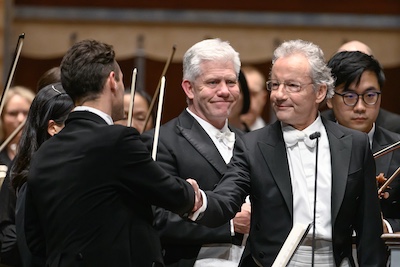
Playing to a good-sized crowd on Thursday, Franz Welser-Möst and the Orchestra checked all those boxes, and Jörg Widmann added “composer” and “conductor” to his Cleveland resumé, having last week appeared with the orchestra in both of those roles.
In spite of its four-movement format, Prokofiev’s suave and witty Symphony No. 1 made a very fine overture. The opening Allegro, fast out of the blocks, was lively and adorned with accented flourishes from the winds.
In the well-paced Larghetto, Welser-Möst drew a lean but rich sound from the ensemble and pointed the musical lines in just the right directions.
It was difficult not to smile during the Gavotte, with its tossed away ending and the edge-of-your-seats velocity of the stunning finale, which never lost tempo or threatened to spin off the rails.
Austrian composer Olga Neuwirth’s “Zones of Blue (Rhapsody for Clarinet and Orchestra),” owes its subtitle to the ancient Greek term for a reciter of epic poetry (rhapsōidos — one who stitches verses together), and takes its inspiration from jazz (the work, a Cleveland Orchestra co-commission for Widmann, is dedicated to the composer’s father, an eminent jazz pianist).
Otherwise, the piece is vintage Widmann, a genius at creating shapely lines out of jagged-edged sounds — isn’t this what a clarinet was always meant to sound like?
In “Zones of Blue,” those sounds are generated by the solo clarinet, an instrument capable of a seemingly inexhaustible collection of extended techniques — including coaxing sound out of silence as in the opening, which has the soloist blowing air through the instrument, and the growls, squeaks, multi-phonics, micro-tones, and other special effects Widmann produces by playing with the clarinet’s rich overtone series.
A few minutes into the piece, Neuwirth imports one historical effect that turned heads — the famous clarinet slide that opens Gershwin’s “Rhapsody in Blue.”
The piece is often ear-piercingly loud, and about five minutes too long, but Welser-Möst kept everything tidy and in sync with the soloist. At the end, Widmann’s sudden final outburst catches you off-guard.
The evening’s conclusion found Franz Welser-Möst completely in his element as he molded excerpts from Wagner’s fourth Ring opera into a sound tapestry that filled Mandel Hall with splendor.
Dawn offered regal horns, full-bodied brass, and a splendid clarinet solo from Afendi Yusuf. Principal horn Nathaniel Silberschlag contributed a noble solo to Siegfried’s “Rhine Journey.” The lengthy “Death and Funeral March” led seamlessly to the “Immolation Scene,” a lesson in extended climaxes — if not techniques — that culminated in a splendid wall of sound from winds and brass.
The program will be repeated Saturday, May 9 at 7:30 p.m. Tickets are available online.
Photo by Yevhen Gulenko
Daniel Hathaway is founder and editor of the online journal ClevelandClassical.com. He teaches music journalism at Oberlin College and Conservatory of Music.
Published on ClevelandClassical.com May 14, 2026
Click here for a printable copy of this article
