

by Daniel Hathaway
 Musical duels are more often fought with compositional one-upmanship tools than with loaded pistols. And so it was when the keen amateur flutist King Frederick “the Great” of Prussia challenged Johann Sebastian Bach to a feat of improvisational prowess during a visit to Potsdam in 1747.
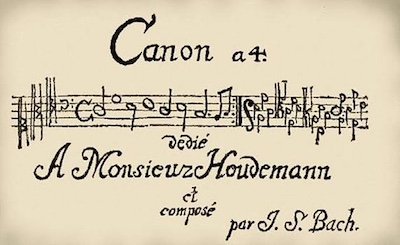
Bach having impressively extemporized a 3-voice Ricercar on a theme of the King’s devising, Frederick upped the ante, suggesting that the composer craft a six-voice fugue for round two. Bach demurred, but not long after returning to Leipzig, he dispatched a bundle of material to Frederick containing not only Ricercars for three and six voices, but also a trio sonata and a collection of canons, all based on the “Royal” theme.
Those canons should have been labeled “Some Assembly Required,” because many came in the form of musical puzzles that needed to be decoded before they could be played.
On Sunday afternoon, October 4 in Gartner Auditorium at the Cleveland Museum of Art, Les Délices artistic director Debra Nagy organized most of the collection that Bach sent to Frederick under the title of A Musical Offering into an hour-long program that not only reinforced Bach’s reputation as a “Learned Musician” well-versed in counterpoint but also challenged the idea that he was lagging behind the times in adopting a new musical style.
The afternoon began with a cogent and engaging talk about canons by harpsichordist Mark Edwards, who referred the audience to the time-honored Row, row, row your boat for a simple example, then taught the crowd Frederick’s theme with its craggy downward plunge and chromatic meandering. He then stylishly played the three-voice fugue on harpsichord — an instrument that got a bit lost in the big auditorium.
Next came four canons each for two voices, one of them of the perpetual type that could cycle around all day, another a ”crab” canon that moved in reverse, a third for two violins playing in unison, and a fourth whose voices moved in contrary motion.
The Trio Sonata was the centerpiece of the afternoon, and its departure from strict counterpoint to dally delightfully in the melodic freedom of the galant style brought fresh air into the performance.
As an aside, perhaps to acknowledge the third person in the room in Potsdam, Nagy chose to introduce something completely different: Carl Philipp Emanuel Bach’s Oboe Sonata. Nagy can be said to have completely domesticated her double-reed instrument (too often known as “the ill wind that nobody blows good”), and she joined Edwards in one of the high points of the concert.
Two more canons included the mysterious “seek and ye shall find” puzzle, whose pitches and entrances performers are left to figure out for themselves (there are multiple possible solutions) led to the 6-voice Ricercar that involved all the performers in a mind-boggling contrapuntal tour de force so captivating that Anton Webern made his own pointillistic arrangement of it. One could only regret that the mannered playing style these excellent musicians adopt occasionally leads to voids in the contrapuntal fabric.
The large audience, swelled by attendees of an academic conference, were generous with applause for Nagy and Edwards and their tag teammates, flutist Emi Ferguson, string players Shelby Yamin (violin), Allison Monroe (violin & viola), and Rebecca Landell (cello), and bassoonist Stephanie Corwin. Too bad that Frederick himself couldn’t make the party.
Published on ClevelandClassical.com October 22, 2026
Click here for a printable copy of this article
