

by Daniel Hathaway
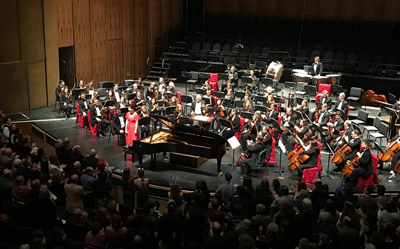 Charismatic conductor and motivational speaker Benjamin Zander made the most recent of his periodic appearances with the Akron Symphony Orchestra on January 21 at E.J. Thomas Hall. The all-Beethoven program featured the Ninth Symphony and the Third Piano Concerto with soloist HaeSun Paik.
Zander plus Beethoven plus the Ninth Symphony guaranteed a packed house for the occasion, and judging from comments overheard at intermission and after the concert, both performers and audience were transported by the experience.
There’s usually a theory behind Zander’s programming, and this one involved the search for Beethoven’s ideal tempos. The composer was one of the early adopters of a new invention patented by Johann Maelzel in 1815. The metronome, described as an “Instrument/Machine for the Improvement of all Musical Performance,” was intended to replace the prevailing system of designating tempos by Italian descriptions. For example, the beginning of Beethoven’s Ninth Symphony is marked, “Allegro ma non troppo, un poco maestoso,” or “Fast but not too much, a little majestically.” A little vague without a metronome marking.
Beethoven seized upon the new invention as a way of guaranteeing that his music would always be performed at the speed he had in mind, and thus many of his compositions bear tempo indications in terms of beats per minute. So far so good, but modern musicians have questioned some of those markings, opining that there must have been some flaw in Beethoven’s metronome that led to his sometimes bizarrely fast tempo indications.
Ben Zander believes Beethoven’s machine was accurate, and has long espoused a return to the composer’s original markings, a conviction he brought to his interpretation of the Ninth Symphony on Saturday evening.
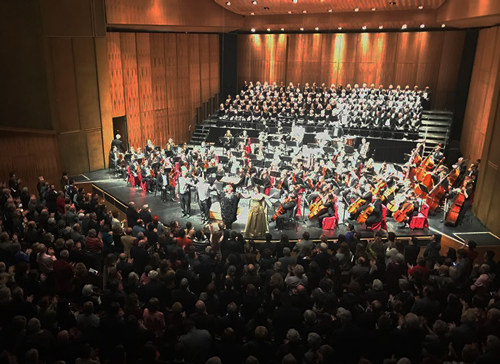 The results were certainly thrilling, but while the Akron Symphony and the combined Akron Symphony Chorus and Summit Choral Society Masterworks Chorale singers were fully committed to Zander’s interpretation of Beethoven’s intentions, not everything was convincing. Quick tempos enlivened the slow movement, the double bass section recitative, and other passages in the choral finale. But some sections — the trio of the Scherzo, the military march in the finale, the solo quartet in “Seiner Tochter aus Elysium” — were inhumanly fast even for the fine musicians on hand.
The choruses, prepared by Marie Bucoy-Calavan, sang handsomely even at breathless speed, and the solo quartet — Elizabeth Baldwin, soprano, Marianne Cornetti, mezzo-soprano, Alex Richardson, tenor, and Alfred Walker, bass-baritone — blended nicely when the tempo gave them ample room to vocalize. In an interesting touch, Zander began the last movement with no soloists on stage. Walker burst through the door a moment before halting the proceedings with “Friends, not these tones,” joined a bit later during the orchestral elaboration of the “An die Freude” tune by the other three soloists.
By way of contrast, the first half of the evening was devoted to a stately and unhurried reading of the Third Piano Concerto, played with flawless technique by HaeSung Paik, who visited a whole range of pianistic colors from the aggressive to the laid back and lovely. Perhaps displaying more emotion in her facial expressions and body language than in her sound, Paik mostly kept in close touch with Zander and the Orchestra, though the ensemble went awry more than once. The audience gave Paik a long, thunderous ovation.
Published on ClevelandClassical.com January 24, 2017.
Click here for a printable copy of this article
