

by Peter Feher
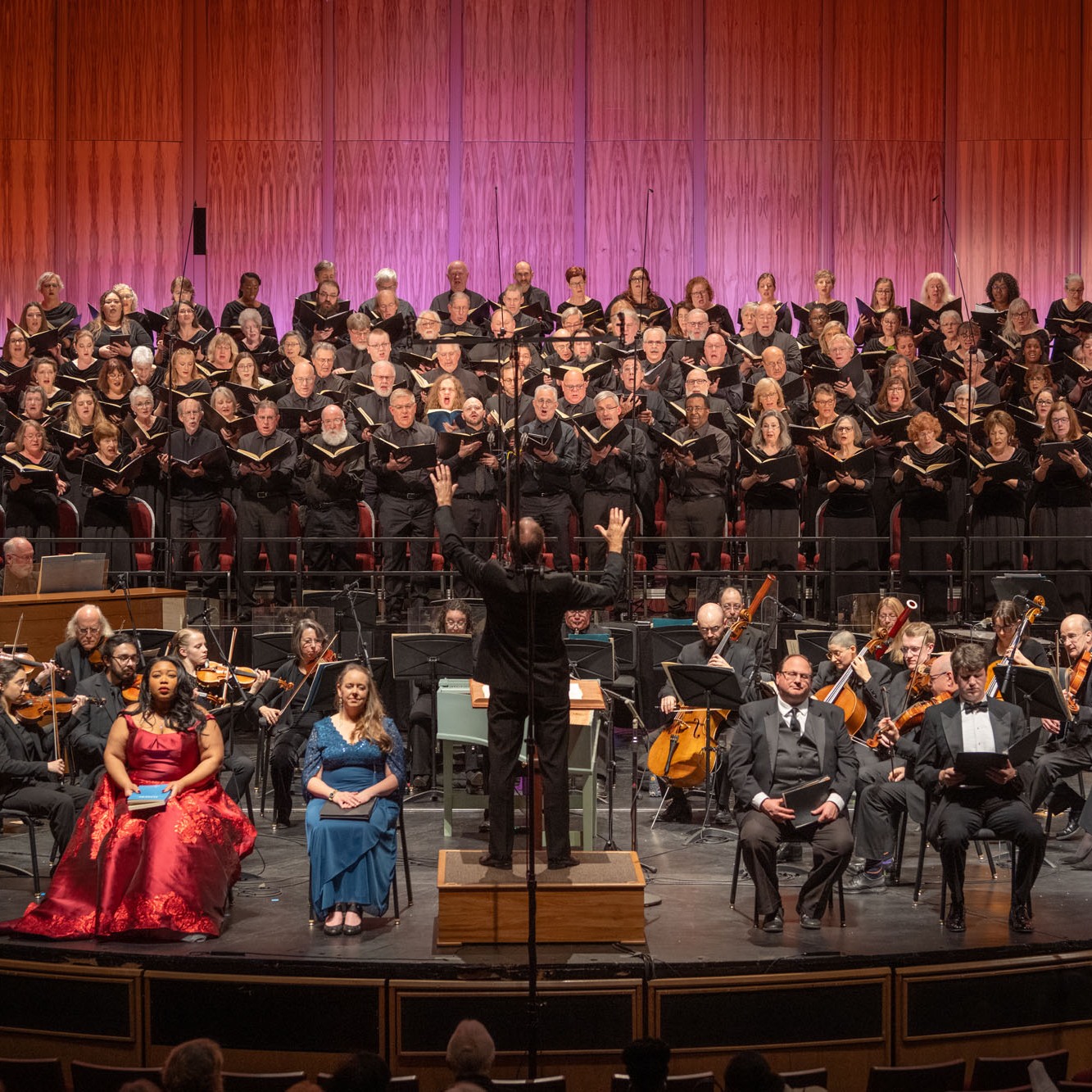 The holiday season got off to an early start at E.J. Thomas Hall over the weekend, with the Akron Symphony and Chorus reveling in a performance of Handel’s Messiah.
In truth, it’s tradition for this great oratorio — which embraces the New Testament theme of Jesus as savior — to arrive ahead of schedule. Handel intended the work to be presented each year during Lent, when theaters were otherwise closed and only entertainment of the most ennobling character was allowed. But in the centuries following its 1742 premiere, Messiah crept up the concert calendar to become a Christmas favorite.
Never mind that the famous “Hallelujah” Chorus comes from Part 2 of the oratorio, which recounts Christ’s death and resurrection. Part 1 includes the Nativity, and it was to this opening section that the Akron Symphony and music director Christopher Wilkins devoted themselves on Saturday, November 15.
Although the evening wasn’t entirely faithful to Handel — with the performers taking a few liberties and the first half of the program featuring three additional composers — the presiding spirit was of honoring the conventions of a classic.
The number of instrumentalists onstage was scaled back to just a couple dozen string and wind players, approximating the size and sound of an 18th-century orchestra. Meanwhile, the Akron Symphony Chorus, prepared by director Chris Albanese, was out in full force at more than 100 members, attesting to Messiah’s mass appeal across generations.
Happily, there weren’t many moments of mismatch. Wilkins and the orchestra easily summoned the strength to support the big, majestic choral movements such as “For unto us a Child is born” and “Glory to God in the highest.”
The vocal soloists tended toward a smaller style of delivery, drawing out the intimacy of certain scenes. The exception early on was tenor Timothy Culver, who sang his single aria, “Ev’ry valley shall be exalted,” with a rich, robust tone. Mezzo-soprano Cierra Byrd and bass-baritone Adam Cioffari dwelled with utmost delicacy on the less mirthful meditations that Handel and librettist Charles Jennens offer in the middle of Part 1. And soprano Rachel O’Connell led the subsequent rejoicing sweetly and simply.
Of course, no Messiah concert would be complete without the “Hallelujah” Chorus, which Wilkins appended for a grand finale, instructing the audience to stand in another salute to tradition.
As a prelude to Handel’s masterpiece, the Akron Symphony programmed three somewhat connected works before intermission. The evening began with the Baroque pomp of Ode to the New Year, 1758 by William Boyce. The mood then turned solemn and spiritual in Ye, Who Seek the Truth by Akron native Julia Perry, here arranged for string orchestra by Jannina Norpoth.
Hadyn’s Trumpet Concerto concluded the first half with a virtuoso flourish. Akron Symphony principal Justin Kohan starred as the soloist, taking to the role with fanfare in the introductory Allegro. He approached each movement as a great singer would, never playing with anything less than his best sound, whether in the lyricism of the Andante or the blazing passagework of the Finale. It was a performance to herald the glory promised on the second half.
Photo by Dale Dong Photography
Published on ClevelandClassical.com on November 25, 2025
Click here for a printable copy of this article