


by David Kulma
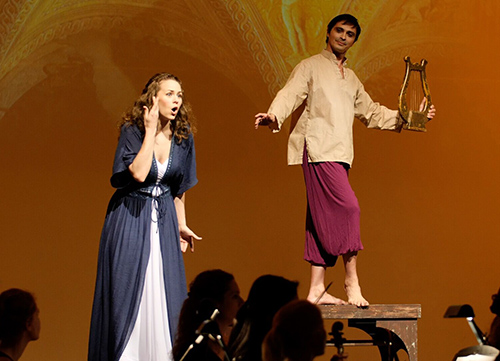 Apollo’s Fire’s L’Orfeo is, in short, spell-binding. You should drop everything and go to their final local performance in Bay Village on Wednesday, April 18. If you’re not yet convinced, please keep reading. Two things stand out about this glorious semi-staged performance of Claudio Monteverdi’s “Favola di musica” in Kulas Hall at the Cleveland Institute of Music on April 13. First is the magnificent production and performance. Second is the special music crafted by Apollo’s Fire principal cello René Schiffer to restore the original 1607 Bacchanale ending.
The libretto by Alessandro Striggio tells the familiar story of Orpheus (Orfeo) as he descends to the underworld to save his beloved Eurydice (Euridice). He ultimately fails by turning too soon to see her as they ascend.
 Monteverdi crafted his “fable in music” long before the crisp recitative and sumptuous arias that keep opera from Mozart through Puccini still breathing today. Instead, the musical possibilities at hand included text-painting madrigals, recurring dance music, and language-based monody — early recitative supported by only the continuo. Luckily, Monteverdi’s musical stew is full of drama and spectacle, and this production was clarified by supertitles in English.
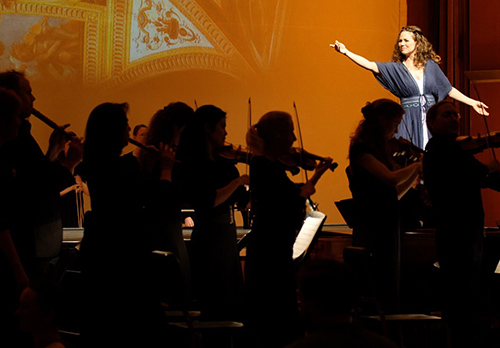 From the first moment of drums and heralding brass, Jeannette Sorrell and company brought complete conviction and humanity to these mythical characters and their tragic tale. This magic confirms Apollo’s Fire as one of the most exhilarating period-instrument bands in the country.
A central platform behind the ensemble was flanked by the excellent Apollo’s Singers — fully engaged and off-book — but the action took place throughout the hall. Behind the platform were both the sumptuous brass and a large screen with wonderful projections of period paintings, often of specific scenes from the Orpheus myth.
 The period colors of the instruments — cornetti, theorbos, Baroque harp, tiny French violins, and regale — led by Sorrell from the harpsichord were enticing throughout. Apollo’s Fire played with the utmost precision while cushioning the music with a gorgeous pillow of sound. Passagework and ornaments from the singing actors were wonderful and fulfilled the most important task of Baroque singing — making the emotions speak through the filigree.
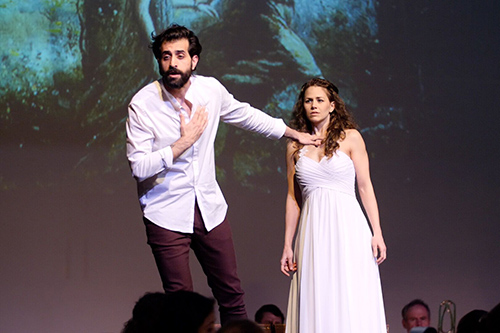
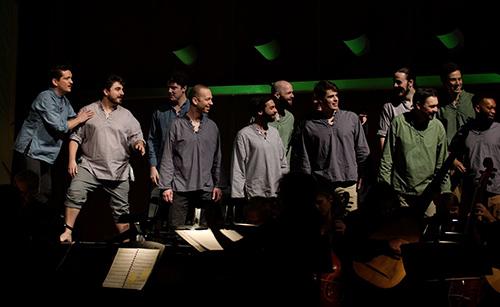 Karim Sulayman’s multifaceted Orfeo was breathtaking. His light and engaging tenor fully embodied the character as boyishly enchanted, stricken, determined to the depths of hell, and then riven with irretrievable loss — all over the course of two hours. Erica Schuller was powerful as the self-assured, clarion-toned La Musica in the prologue, while her pure, love-soaked Euridice was sweet even in her anguish.
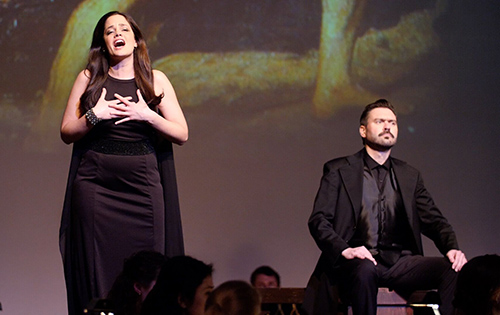
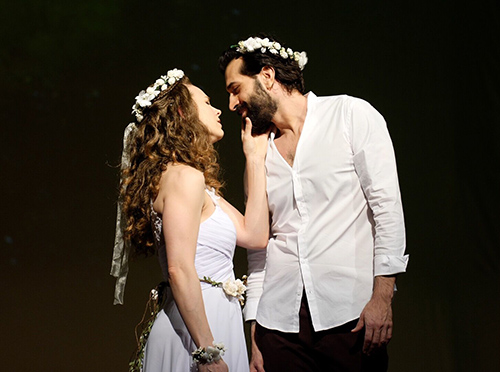 Amanda Crider’s burnished mezzo-soprano gave authority to Speranza — Orfeo’s supernatural guide. Mischa Bouvier’s stentorian, ringing baritone as Plutone and Jonathan Woody’s deeply rich bass-baritone as Caronte gave both characters complexity. Tenors Owen McIntosh and Jacob Perry and sopranos Molly Netter and Madeline Apple Healey were delightful and on point in their various smaller roles as shepherds, nymphs, and spirits.
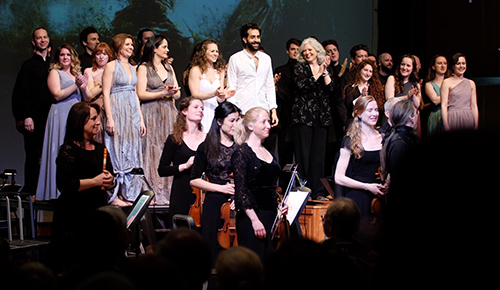 Flexible soprano Amanda Powell gave her three roles clear definition. Her Messagiera — who tells of Eurydice’s death — was pained and woeful, her Proserpina was assured and clearly in charge, and her Bacchante was delightfully crazed.
Brandishing a lyre, dancer and choreographer Carlos Fittante took part in the opening wedding celebration with regal, upright dancing. He returned as a vigorous Bacchus in the final act to goad on the murder of Orpheus.
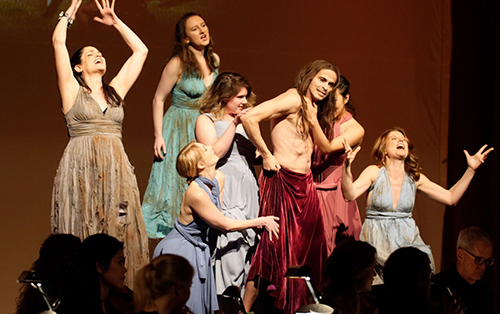 Stage director Sophie Daneman’s cohesive and detailed stage direction gave clear purpose to this opera and kept focus on the story. The effect of having Fittante help Schuller’s La Musica remove her blue cloak to show her strapless white dress at her transformation into Euridice was beautiful in its simplicity and magic. Camille Tassi’s projections and Cassie Goldbach’s lighting gave the opera extra depth, especially tiny details like the virtual smoke moving across the underworld painting.
Finally, Schiffer crafted an excellent and fitting ending for Monteverdi’s tale from Striggio’s original text from 1607. He has the style down and and even brought back an earlier ritornello to seamlessly wed this new work to Monteverdi’s. This new/old ending gives the opera balance and a logical mythological ending full of fury and sadness — even if it is less “authentic” than the ending Monteverdi wrote in 1609.
In the end, Apollo’s Fire has created a moving and musically engaging evening. If only I had Wednesday night free.
Photos: Erica Brenner Productions.
Published on ClevelandClassical.com April 16, 2018.
Click here for a printable copy of this article
