by Robert Rollin

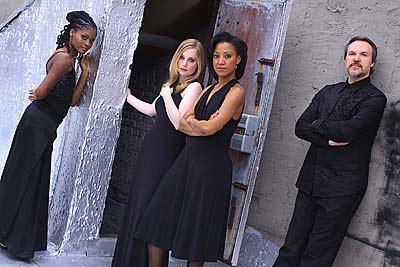
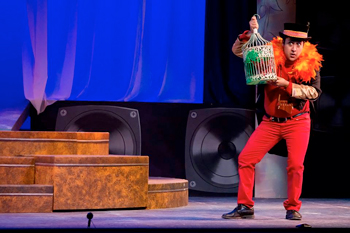
Tamino, a foreign prince tries to fight a menacing dragon, but faints after loosing all his arrows. Three ladies appear and save him by killing the dragon with their spears. [Read more…]
by Robert Rollin

Tamino, a foreign prince tries to fight a menacing dragon, but faints after loosing all his arrows. Three ladies appear and save him by killing the dragon with their spears. [Read more…]
by Daniel Hathaway

The festival culminated in a Friday evening concert by student chamber ensembles, a Saturday evening concert by the Motet Choir, Symphonic Wind Ensemble and Symphony Orchestra and a Sunday afternoon concert by faculty chamber ensembles. I “attended” the Saturday concert via BW’s new streaming service — along with fifty-some fellow viewers — and heard the Sunday performance live.
Unlike some of the thornier composers in Focus Festival history, Christopher Theofanidis makes friends quite easily through his music — a remarkable trait because there’s nothing facile or consciously ingratiating about his musical style. [Read more…]
by Daniel Hathaway

Catalonian composer Eduardo Toldrà (1895-1962) subscribed to an anti-modernist movement, “1900-ism”. Though his cheerful and tuneful 1920 quartet, Vistes al mar, based on three sea-related poems by Catalonian poet Joan Maragall, may have bucked against prevailing trends, the piece is thoroughly engaging and makes a delightful concert opener. Its lyrical lines, solid sense of form and rhythmic thrust were masterfully revealed by the players, who achieved an elegant blend and brought a catalog of nuances to their task. [Read more…]
by Robert Rollin

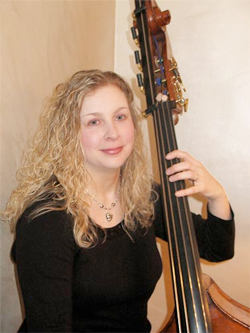
Bottesini (1821-1889) entered the Milan Conservatory at fourteen as a scholarship student, graduating four years later after winning a three hundred franc prize for his bass playing. He was soon designated “the Paganini of the bass” for his virtuosity. Bottesini had a huge following and regularly added new original showpieces to his repertoire. He became principal bass at a Venetian theater where Verdi’s opera, I due Foscari was being performed. The two composers became lifelong friends. Though highly respected as a double bassist, Bottesini also acquired a European following as an opera conductor, and composed thirteen operas. He is best known for his virtuosic and idiomatic bass writing in the concertos that continue to be played today. [Read more…]
by Guytano Parks

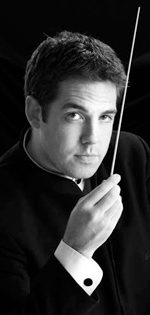
A bright and chipper Festive Overture by Shostakovich opened the concert, revealing Mitchell to be a conductor full of charismatic energy and excitement as his enthusiasm prodded the musicians to exciting heights through sharp and precise gestures. Playfully tossing melodies back and forth between sections with effective variances of tone color and character, the music joyfully galloped toward its spirited conclusion.
The winds and strings were featured in the next two works: Stravinsky’s Symphonies of Wind Instruments and Kilar’s Orawa for strings. In the cubist-like Stravinsky piece — a complex mosaic-like network whose elements combine, conflict and interlock — the players are extremely vulnerable as every detail of articulation, phrasing, dynamics and balance are exposed due to the absence of the cushioning sound of strings. [Read more…]
by Nicholas Jones

O’Connor, who performed last week with his string quartet on the Cleveland Museum of Art’s “Masters of the Violin” series, has a formidable violin technique, based on what he calls the “language” of bluegrass, with dazzling arpeggios, energetic and persistent double stops, prominent slides, percussive “bow crunches,” and—above all— rhythmic drive. O’Connor has very successfully elevated his traditional Appalachian fiddle techniques to embrace the classical concert stage. He is a prolific composer in this mode, and has created a popular series of pedagogical materials, including workshops and summer camps, to build interest in the progressive bluegrass style that has come to be known as “newgrass.”
Introduced from the stage, the program included a few shorter pieces, especially duets at the beginning with each of the members of his string quartet, as well as a dazzling solo improvisation by O’Connor himself. [Read more…]
by Nicholas Jones

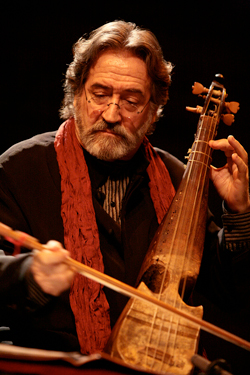
In a beautifully crafted program led by the Catalonian gambist Jordi Savall with scrupulous attention to detail as well as overall coherence and impact, this ensemble of seven instrumentalists and five singers took the audience through a moving geographical and emotional journey.
The program was the best tour one could imagine of this troubled and fascinating region. The songs moved through whole worlds of language — Serbian, Greek, Hebrew, Bulgarian, Bosnian, and more. The program’s mobility itself reflected the area’s many diasporas — of Jews, Ottomans, Roma, and Christians alike, who through the centuries have migrated through the region. The singers and instrumentalists themselves were a United Nations of the Balkan peninsula, each a master of their regional style and instrument. [Read more…]
by Daniel Hathaway

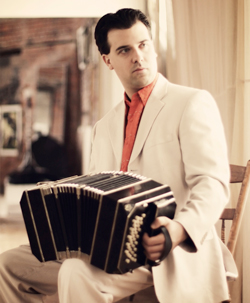
A large audience turned out to hear a varied program of music performed by Takács, violinist Michelle Abraham, cellists James Jaffee and Fedor Amosov and pianists Gregory Wang and Aleander Kostritsa, with a special appearance by Detroit accordionist and bandoneónist Julian Labro.
The concert took place in the village Council Chambers, a large octagonal room flooded with natural light and blessed with agreeable acoustics for chamber music. [Read more…]
by Guytano Parks

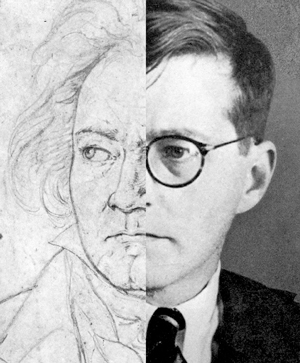
Included in the Festival were films screened at The Cleveland Institute of Art (A Clockwork Orange) and The Cleveland Museum of Art (The New Babylon, featuring Shostakovich’s first film score), in addition to pre-film and pre-concert talks and a chamber music performance by members of The Cleveland Orchestra. On Saturday afternoon as a related event, the Metropolitan Opera’s production of The Nose by Shostakovich was shown LIVE in HD in select Northeast Ohio movie theaters.
Described by Robert Schumann as a “slender Greek maiden” compared to the Third and Fifth symphonies, Beethoven’s Fourth Symphony in B-flat is considerably less forceful and dramatic. [Read more…]
by Larry and Arlene Dunn

The 34th annual Bowling Green New Music Festival, October 16-19, 2013, showcased the school as an international powerhouse in the field of contemporary music. Prior festivals have presented a hall-of-fame of new music artists, including composers John Cage, Philip Glass, Pauline Oliveros, and George Crumb and ensembles such as the Jack Quartet, Philip Glass Ensemble, and International Contemporary Ensemble (ICE).
George E. Lewis, Edwin H. Case Professor of American Music at Columbia University, (pictured above) was this year’s featured guest composer and Chicago-based Ensemble Dal Niente served as featured performers. German was the dominant international flavor, thanks to partial support of Dal Niente’s participation by the Goethe-Institute Chicago. [Read more…]