

by Daniel Hathaway
 If their recent three-week Asian tour left The Cleveland Orchestra with any residual fatigue or jet lag, the musicians ignored all that in last weekend’s concerts with French guest conductor Stéphane Denève. Building on the theme of ecstasy, he set a demanding program of works by Jennifer Higdon, James MacMillan, Debussy, and Scriabin in front of the players, and they rose to the occasion brilliantly.
World premieres are common, second performances less so. Higdon’s blue cathedral (2000) and MacMillan’s Piano Concerto No. 3, subtitled “The Mysteries of Light,” have set records in that regard. Higdon’s piece has received some 600 performances to date, and MacMillan’s nearly 40 since its debut with Jean-Yves Thibaudet and the Minnesota Orchestra in 2011. Each work was being performed for the first time at these concerts.
On Saturday, April 27, it was revealing to hear Higdon’s piece, written in honor of her late brother Andrew Blue, played by The Cleveland Orchestra, who brought a special vibrancy and transparency to the work.
Jennifer Higdon represents her brother in blue cathedral with solo clarinet, herself with solo flute. Those instruments hold intimate conversations over eventful music from the orchestra — including in quiet moments the tinkling of bells and the sound of crystal glasses — until the clarinet is left alone to head skyward.
In her notes, Higdon’s words that cathedrals are “…a place of thought, growth, spiritual expression…serving as a symbolic doorway into and out of this world” resonated with responses to the recent fire at Notre-Dame de Paris. Her vision of a glass cathedral with “an immense ceiling, which would open to the sky” seemed uncannily topical.
Would MacMillan’s Third Piano Concerto ever have been a possibility without the model of Messiaen’s Turangalîla-Symphonie? The music of both composers is steeped in Catholic mysticism, drunk on orchestral color, and admits a wide range of extraneous elements into its special sound world.
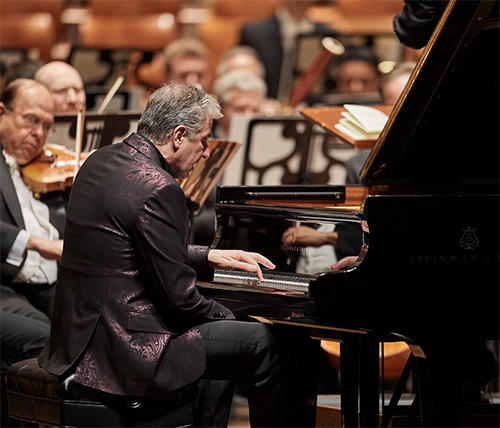
Introducing the piece in a brief, charming talk with musical illustrations by Thibaudet (and joining the pianist in a four-hand excerpt), Denève told the audience that they needn’t embrace any of the religious themes of the work (which is based on new meditations on the Rosary introduced by Pope John Paul II in 2002). They could simply meet it on whatever terms they chose.
The searching, restless, transcendent, triumphant character of the work — distinctly episodic yet strangely connected — came alive in an intensely committed reading by Denève, Thibaudet, and the Orchestra. New textures and musical ideas appeared at every turn in the five-movement, continuous narrative, glued together with plainchant motives, virtuosic contributions from Thibaudet, and sheer religious ecstasy.
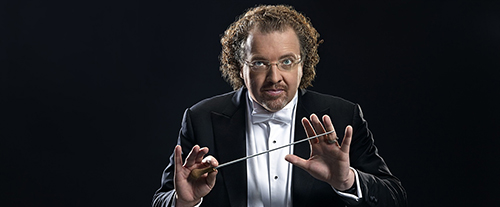 The intensity of the evening’s fare was momentarily relieved by Debussy’s Prelude to the Afternoon of a Faun, set up by Joshua Smith’s luscious opening flute solo — but only after Denève had conjured up a long, meditative silence (yes, conductors can do that with their magic wands). Oboist Frank Rosenwein and clarinetist Daniel McKelway matched Smith for expressive color, and the slightly reduced orchestra bathed the winds in warm sound.
A large ensemble assembled onstage for Scriabin’s The Poem of Ecstasy, the final entry in Denève’s treatise on various types of musical euphoria. The 20-minute piece is drenched in orchestral color, surging to sublime climaxes then regrouping for more. Conductor and orchestra managed these crests of overflowing emotion in such a way that there was always something left for the next. Trumpeter Michael Sachs frequently topped off those moments, and Joela Jones crowned the final statement with a burst of energy from the floor-rumbling E.M. Skinner organ, ending a thoroughly magnificent concert.
Thibaudet photo by Roger Mastroianni from an earlier Severance Hall concert.
Published on ClevelandClassical.com May 1, 2019.
Click here for a printable copy of this article
