


by Daniel Hathaway
BUSTING OUT ALL OVER
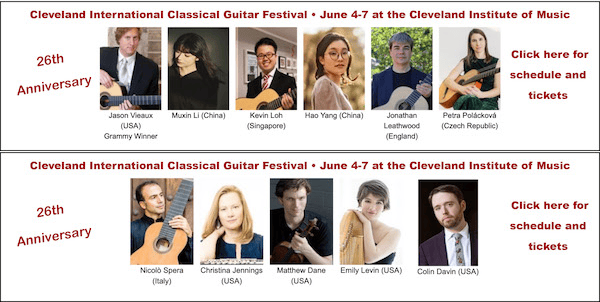
 The first month of summer promises an explosion of music in Northeast Ohio, with rollouts of numerous festivals that we’ll be previewing and reviewing in June. They include, in launch order, the Cleveland Classical Guitar Festival (artists pictured) and James Stroud Youth Competition (June 4), ENCORE Gates Mills Chamber Music & Ideas Festival (June 5), ChamberFest Cleveland (June 10), Ohio Light Opera in Wooster (June 13), and Kent Blossom Music Festival (June 24), All of those happen before The Cleveland Orchestra takes over at the beginning of July with performances both at Severance Music Center and Blossom.
Additionally, there’s a whole galaxy of individual events to attend and enjoy. Keep track of all this music making through our Concert Listings, and enjoy!
TODAY’S ALMANAC:
Two future piano makers entered the world on June 1: Ignaz Joseph Pleyel in 1757 near Vienna, and Carl F.W. Bechstein in Gotha in 1826.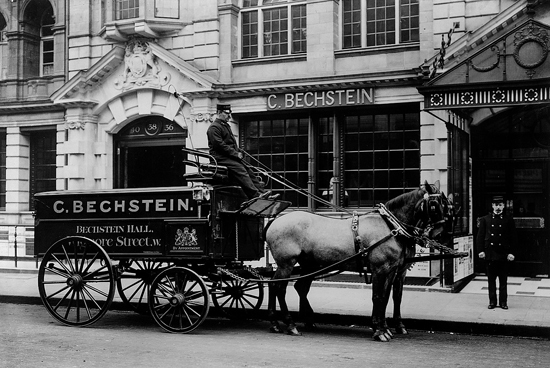
Pleyel, a student of Haydn, was active in the French cathedral town of Strasbourg until the Revolution, when he fled to London, returning to Paris after the Terror to establish Pleyel et Cie in 1807. The firm began building instruments with metal frames, and introduced the “cottage” or upright piano in 1815, and the double piano in 1890.
Pleyel also supplied missionary, organist, and medical doctor Albert Schweitzer with a “jungle” piano built with tropical wood and an added pedalboard, brought out the first chromatic harp, and contributed to the harpsichord revival with modern instruments built for Wanda Landowska. The company finally stopped producing instruments in 2013.
Bechstein established his company in Germany in 1853, building a solid reputation that got complicated during the 20th century when his son Edwin and his wife became ardent Nazi sympathizers. But before that, in 1901, Carl Bechstein opened the 600-seat Bechstein Hall in London next to his showroom, a beloved venue with superb acoustics that was renamed The Wigmore Hall after 1916, when the entire complex was sold in the wake of anti-German sentiment. The Wigmore Hall has recently been in the news for turning away from government funding in favor of private financial support,
Watch a video made by pianist Pierre-Laurent Aimard in the Wigmore Hall on March, 2017 on a recently restored 1899 Bechstein instrument. He chose to play works by composers who had direct connections to Bechstein — Liszt, Scriabin, Debussy, Julian Anderson and Nikolay Obdukhov.
On this date in 1804, Russian composer Mikhail Ivanovich Glinka was born in Novospasskoye. Credited with establishing what we now recognize as the Russian style, Glinka is best known for his two operas, A Life for the Tsar, and Ruslan and Lyudmila (the overture to the latter frequently appears on concert programs). Here’s another example of his work, the Grand Sextet in E-flat played by the State Borodin Quartet and guests in St. Petersburg in November, 2014.
Back to the keyboard: American pianist Richard Goode. who was born on June 1, 1943 in Brooklyn has performed frequently in Northeast Ohio. I had the pleasure of interviewing him before his solo recital for the Cleveland Chamber Music Society in March, 2016. Read Peter Feher’s review of his April 29 concert on the Oberlin Artist Recital Series here.
And two famous singers made different debuts on this date: American mezzo-soprano Frederica von Stade was born in 1945 in Somerville, N.J., and Italian tenor Luciano Pavarotti first appeared onstage in Covent Garden in 1966 as Tonio in Donizetti’s La Fille du régiment, an occasion that earned him the title, ‘King of the High C’s.’
Enjoy von Stade’s performance of William Bolcom’s cabaret song Amor here, and catch up on her career with two video interviews. In the first, a WFMT backstage chat at Chicago Lyric Opera, she reflects on highlights of her professional life, and in the second, she joins Dame Kiri Te Kanawa to talk about “secrets, long careers, and friendship” during the BBC Cardiff’s Singer of the World 2019 Fringe Benefit.
As for Pavarotti, enjoy his silver jubilee concert at New York’s Madison Square Garden in 1986.
