



by Peter Feher
 Life is too short to take the opening repeat in Franz Schubert’s Piano Sonata in B-flat, D. 960. The first movement — marked Molto moderato, or “very moderately” — already clocks in at around 15 minutes, even without hearing the entire exposition twice.
Of course, purists will play up those few transitional bars that Schubert crafted to lead back to the beginning, which would be cut in a straight-through performance. The composer’s overall conception is supposedly lost if the strict symmetry of sonata form isn’t upheld.
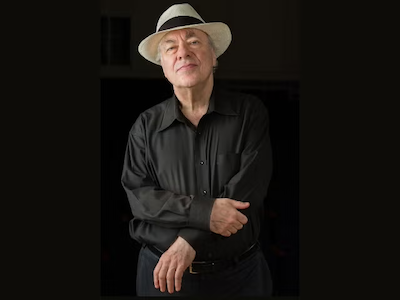
Such arguments are no match for pianist Richard Goode, who gave an authoritative account of the work — sans repeat — for the final concert of this season’s Oberlin Artist Recital Series. Goode offered an interpretation borne of age and experience, qualities that were in evidence throughout his solo program on Wednesday evening, April 29, in Finney Chapel.
Mind you, seniority isn’t necessary for making sense of Schubert’s last sonatas, which were written in the months before the composer’s premature death at 31. Goode himself may be 82, capping a venerable career devoted to the piano music of the Classical and Romantic periods, but his single studio recording of D. 960 dates from 1978, nearly five decades ago.
Time just passes differently for great musicians, and Goode took Wednesday’s performance at his own considered pace. Neither too fast nor too slow, the first movement unfolded with a sense of order and proportion, upset only on occasion (as Schubert intended) by a rumbling trill in the keyboard’s low register.
Goode saved his indulging for the second movement, Andante sostenuto, whose every subtle shift in harmony was something to savor. The subsequent Scherzo skipped by, and the Allegro finale ultimately arrived at a happy ending, with the pianist persevering through the score’s dramatic outbursts and lingering pauses to conclude the recital triumphantly.
The evening got off to a less sure start with Mozart’s Piano Sonata No. 8 in a, K. 310. Meant to parallel the substantial demands of Schubert on the second half, this rigorous Mozart work allows little interpretive leeway by comparison. Here, Goode’s unique flourish and freedom with a phrase ran counter to the music’s innate precision.
There was a feeling of throwing off formal constraints as the program segued into a series of shorter pieces before intermission. Nothing obviously connects a sacred Renaissance motet by Carlo Gesualdo with the Czech folk tunes that inspired Leoš Janáček. That is, save for their shared eccentricity, which Goode channeled in a mostly bewitching section of the concert he titled “Fancies and Goodnights” (after a favorite book of short stories by John Collier).
After Gesualdo, the pianist showed a surprising affinity for English early music, trotting out several choice dances from William Byrd’s My Ladye Nevells Booke. Two French character pieces by Jean-Philippe Rameau followed — The Assembly of the Birds and The Indiscreet One — but lacked the requisite spirit and touch.
Goode’s natural sensitivity didn’t quite suit the schlockiest selections, such as Ignacy Jan Paderewski’s Légende Op. 16, No. 1. But when a simple tune by Schubert — his Hungarian Melody, D. 817 — popped up near the end of the set, the pianist was instantly in his element.
Published on ClevelandClassical.com May 14, 2026
Click here for a printable copy of this article