


by Daniel Hathaway
HAPPENING TODAY:
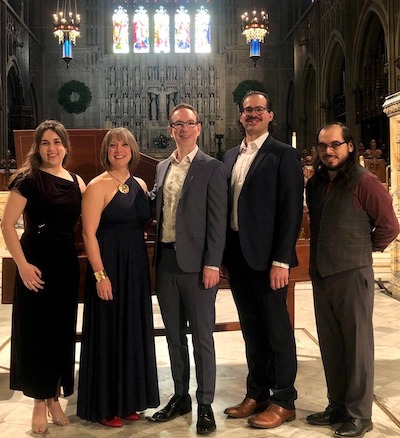 At 12 Noon, the Trinity Cathedral Brownbag Concert Series will present a quartet of Cleveland Chamber Choir singers in William Byrd’s Mass for Four Voices, English madrigals, and works by Cleveland-area composer Judith Eckelmeyer. And at 6 pm, the Cleveland Museum of Art will host Chamber Music in the Galleries featuring young artists from Case Western Reserve University’s Historical Performance Practice Program.
For details of these and other classical events, visit the ClevelandClassical.com Concert Listings.
ANNOUNCEMENTS:
CLEVELAND, April 1, 2026 – The Cleveland Institute of Music (CIM) today announced the appointment of acclaimed actor and tastemaker Timothée Chalamet as its new Director of Opera and Vocal Ensembles, marking a bold and imaginative new chapter for the conservatory’s storied vocal and operatic programs.
Chalamet, whose recent public remarks have ignited a renewed interest in the expressive power of opera and ballet, will begin his tenure in the 2026–27 academic year. He will make his home on the West side of the East side. His inaugural season will open with a reimagined production of The Magic Flute by Wolfgang Amadeus Mozart, featuring entrepreneur and cultural icon Kylie Jenner in the role of the Queen of the Night(life).
“Timothée represents a genuinely consequential shift in how we understand opera in the 21st century,” said Paùl W. Hôgle, CIM President and CEO. “He brings intuition, artistic sensibility, and an approach to the art form that is notably unencumbered by intellectual framing or curiosity. That absence of thought is precisely what makes his perspective so uniquely obtuse.”
INTERESTING READ:
Elena Manferdini, founder of the California-based architecture studio Atelier Manferdini, was initially surprised when she was invited to collaborate with the Rome Opera House. A design critic in architecture at the GSD, Manferdini had little background in the art form. Yet, she was contacted by Paolo Cairoli, director of Calibano, the magazine of the Teatro dell’Opera di Roma, who had seen Manferdini’s 2024 exhibition of models, sculptures, and AI illustrations, Flora, at the Italian Cultural Institute in Los Angeles. This encounter eventually led to Atelier Manferdini creating promotional materials for twelve operas and five ballets in the Rome Opera House’s 2025–2026 season. Read the story from the Harvard Graduate School for Design here.
TODAY’S ALMANAC:
Today we honor two composer/pianists who came into the world on April Fools Day: Ferruccio Busoni in 1866 and Sergei Vasilyevich Rachmaninoff in 1873.
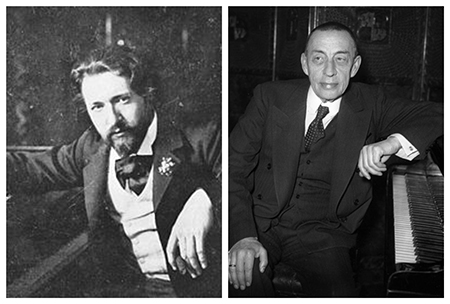 Born in Empoli, Italy, Busoni (left) revealed himself to be a pianist and composer of note at an early age. After holding several teaching positions he dedicated himself to writing music and touring. Also a musicologist, Busoni’s visits to the United States sparked his interest in the music of North American Indigenous people. In addition to the Piano Concerto, his transcriptions of works by J.S. Bach are legendary.
Prior to his 2019 performances of the monumental Piano Concerto with The Cleveland Orchestra, Garrick Ohlsson — who won the Busoni Competition in 1966 — told Clevelandclassical.com that during his lifetime, Busoni was a leading teacher, composer, and theorist as well as a great pianist. “People were drawn to him. He was in the middle of musical and artistic society. He taught in all sorts of places including the United States, Finland, and Russia — he was a true internationalist. But one of the problems with Busoni as a composer is that he’s very eclectic in his choice of language. If you see his name on the program, you don’t know if you’re going to have a tonal neoclassical, a completely atonal piece, or an overripe Romantic one like this.” Click here to read the preview.
Olhsson recorded Busoni’s five-movement concerto with The Cleveland Orchestra and Men’s Chorus under the direction of Christoph von Dohnányi in 1989. Click here for part one and here for part two.
Born in Semyonovo, near Novgorod, in northwestern Russia, Rachmaninoff’s life and celebrated career are well-documented. What people may not know is that he had a long relationship with The Cleveland Orchestra. Rachmaninoff first came to Cleveland in 1923 to perform his second piano concerto at the Masonic Auditorium on March 29 and 31, an event that coincided with the 25th anniversary of Adella Prentiss Hughes’ reign as Cleveland’s musical impresario.
He returned in 1932 just after the Orchestra moved to Severance Hall, and four more personal appearances followed: November, 1937 (the Rhapsody on a Theme of Paganini), October, 1939 (Piano Concerto No. 1), March, 1941 (Beethoven Concerto No. 1 & the Paganini Rhapsody) and January, 1942 (Piano Concerto No. 2). The 1923 and 1932 engagements were led by Nikolai Sokoloff, the rest by Artur Rodzinski.
The January, 1942 Severance Hall concert also included his symphonic poem The Isle of the Dead (1907), and the recently composed Symphonic Dances, Op. 45. (1940). His return was highly anticipated. The Cleveland Plain Dealer, Cleveland Press, Cleveland News and Akron Beacon Journal, as well as local foreign language publications, all ran previews announcing the concerts.
How was the almost 69-year-old pianist’s performance of his concerto received by the local critics?
Plain Dealer critic Herbert Elwell wrote, “There was even more enthusiasm when Rachmaninoff appeared in the concerto. As usual he gave to his own music luster and animation that only his brilliant pianism can give it. And it was with evident pleasure that listeners heard from his own hands the drooping wistful melodies that have now reached the domain of popular music.”
However, Cleveland Press critic Arthur Loesser was unfavorably impressed by the tempos. “It must be said that much of Mr. Rachmaninoff’s performance was on the streamlined side, some of it even seemed to be functioning with a tailwind. Those of us who know this concerto pretty thoroughly had trouble recognizing our friendly note-figures in the rush.”
Loesser went on to say, “Great praise must be bestowed upon Dr. Rodzinski…for the highly skilled accommodation of his beat to Mr. Rachmaninoff’s frequent willfulnesses as well as for his success in keeping the occasionally heavy scoring in good balance.” Click here to read our “From the Archives” preview and here for our “What would Rachmaninoff post on Facebook” feature.
