


by Daniel Hathaway
ANNOUNCEMENT:
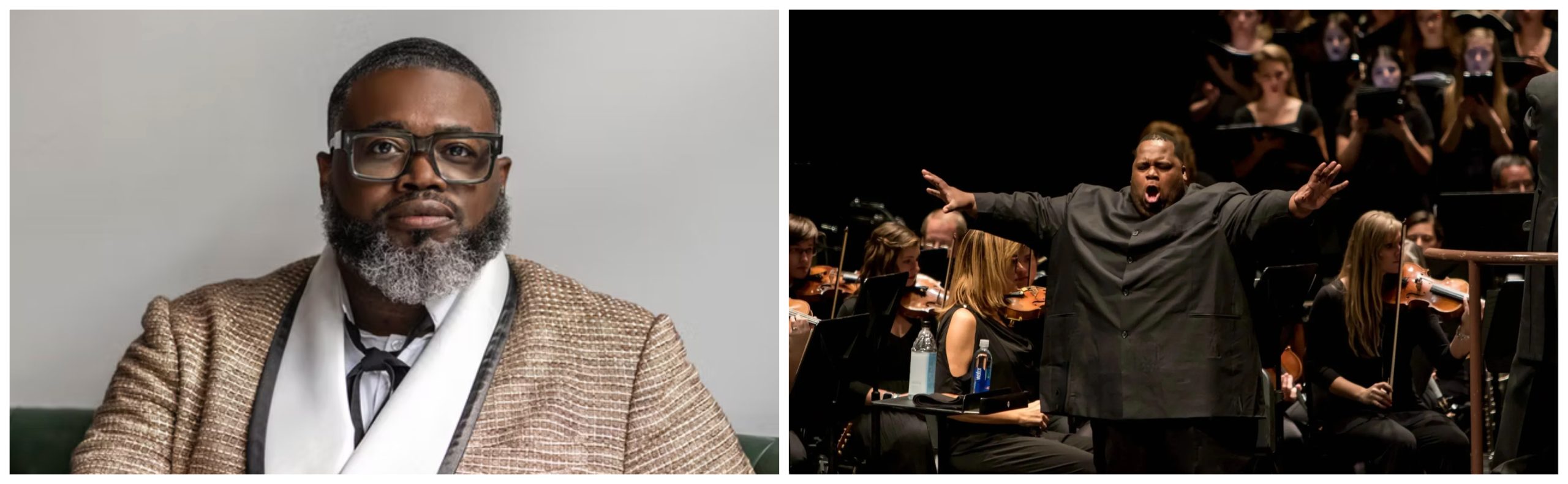 The Cleveland Orchestra has announced a guest artist update to its America at 250 concert at Blossom Music Center on Friday, July 3. “Tenor Russell Thomas (left) has graciously agreed to join the program, singing a selection of traditional spirituals and narrating Copland’s gripping Lincoln Portrait, in his Cleveland Orchestra debut.”
Thomas replaces the late Limmie Pulliam (right), “an artist with extraordinary vocal power and sincerity” who made his Cleveland Orchestra debut in 2022, stepping into the title role in Verdi’s Otello. “He deepened his connection with our musicians and audiences through Puccini’s The Girl of the Golden West and, most recently, Mahler’s Das Lied von der Erde.
“Thomas wishes to dedicate his performance to the memory of his friend Limmie Pulliam.”
HAPPENING TODAY:
Tonight at 7:30 in CIM’s Kulas Hall, ChamberFest Cleveland launches its 2026 season, “Global Fanfare.” Eleven of the festival artists will present works by Weedie Braimah, Steve Reich, Yang Baozhi, Miguel del Águila, Matthew Hindson, and Johannes Brahms. Executive director Jessica Peek Sherwood presents the pre-concert festival welcome at 6:30 pm
TODAY’S ALMANAC:
English composer Frederick Delius died on this date in 1934 in Grez-sur-Loing, near Paris, blind and paralyzed by syphilis.
 His music, a London Times critic wrote, “belongs to no school, follows no tradition and is like no other composer in the form, content or style of his music,” although other commentators have noted the influence of Debussy, Wagner and African American music — which Delius heard in England by the touring Fisk Jubilee Singers and on Florida plantations where he was sent by his father to manage a citrus grove.
Cleveland hasn’t heard much of Delius’ music live, though British conductors like Bramwell Tovey and Andrew Davis have brought his music along to their Cleveland Orchestra appearances, and a smattering of his smaller pieces have been played by university and avocational orchestras. Here’s a tiny piece, the “Serenade” from Delius’ incidental music to the play Hassan with violinist Rafel Druian and the Cleveland Sinfonietta, led by Louis Lane. And here’s a seasonally appropriate work, Song for Summer, performed by the London Symphony under Sir John Barbirolli (you can follow along with the score).
And on June 10, 1911, harpsichordist Ralph Kirkpatrick was born in Leominster, Massachusetts. One of the early champions of the instrument, he gave his first recital while studying art history at Harvard in 1930, and went on to work with Nadia Boulanger and Wanda Landowska in Paris. While serving as a professor at Yale from 1940-1976, he wrote a biography of Domenico Scarlatti and devised a chronology of his harpsichord works, which are identified by their “K” numbers.
Since Kirkpatrick was active during the early period of the harpsichord revival, he favored the instruments built by Neupert in Bamberg, only later turning to copies of historical instruments by Hubbard and Dowd for his Bach recordings.
For a taste of Kirkpatrick’s style during the revival period, here’s a recording of 60 late Scarlatti sonatas he played on a John Challis instrument from Detroit (view the album booklet here, and heed Columbia Records’ warning to frequently change your phonograph needles: “‘Permanent needles’ may cause permanent damage”).
