

by Daniel Hathaway
 IN THIS EDITION:
. Something for everyone to enjoy in this weekend’s concert listings
. The guest list for this weekend’s birthday anniversaries could spin off some fascinating conversations (about that missing opera, Herr Schütz…)
WEEKEND EVENTS:
On Friday, October 7, three intriguing concerts all begin at 7:30 pm.
An Evening of Czech Vocal Music features students preparing to compete at the 10th annual American International Czech and Slovak Voice Competition in Wisconsin. Guzzetta Recital Hall at the University of Akron. Free.
Conductor Thierry Fischer leads The Cleveland Orchestra in Boulez’s Notations, Stravinsky’s Violin Concerto with Leila Josefowicz, violin (replacing Vilde Frang, who will not appear due to travel complications), and Saint-Saëns Symphony No. 3 (“Organ”) with Todd Wilson at Severance Music Center. The program is repeated on Saturday at 8:00 pm. Tickets available online.
The third is a guest recital by The Unheard of Ensemble, Ford Fourqurean, clarinet, Matheus Souza & Erica Dicker, violins, Iva Casian-Lakoš, cello & Daniel Anastasio, piano, who plan an adventurous, free program of music using technology and interactive multimedia at Oberlin’s Birenbaum Innovation and Performance Space.
Saturday, October 8 offers an eclectic mix of offerings.
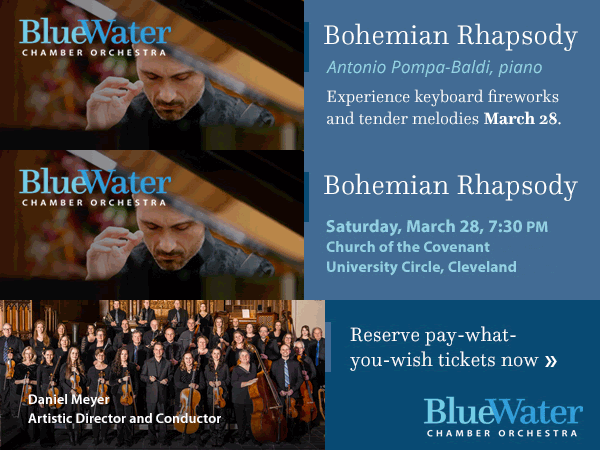
On Saturday at 7:30 pm, BlueWater Chamber Orchestra and the Cleveland Chamber Choir will present “Heaven and Earth,” featuring Beethoven’s Mass in C and Gwyneth Walker’s The Golden Harp at the Church of the Covenant. A pre-concert talk by Oberlin musicologist Charles Edward McGuire begins at 7. Click here to read an interview with conductors Daniel Meyer & Gregory Ristow, then pay what you like for tickets here.
Also at 7:30 pm, the Cleveland Classical Guitar Society International Series will present Bokyung Byun, (South Korea) at Plymouth Church. Click here for a detailed program. Tickets available online.
And at 8:00 pm, Jeannette Sorrell and Apollo’s Fire will kick off their season at First Baptist Church in Shaker Heights with one of their reliable hits: Monteverdi’s Vespers of 1610. Soloists include Erica Schuller, Molly Netter, Rebecca Myers, sopranos, Kristen Dubenion-Smith, mezzo-soprano, Jacob Perry & Steven Caldicott Wilson, tenors, and Edward Vogel & Andrew Padgett, baritones.
The program will be repeated on Sunday, October 9 at St. Raphael Catholic Church in Bay Village. Visiting Scholar Marica Tacconi of Penn State University, will talk about the Vespers one hour before each performance. Tickets available online.
On Sunday at 2:00 pm, Tri-C Classical Piano Series presents Alexandre Dossin in Gartner Auditorium at the Cleveland Museum of Art. His program features Six decades of music by George Walker. The event is Free.
A half-hour later at 2:30 pm, Ben Johns will lead the Oberlin Chamber Singers in music of Claudio Monteverdi, Juan Gutiérrez, Heinrich Schütz, Thomas Tallis, and Benjamin Britten in Fairchild Chapel (Bosworth Hall). The performance is free. Click here for the live stream.
And at 3:30 pm at St. Paul’s Episcopal Church, the Heights Chamber Orchestra launches their 40th anniversary season. Guest conductor Carl Topilow leads Mendelssohn’s Six Children’s Pieces in his own orchestrations, Rossini’s “Three Movements” from La Boutique Fantasque, and Tchaikovsky’s “Finale” from Symphony No. 2.
WEEKEND ALMANAC:
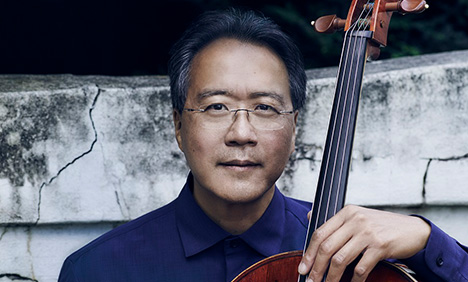
Today, October 7, we celebrate cellist, cultural ambassador, and humanitarian Yo-Yo Ma (pictured above), born on this date in 1955 in Paris. Since his days as a child prodigy, Ma has carved out a remarkably diverse career — one need to look no further than his expansive discography to understand why his is a household name around the world.
Ma enjoys building relationships and finding common ground with everyone he meets. Perhaps his best-known example of using music to find that common ground is The Silk Road Project, a collaborative enterprise that promotes artistic exchanges between cultures. It’s named after the 4,000-some miles of ancient trade routes that for two millennia linked parts of Asia with Europe and encouraged the trading of art, knowledge, philosophy and religion — as well as silk and other commercial goods.
Without a doubt, Ma is committed to bringing people together through music. In a 2013 interview with this publication, Ma said, “I do believe totally in what I’m trying to do, and I feel incredibly grateful — especially during these hard economic times. The world is changing so quickly and there are people left out. But we want to make sure that while things are changing, we have a sense of where we are going that we can all mutually work towards.”
He went on to say that culture and the arts are effective because as artists you are always working toward something bigger than yourself. “It’s not just about interest groups but rather that we have common interests. And sometimes the common interests get lost when we’re only saying ‘wait, you’ve got to look at me.’”
The cellist is also a firm believer in the power of education. In a 2013 interview prior to Silk Road’s appearance in Akron, Galician bagpipes player Christina Pato pointed out that the importance of education is very strong and the ensemble is constantly scheduling educational activities. “Watching Yo-Yo work has been an inspiration to all of us. He is constantly there worrying about everything,” Pato says. “Even in the middle of a long tour, he arrives at schools at 9 am to make things happen. He works with all the children and brings joy and happiness. It’s great to have a mentor like him.”
By his own admission, Yo-Yo Ma is a person who enjoys being busy. “I can’t say that I don’t lead an interesting life,” he told ClevelandClassical.com in 2013. “It’s sometimes a little crazy and when that happens I just need to look at myself and say, I am the one responsible for it and I can’t blame anybody but myself.”
In 2020 Ma, along with Stuart Duncan, Edgar Meyer, and Chris Thile released their collaborative album, Not Our First Goat Rodeo. The group also made a fun video for NPR’s Tiny Desk (Home) Concerts. His latest album, Notes for the Future, was released on September 10, 2021 on Sony Classical. And this past Tuesday, Ma, along with storyteller, narrator, and librettist Charlotte Blake Alston, performed at the season opening concert of the Philadelphia Orchestra. Read Peter Dobrin’s review here.
On October 8, 1585, German composer Heinrich Schütz was born in Kostritz. Renowned for his evocative settings of texts, Schütz’s vocal music comes in all shapes and sizes, from two-part motets that reflected the decimation of choirs during the Thirty Years War, to splendid polychoral works he wrote after study trips to Venice. It’s a pity that his only opera, Daphne, has been lost.
Listen here to Concerto Palatino perform his astonishingly expressive motet Anime mea liquefacta est from the Symphoniae Sacrae, and here to his funeral cantata, Ein Musikalische Exequien, a Protestant requiem commissioned long before it was needed by a patron who wanted to enjoy it while he was still alive. Lionel Bringuier leads the Belgian choir Vox Luminis, who sang most recently in Cleveland at St. John’s Cathedral in October, 2018 (they’ll be on tour this fall in the US, but unfortunately not in our neighborhood).
Meet, if you haven’t already, two composers with Cleveland connections who were born on October 9 in 1869 and 1922 respectively.
Hearing a performance of Tannhäuser at the age of 18 inspired Cleveland-born Henry Lawrence Freeman to compose opera, and by his death in 1954, he had written scores for at least 23 titles, 21 of which are preserved in manuscript at Columbia University. He also founded two opera companies — one at the age of 22 in Denver that bore his name, and the Negro Grand Opera in 1920 in New York. The Martyr — the first opera to be produced by an all-Black company, was staged in Chicago in 1893 and in Cleveland in 1894.
In June, 2015, Morningside Opera, Harlem Opera Theater and the Harlem Chamber Players gave two performances of Freeman’s VOODOO, a Harlem Renaissance Opera at Columbia’s Miller Theater. Watch a trailer here.
Raymond Wilding-White, born in Surrey in England, followed a circuitous career path that took him to France, Argentina, the Juilliard School, the New England Conservatory, then to Cleveland in 1962 to occupy the Kulas Chair at CWRU and to become one of the city’s foremost exponents of avant-garde music. He won the Cleveland Arts Prize for Music in 1967, when Dennis Dooley wrote:
He stunned and stretched local ears (and minds) with adventurous compositions of his own such as Paraphernalia—a Regalia of Madrigalia from Ezra Pound (recorded by CRI in the fall of 1963 with a chorus drawn mostly from the choir of the First United Church of Shaker Heights, directed by Robert Shaw) and the 13-movement Monte Carlo Suite No. 1 for String Quartet (premiered the same year by the Koch Quartet). Among other avant-garde works composed by Wilding-White that were performed and recorded during those years: settings of four songs by William Blake and three poems by A. E. Housman as well as playful piano pieces for young players intriguingly titled Cartoon and Character Sketches.
By the time of his death in 2001 at the age of 78, Wilding-White’s catalogue of more than 200 compositions comprised chamber music (including seven string quartets), dozens of songs and choral works, concertos, three symphonies (and another for swing band), an opera for television (The Selfish Giant), stage works, arrangements for jazz vocal groups, and oratorios—all of them full of a sense of exploration. One of the most ambitious is De Profundis, a meditation for orchestra and multiple vocal groups on “the Eight Virtues and Seven Vices as Seen by Peter Breughel.” Taking its title from the ancient Latin hymn sung at funerals that begins, “Out of the depths, I cry to thee, O Lord,” it juxtaposes texts from such disparate sources as the medieval play Everyman and a 1960 book written for the Rand Corporation by military strategist Herman Kahn with the chilling title (especially in the Putin Era), On Thermonuclear War.
Alas, the only recordings readily available seem to be his choral arrangements of Aaron Copland’s Old American Songs. Wouldn’t it be interesting to hear a performance of De Profundis?
