

by Daniel Hathaway
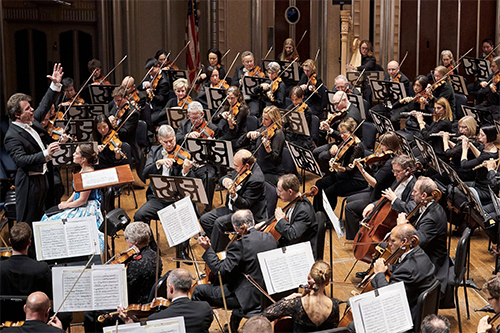 You can usually count on Jakub Hrůša to offer up some Czech music during his guest conducting appearances at Severance Hall. Not this time, but in his recent two weekends of concerts, works by Russian, American, and Austrian composers revealed the conductor’s ability to communicate in multiple musical languages. His readings of Shostakovich and John Adams were as probing and masterful as his takes on Beethoven and Mahler were fresh and surprising, and he brought his colleagues along with him all the way.
Each evening began with a dark-hued work inspired by contemporaneous events, and each was balanced by a joyful, cathartic work in the second half. On Saturday, November 9, Sergey Khachatryan opened the proceedings with an emotionally wrenching account of Shostakovich’s First Violin Concerto whose scenario was dictated by the ravages of World War II and the atrocities of Stalin.
Playing a 1740 Guarneri instrument once owned by Eugène Ysaÿe, the Armenian violinist and the Cleveland Orchestra musicians joined in a sinister nocturne, a crazed scherzo, and a portentous passacaglia introduced by horn and timpani fanfares that thinned out into an expressive cadenza. Forming a bridge to the final movement, the cadenza began ruminatively, gradually intensifying and becoming increasingly crazy. The Burlesque began in a riot of mallets and woozy horns and winds, ready to spin off at any moment into a barely concealed Klezmer Fest.
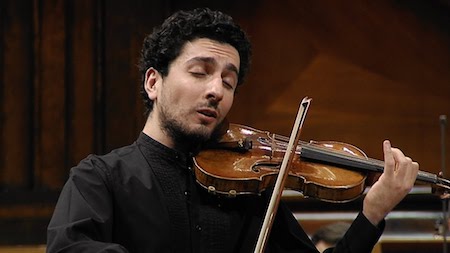 Khachatryan threw himself headlong into his solo role, looking completely spent at the end of the 35-minute work. After a thunderous ovation and several callbacks, he seemed almost reluctant to offer an encore, but his performance of a Bach slow movement was serene and understated.
Beethoven’s Third Symphony restored equilibrium, and in Hrůša’s interpretation wore its “Heroic” badge lightly — the opening was lithe and spacious. One of the surprising elements in the first movement is the introduction of a new theme where it shouldn’t happen, and in the very distant key of e minor. Hrůša made a big moment out of that, but downplayed Beethoven’s little joke of bringing the horns in two bars too early for the recapitulation.
The funeral march moved gently forward even as Hrůša called out its internal details. He set up the ending with a sotto voce passage just before bringing it to a dramatic conclusion.
Every dynamic level from softest to loudest was called into play during the Scherzo, where the horns covered themselves in glory. Hrůša brought out Beethoven’s playfulness in the finale, keeping textures light. Joshua Smith’s virtuosic flute licks and a sonorous wind chorale set up the festive, final tutti.
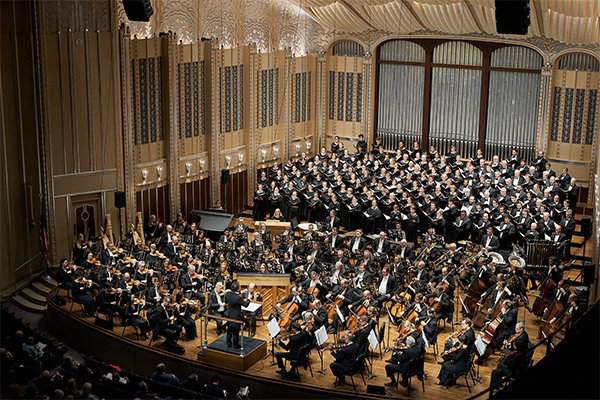 On November 14, John Adams’ On the Transmigration of Souls provided the somber half of the concert. Commissioned by the New York Philharmonic for the first anniversary of 9/11 and begun only three months before its debut, the piece summons up a strong emotional reaction, but seems more frozen in a moment than universal.
Recordings of street sounds and sirens, murmuring of names and phrases about the deceased (“She had a voice like an angel” and “I loved him from the start”), and solo trumpet calls from the balcony by Michael Sachs combined with wordless choral lines from the Cleveland Orchestra Chorus and a special youth chorus to create a montage both vague and pointed. Sonic cataclysms topped by clanging percussion alternated with atmospheric moments graced by celesta. There was a quarter-tone-tuned piano involved as well, but its meaning was unclear and its sounds inaudible.
Adams wrote that he set out to create a “memory space” where the audience could be alone with their thoughts, and shied away from calling his work an actual composition. The performance, sensitively shaped by Jakub Hrůša and sung with commitment by the Severance Hall choral forces, inspired a warm ovation.
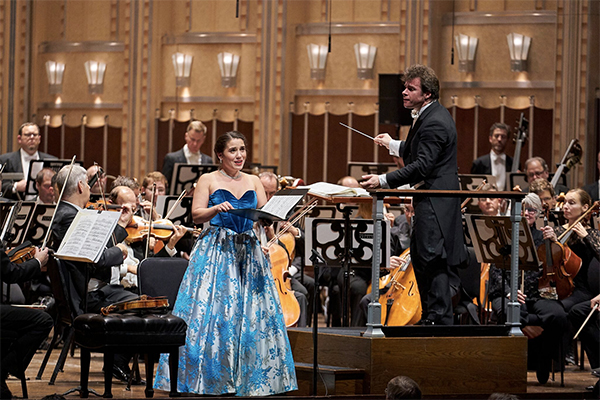 Mahler provided an antidote to the bleakness of the Adams. His Fourth Symphony operates on a general plane of cheerfulness, though like most of the composer’s works, it can turn on a dime in different emotional directions. Hrůša and The Cleveland Orchestra managed these transitions superbly amid blaring horns, sassy E-flat clarinets, and the din of fortissimo chords.
Hornist Nathaniel Silberschlag, concertmaster Peter Otto, and clarinetist Daniel McKelway introduced the pompous second movement with arresting solos (Otto playing a small violin), and assistant concertmaster Amy Lee and principal oboe Frank Rosenwein contributed a lovely duet.
The third movement was tender and timeless at the beginning, but surged to an organ-like climax before subsiding into gentle traveling music and ending in an enormous, glistering tutti.
Soprano Joelle Harvey headlined the finale, a rapturous vision of heaven — at least from the point of view of carnivores. Based on a poem from Das Knaben Wunderhorn, it celebrates a celestial feast for which animals are delighted to be slaughtered (fish are eager to take their place on fasting days). Harvey’s radiant singing, Hrůša’s infallible pacing and balancing of his forces, and the responsive playing of the Orchestra brought Mahler 4 to a glowing conclusion.
Orchestra photos by Roger Mastroianni.
Published on ClevelandClassical.com November 25, 2019.
Click here for a printable copy of this article
