


by Daniel Hathaway
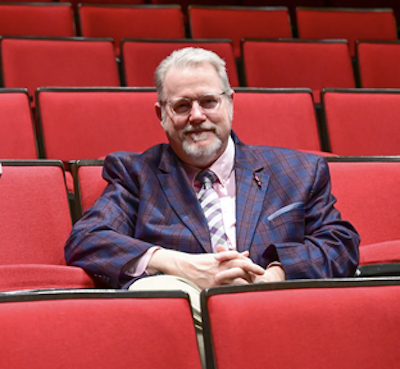 2026 will mark the end of an era for Ohio Light Opera at the College of Wooster. Artistic director Steven A. Daigle will retire at the end of this summer’s season, which makes this a good opportunity for an exit interview. What has his job entailed for the past quarter century, and how does he see OLO moving into the future?
I reached Steve by telephone on Memorial Day in a moment of calm before the cast, orchestra and crew descended upon the Wayne County campus to set things in motion for this season’s six shows. I began by asking how he and his colleagues go about choosing the titles for a season.
Steven Daigle: Well, there is a formula that we’ve been using since I’ve been artistic director. ’Doc,’ James Stewart, used one before, but since then we’ve expanded the repertory to include musical theater. With our mission now, we pick three musicals, and we try to have one of them be an early musical — this summer, it’s The Boys from Syracuse.
We try to choose stylistically different titles for the other two, and I think we’ve achieved that in My Fair Lady and Damn Yankees. They’re golden age musicals from the 1950s and 1960s, but in a way they couldn’t be more different from each other.
We always do a Gilbert & Sullivan — that’s part of the original mission of our company. Then we usually choose a Viennese operetta, and that last slot could be an American operetta, or it could be French. As you know, we did Orpheus a couple of years ago. This year it felt like the right choice to pick a work by Victor Herbert, the creator of the American operetta.
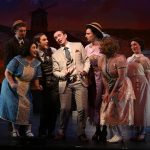
What’s interesting about Herbert’s The Red Mill is that it’s actually listed as a musical comedy, but it combines operetta elements — big singing — with vaudeville comedy. Everyone credits Jerome Kern and the Princess Theatre shows with inventing the American musical, but it isn’t that clear cut. I think that Victor Herbert was leaning very close to that style in his earlier works. I’ve always said that if I was going to write a book, I would like to write a book about that.



Daniel Hathaway: Do you have individual singer/actors in mind that influence your choice of shows?
SD: No. For the musicals, we do look for certain types that will cater to those shows more than to the operetta, and we need to have really good dancers. That has become more important over the years, and there’s a new requirement for the dancers that we added right before COVID happened. We’re looking for people with a strong dance background who can sing, and classical singers who can sing operetta who have dance ability.
Certain shows do have certain requirements where we’re looking for a certain type of personality. For example, in Damn Yankees, there’s a lot of history with Gwen Verdon singing the role of Lola, so we’re looking for that type.
DH: Are the three shows you’ve chosen to direct especially meaningful for you?
SD: Damn Yankees was the first show I was ever in over fifty years ago, outside of Baton Rouge in Louisiana. I played one of the little fan club members who sing the song “Heart.” My brother Gary was the director of the show, and it was a pretty big deal because he was still a high school student.
This is my third time directing Merry Widow, and I’ve created a new performance version that’s a combination of James Stewart’s original and some other versions. My first encounter with Viennese operetta was when he produced the show in the early ’90s, and I was stage managing it. My interest in all the Imre Kalmán works is the art form, the sentimental aspect, the pathos. I like the humor, but I also like the romance in it.
And then Yeoman was the first G&S that I took on when I became artistic director. It starred Ted Christopher, who is coming back to perform, so there’s a little bit of nostalgia with that. He was in that production in the early 2000s, and his daughter, who grew up in OLO, is in the show this summer.
I asked Charlene Gross, who’s a costume designer, if she’d be interested in designing for my last shows. She was a production manager for us for about 15 years. I think we’ve done 25 productions together.
DH: What do you try to accomplish on day one with a new show?
SD: For the first four days, we go through all the shows and coach them musically. While we’re doing that, Spencer Reese, who’s the workhorse of the company, is learning the cast and putting together some of the big choreographic numbers. The first day he has a dance call when he teaches the entire company a dance combination from one of the shows, and that helps him solidify how he might use dancers in smaller dance breaks.
On Day Two, we start to do two sing-throughs a day with all the dialogue. Our goal is to make sure everyone is assigned and everything is figured out before the first staging. There are a lot of moving pieces and bit parts. Meanwhile, the conductor is making sure we’re not cutting any of the music, and the costumers have all the cast members with small roles covered. That’s going to be important because they’re creating five or six hundred costumes over the summer.
DH: What a dizzying process.
SD: Yes it is, but what’s really great is that out of 120 cast members this year we have more than half returning. And out of 30 orchestra members who will be playing 50 or 60 performances, we only have four that are new. It says something about the company, and it does help us survive that schedule because those who are coming in new and are unsure can turn to the ones that have been here for multiple years and hear them say, “It’s okay. It looks daunting, but don’t think about four days from now. Just concentrate on what’s happening now.” So it works.
DH: Well, it’s a wonderful company and a wonderful program. Anything else you’d like to tell me about the season that particularly stands out?
SD: I would just say that this whole process of transitioning has been really great. I’m going to miss not being here every year, but I know that for me, it’s time. And what I’m so grateful for is that Jacob is the perfect person to be taking over. He’s been with the company 20 years, and he was a student of mine at one point at Eastman. But he’s developed his own career at the University of Memphis, where he’s doing a lot of amazing things in leadership positions, and he has strengths I don’t have.
I feel confident that with Jacob and Laura Neill, the executive director and company manager, the mission will continue. It’s not going to look completely different, but it’ll have their touch on it.
Published on ClevelandClassical.com June 11, 2026
Click here for a printable copy of this article
