

by Daniel Hathaway
 The Intergalactic Scheduling Office that normally takes care of bringing planets and other heavenly bodies into conjunction without causing head-on collisions has messed up big time.
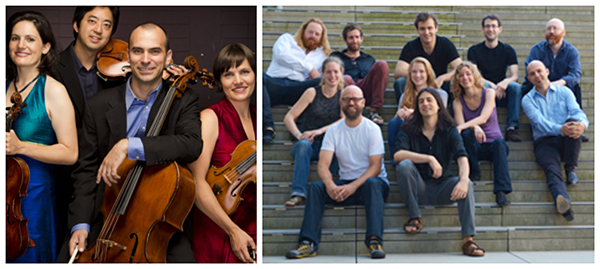
On Tuesday, November 15 at 7:30 pm, the Jupiter Quartet, formed in Northeast Ohio, will celebrate its 20th anniversary with a return to the Cleveland Chamber Music Society series at Plymouth Church where it last appeared in 2015. On the same date at the same hour, the Oberlin Artist Recital Series will bring ACRONYM, the Baroque string band formed by Oberlin Conservatory alumni, back to campus for the first time since its founding a decade ago in 2012.
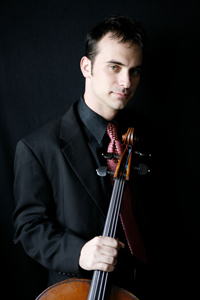
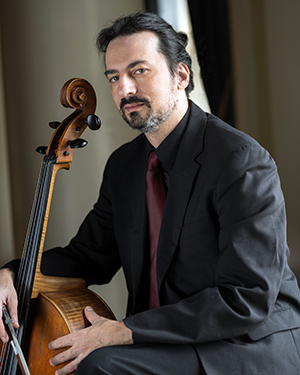
What is a conflicted audience member to do? In order to encourage a bit more scientific solution than flipping a coin, ClevelandClassical.com has spoken with Jupiter Quartet cellist Daniel McDonough and ACRONYM cellist Kivie Cahn-Lipman, both founding members of their ensembles, to find out what’s in store at Plymouth Church and Warner Concert Hall on Tuesday.
I caught up with Daniel McDonough in Champaign-Urbana, Illinois, who was walking his sons to a park where his 5-year-old would meet up with a friend and Daniel and his older son were going to kick a soccer ball around in celebration of the great fall weather.“Twenty years now. Is that how long it’s been?” McDonough mused. “I left Cleveland in 2001 and the quartet started just after that. We’ve been back a couple of times. We love to play in Cleveland. It’s one of our favorite places.” Their program this time is a bit unusual. “We’re playing a lot of pieces. The first half highlights American composers and draws connections between different voices.”
 Florence Price has been a new name for many. “We weren’t aware before recent discoveries how much she had written, although she enjoyed some renown during her lifetime as the first Black composer to be played by the Chicago Symphony,” McDonough said. A lot of her manuscripts were discovered outside of Chicago in a treasure trove in an abandoned house. Our quartet hadn’t played any of her works for strings until recently, but we’re happy to be celebrating her music.
“We’re playing the Ives as a standalone piece — it may not have been meant to be a movement in a string quartet. It’s an early student piece, full of counterpoint, chords from Bach, and congregational hymns. The Price is also a contrapuntal piece but the chorale is based on folk songs like My Darling Clementine.
“Steven Andrew Taylor’s Chaconne/Labyrinth is wonderful.” Not originally intended as a pandemic piece, it was a commission from the Arizona Friends of Chamber Music. “All of that got shot down when the coronavirus arrived and was premiered in a digital broadcast. Steven is interested in the intersection between science and music. He analyzed the proteins of the virus, which is the monster at the center of the labyrinth. The Chaconne represents the monotony of the quarantine. The piece is a palindrome in a way. Mysterious, hazy music works its way into the depths of this labyrinth, then it becomes terrifying as you meet the Coronavirus and work yourself out using Ariadne’s thread. It’s become very popular with audiences.”
McDonough said that the Quartet started playing George Walker’s Lyric for Strings during pandemic on digital streams. “It’s slightly mournful but not terribly depressing, and very beautiful in its own way. A cousin of the Barber Adagio for Strings, it also comes from a String Quartet, and like the Ives, was written at the end of his student days. It’s dedicated to his grandmother, who had recently passed away.”
Considering how close-knit the Jupiter is, the beginning of the pandemic was the first time they didn’t rehearse together regularly. “At first it was isolating with no concerts, but then we formed our own little quartet bubble — we have children all about the same age. We were fortunate to have a University position that sustained us when our friends suddenly found themselves out of work. We felt very fortunate to have each other.”
ACRONYM: “dedicated to giving modern premieres of the wild instrumental music of the seventeenth century.”
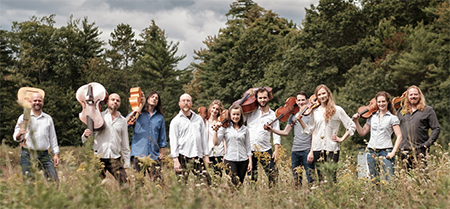 I spoke to Kivi Cahn-Lipman by telephone from Lincoln, Nebraska, where he was on tour with the ensemble. “This will be our first concert in Oberlin since the group’s very first appearance in early 2014. We had already recorded two albums before we ever played a public concert, and that Oberlin performance was a CD release party.”
Most of the group are Oberlin alumni and love returning to the area — some are now locals. “Edwin Huizinga just accepted a position teaching Baroque Violin at Oberlin, and I’m at Youngstown State University.”
Cahn-Lipman noted that their originally planned program for this tour is one that they took to the Boston Early Music Festival back in 2018. “Unfortunately one of our players is out sick,” he said. “So we’re keeping the core concept of it — a story about a wounded Musketeer — but we’re replacing some of the pieces.”
 The program, Dreams of the Wounded Musketeer, is crafted around Henrich Bieber’s Battalia, a sensational piece from the late 17th century. “It’s a programmatic battle piece in which there is a movement that’s in about six different keys all happening at once,” he said. “It’s a tavern scene with soldiers all singing at the same time. At the end is the lament of the wounded Musketeer,” the cellist said. “We took that theme a little further and added a couple of other battle pieces.”
The program, almost entirely Viennese music, will open with an anonymous piece called Sonata Ukunda. “You sort of hear the Ottoman army over a distant hill and by the end, the battle has begun. It’s full of crazy dissonances.”
Cahn-Lipman described the early Baroque period as “a clever and wacky period of time. Nothing was codified, and the rules of structure and harmony were being broken all over the place — anything was possible.”
“It’s so different from the late Baroque,” he added. “The Baroque era is wide and varied in style, and we tend to lump it all together — Handel, Vivaldi, Bach, and Telemann were all in the final 30 or 40 years of that 163 year period. But what we love is the strange music that has been overlooked. It’s wild, fun stuff that almost no one has heard in 400 years.”
As a student at Oberlin, Cahn-Lipman was strictly a modern cellist. But a turning point occurred when his friend played him a CD with a chaconne by Johann Petzel. “We were listening to it like ‘Wow, that’s so cool.’ So I started doing some research and realized that no one has heard of him. That chaconne came from a collection of 25 sonatas for small string orchestra — no one had played them, and they hadn’t been published since 1686. That became my Doctoral Thesis.”
ACRONYM formed because of that Doctoral Thesis, which needed to have a recording to go along with it. “We all had so much fun that we decided to do it again.”
Keeping true to their name, each project they record has an ACRONYM — “so we have ten of them now. The most recent was Archive Crawlers: Researchers of Niche Yellowed Manuscripts.”
Published on ClevelandClassical.com November 10, 2022
Click here for a printable copy of this article
