

by Daniel Hathaway

by Daniel Hathaway

by Daniel Hathaway

by Daniel Hathaway

by Daniel Hathaway

by Mike Telin

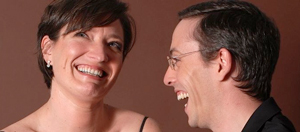
Good thing they thought better of that decision. During their two-piano concert on the Tri-C Classical Piano Series at the Cleveland Museum of Art on January 26 the South African-based duo played music by Bach, Barber and Adams like one musical mind connected to four hands.
Facing each other, the couple (who perform under the name TwoPianists) began their program with Josef Rheinberger’s two-piano version of Bach’s Goldberg Variations. The arrangement was made by the Lichtenstein composer in 1883 for “domestic music-making” and was revised a bit later by Max Reger. [Read more…]
by Daniel Hautzinger

When they first encountered each other back in 1990, they would have never predicted this future. “The first time we played together, it was a complete disaster. We vowed we would never play together again,” said Magalhães in a Skype call across an ocean and a hemisphere. “Luis had training that was opposite from mine,” Schumann said. “In the beginning, we couldn’t match at all. But through the years, my playing actually changed: I picked up some of the things that I admired in his playing, and vice versa.”
Now the duo is so attuned to each other that when, in a recent concert, “Luis deliberately played before me on the last chord, I almost fell off my chair,” Schumann said. [Read more…]
by Guytano Parks

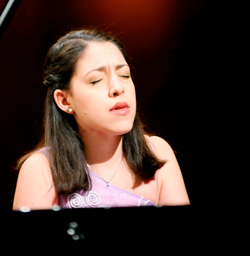
In traditional-sounding harmonic language with colorful tinges of bitonality, Lyapunov’s Transcendental Etude Op. 11, No. 12“Elegy in Memory of Franz Liszt” opened the program deliberately and dramatically, much like a Hungarian rhapsody. Continuing in true Lisztian fashion with cascades of octaves, scales and shimmering harmonic effects, Pompa-Baldi’s playing revealed a musical temperament ranging from the poetic to the virtuosic, with great intelligence and a kaleidoscopic imagination.
As the First Prize winner of the 1999 Cleveland International Piano Competition and top prize winner of several others, Pompa-Baldi’s repertoire undoubtedly includes a cache of etudes. [Read more…]
by Mike Telin

“I think it is an interesting program and one that I also recorded in a live recital in Cape Town, South Africa at the end of June for the Two Pianist label,” the pianist told us during a telephone conversation. “It’s a program dedicated to Liszt — but not entirely of his music.”
Sunday’s program opens with Sergei Lyapunov’s Transcendental Etude No. 12 (Elegy in memory of Franz Liszt). “Lyapunov composed twelve Transcendental Etudes just like Liszt, and the set is dedicated to him. I’ll complete the first half with the Twelve Etudes, op. 10, of Chopin – which as a set are also dedicated to Liszt.”
The second half of the program features Liszt’s Ballad in b minor and Sposalizio (Years of Pilgrimage, Book II). “Sposalizio was inspired by Raphael’s painting of the Marriage of the Virgin, and since this is also the Verdi year I’m also including Liszt’s Paraphrase of Verdi’s “Ernani.” [Read more…]
by Robert Rollin

His program concentrated on the genre of piano fantasy and fantasia, and featured works by Mozart and Schumann. This was a clever choice because both composers are noted for their ability to string many themes together in a manner that makes their pieces seem structured and beautifully organized.
Fantasiestücke, Op. 12, typifies Schumann’s ability to write character piece sets with extra-musical connections. The eight movements seemed more intricate and complex than most. Gortler played the relatively slow Evening, the first piece, with a gorgeous singing tone that made the oddly-grouped cross rhythms stand out. He also stressed dovetailed soprano and bass lines when appropriate, expressing the essence of Schumann’s rather limited dynamic markings. [Read more…]
by Daniel Hathaway

“Letting Schumann’s Symphonic Etudes, the Arabesque and ten of Mendelssohn’s Songs Without Words largely speak for themselves without putting his own personality in the way, Gortler nonetheless left his own stamp on these pieces by thoughtfully pointing up their many subtleties and placing every note as carefully as a curator would place valuable objects in an exhibition. The result was a memorable afternoon of piano music with no over-the-top pianism to be seen or heard.” (clevelandclassical.com review)
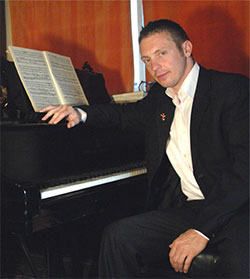
Gortler, who divides his life between New York and Israel, will be back to open this year’s Tri-C Series in Gartner Auditorium at CMA on Sunday afternoon, October 27 at 2:00 pm, with more Schumann — the Fantasiestücke, op. 12 and Fantasy, op. 17, as well as Mozart’s Fantasia in c minor. We reached the pianist by telephone in New York, where he was busy practicing Mozart for a midweek concert at Symphony Space.
Daniel Hathaway: You seem to have a special affinity for Schumann. What attracts you to his music?
Daniel Gortler: It’s not that I don’t like other composers — they’re all geniuses in a way — but with Schumann I think it’s the complexity of emotion and intellect together with structure and rhythm and feeling and passion. For me, all of this makes his music very beautiful and intense. [Read more…]