

By Kevin McLaughlin
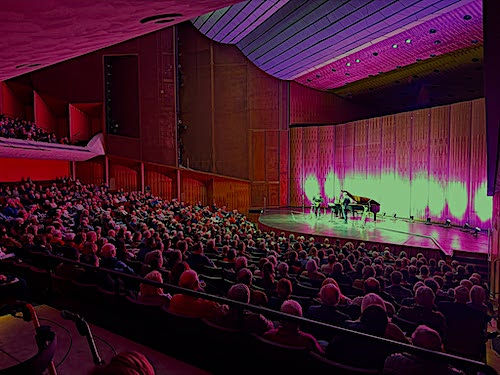 The Marsalis–McAllister–Ames Trio arrived at Akron’s E.J. Thomas Performing Arts Hall on March 3, with a program for Tuesday Musical that strolled through several musical neighborhoods — French impressionism, a touch of Scotland, American concert music, and Kansas City jazz. Branford Marsalis and Timothy McAllister handled the saxophones, Liz Ames the piano.
Between them, the saxophonists covered much of the instrument’s extended family, from baritone sax upward, switching horns as the repertoire required. For the first half, Marsalis stayed with the soprano — Coltrane’s instrument — which, in Marsalis’ hands, had a sweet, veiled quality that especially suited the program’s opening music.
Marsalis is widely known as a jazz musician, but he has long been at ease in classical repertoire as well — an aspect of his playing documented early on, as in his 1986 album Romances for Saxophone.
McAllister, currently professor of saxophone at the University of Michigan, has commissioned works, traveled and recorded widely, often with Ames, and generally advanced the saxophone’s reputation in the classical world.
Marsalis and Ames opened the program with Samuel Barber’s Nuvoletta. Originally a vocal setting of a fragment from James Joyce’s Finnegans Wake, the music drifts and circles quietly. On soprano saxophone it took on the character of speech — something half narrated, half sung.
A Debussy set followed. Arabesque No. 1 paired Marsalis and Ames. Clair de lune gave the melody to McAllister on alto, while Ames shaped the piano lines with calm familiarity. Debussy’s Rapsodie, originally written for alto saxophone and orchestra, appeared in a trio arrangement for soprano and alto saxophones with piano. Here Marsalis and McAllister moved easily between harmony and counterpoint, sometimes blending into a single, astonishing mix of color before drifting apart again. Ames was an ideal partner, keeping the harmonic and rhythmic foundation intact.
Sally Beamish’s Divertimenti, newly adapted for the trio, arrived like a musical postcard from Scotland. The five brief movements draw on fragments of Robert Burns’s “Ae Fond Kiss,” and Beamish wrote the piece after living in the country for many years. The result is affectionate and lightly nostalgic, with a hint of melancholy.
“Stramash,” a word suggesting cheerful chaos, bounded forward with dance energy. “First Light” wove the saxophones together over Ames’s spare accompaniment. “A Lullaby” provided a calm center before a whimsical “Waltz,” touched with Scottish fairy lore, led to the closing “Reel,” relished by the players and dispatched at a lively clip.
After intermission came music by Marsalis’s younger brother, Wynton. Although Book Book Nova was written with Branford in mind, the piece was composed for McAllister and Ames. “In Thy Guiding Light” moved at an easy pace, while “Skips, Trips, and Double Dips (Pas de Deux)” darted about Thelonious Monk-like. The finale, “Breaks for Branford,” let McAllister stretch out a bit, revealing his comfort with jazz.
A brief medley from Morricone’s Cinema Paradiso provided a moment of film-music nostalgia — sentimental melodies that are hard to resist, even if you never saw the movie.
The evening closed with Michael Daugherty’s Kansas City Confidential, written for the trio and premiered earlier this year in Ann Arbor. Daugherty looks back to Kansas City during the Prohibition years, when the district around 18th and Vine teemed with dance halls, jam sessions, and saxophonists — Coleman Hawkins, Lester Young, Charlie Parker. The score captures competitive spirit, the two saxophones circling each other like teenagers itching for a fight.
The encore brought back a movement from Morricone’s Cinema Paradiso. No second encore, but by then the trio’s good spirits had spread into the hall — and that was enough.
Published on ClevelandClassical.com March 11, 2026
Click here for a printable copy of this article
