


by Daniel Hathaway
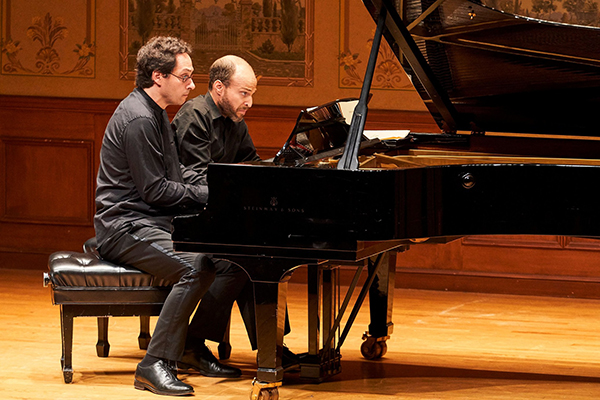 In the last event in its concert series before it turns its attention to the 2020 contest, the Cleveland International Piano Competition presented duo-pianists Shai Wosner and Orion Weiss in a viscerally thrilling and intellectually stimulating recital on Saturday evening, September 14 in Reinberger Chamber Hall at Severance Hall.
The program was unusual: two big works by Schubert and Brahms, the first rarely performed, the second better-known in the guise of a piano quintet, and each introduced by a mysterious little piece by David Lang — palette cleansers before the entrées.
Wosner and Weiss shared a single keyboard for the first half, beginning Lang’s Gravity with nearly inaudible single notes that gradually inched their way downward, reflecting one of the melodic characteristics of Schubert’s Sonata in C, which followed without pause.
Conceived as if on a large canvas and suffused with color, the Sonata seemed so symphonic to Joseph Joachim that the famous violinist orchestrated it in a version that Johannes Brahms conducted in the 1870s. Others have followed since with their own versions. It’s lengthy and spaciously unhurried, and Wosner and Weiss delighted in its lyrical passages and set up its climaxes with well-measured crescendos. It was fun to flip the situation and imagine that the two pianists were playing a four-hand transcription of an orchestral work for themselves and (several hundred) friends — the way many listeners first encountered large works before recordings were invented.
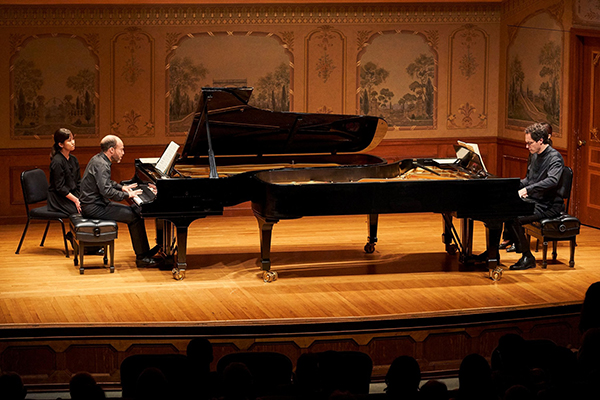 A second Steinway appeared during intermission, giving each pianist 88 keys of his own. Facing each other, Weiss on the left and Wosner on the right, they first applied their twenty fingers to Lang’s After Gravity. An essay in weightlessness accomplished through repetitive music that abandons regular meter, its unattached notes merely hang in the air, creating a miasma of otherworldly harmonies. It goes on a bit too long, but conveniently ends up on the right note to segue into Brahms’ Sonata in f.
The So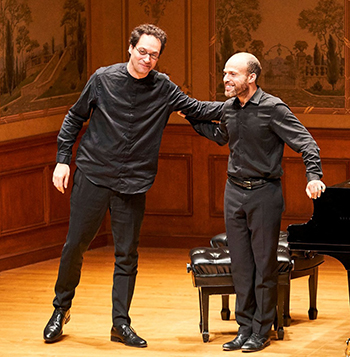 nata began as a string quintet, but the composer sensed there was something important missing and revised it for piano quintet, later rescoring it for two pianos. Obviously what Brahms found wanting was an incisive, percussive voice, a quality the two-piano arrangement serves up in abundance.
Weiss and Wosner play with telepathic coordination and manage to conjure up torrents of tone with little apparent physical effort. Their journey through the Brahms was varied and eventful, and they saved just enough excitement to make the composer’s final statements ring out over his numerous false endings.
The sizeable audience wanted — and got — more Brahms after a thunderous ovation. Wosner and Weiss returned to a single keyboard for two Hungarian Dances, and this time, Orion Weiss allowed himself a little showmanship, especially in No. 2, “The” Hungarian Dance that everybody recognizes.
Photos by Roger Mastroianni.
Published on ClevelandClassical.com September 17, 2019.
Click here for a printable copy of this article
