

by Daniel Hathaway
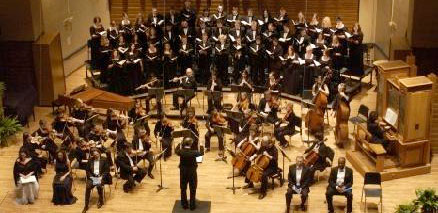 The eighty-second edition of the Baldwin Wallace Bach Festival, “the first collegiate Bach Festival in the Nation,” comprised four afternoon and evening concerts in Gamble Auditorium on Friday and Saturday, April 25 and 26. Set up so that BW’s students will get a crack at performing each of four extended Bach works during their college career, the festival rotates the Leipzig cantor’s two passions, the Christmas Oratorio and the B-Minor mass during each four-year cycle.
This year’s featured work was the St. John Passion, but students also got to perform the Magnificat and the cantata Wie schön leuchtet der Morgenstern, BWV 1. Other concerts included solo baroque works played by BW alumni, and music and dance from Paris and London during Bach’s time presented by Catherine Turocy’s New York Baroque Dance Company and (from the opposite coast) Musica Pacifica. The weekend was filled out with lectures, master classes, a period church service and an alumni sing.
This iteration of the Bach Festival also marked a milestone: festival director Dwight Oltman is to retire at the end of the academic year, having served for 39 of its 82 years — just short of half its history. [Read more…]
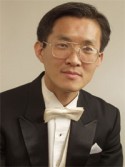 Welsh composer Karl Jenkins’s The Armed Man: A Mass for Peace has been on Hae-Jong Lee’s mind for a decade. Lee, who is director of choral activities at the Dana School of Music at Youngstown State University, first came across the work at a convention of the American Choral Directors Association.
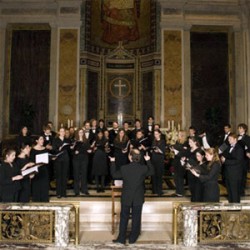 “England is one of our rather frequent places to visit. In part it has to do with the richness of the sound that the repertory offers,” Oberlin Collegium director Steven Plank told us during a recent telephone conversation. “Almost everything that we are singing on this program is very richly scored so it suits the ensemble well. It’s also the kind of music that revels in glorious sound and the combination of those two things make it rather inviting.”
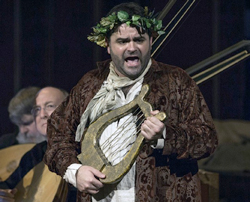 Inspired by one of the 18th century’s most famous tenors, Pierre Jélyotte, Les Délices’s new program The Leading Man includes operatic excerpts of musical heroism, absurdist comedy, and ravishing beautythat were central to Jélyotte’s repertoire. In her program notes, Les Délices’s founder and director Debra Nagy writes: “Jelyotte appears to have cultivated nothing but admirers. [His] contemporaries remarked on his range, volume, and the velveteen beauty of his tone. … He had only to sing, and those who listened were intoxicated. All the women went mad.”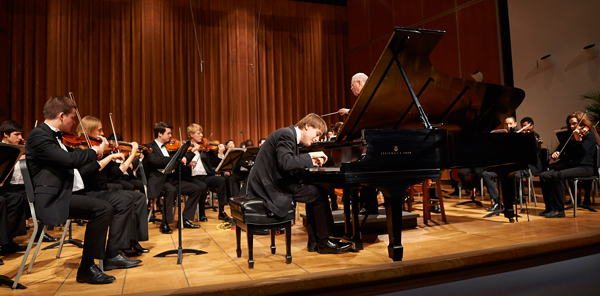
 Composed in Vienna in 1791, Mozart’s Requiem Mass in D minor, K. 626 was left unfinished by the composer at the time of his death. Although mystery surrounds the work (who was the mysterious messenger who ordered Mozart to compose a requiem?), the Mass has become one of Mozart’s most beloved works.
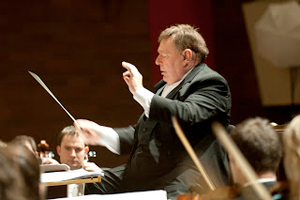 Describing this season’s final concert by the Canton Symphony Orchestra at Umstattd Performing Arts Hall on April 26 brings to mind a bevy of feel-good bromides. Still, none would be more apropos than “out of this world.”