by Mike Telin
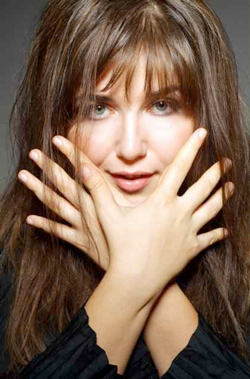 The Cleveland Institute of Music will take a different approach to its Mixon Masters Series this season. “Return of the Composer/Virtuoso” will bring performing composers to the Mixon stage in 2013-2014, beginning with Russian-born composer-pianist Lera Auerbach on Tuesday, September 17 at 8:00 pm. Auerbach will perform her 24 Preludes and Mussorgsky’s Pictures at an Exhibition on her Cleveland debut recital.
The preludes are personally important to her. “I have always loved cycles of 24 preludes”, Auerbach said in a telephone conversation from Berlin. “I have studied and played many of them like Chopin, Scriabin and of course Bach. I always knew that one day I would be writing my own 24 preludes but I didn’t anticipate what would happen. I had such a great time writing the piece. It gave me a canvas to explore — there are so many possibilities. It was such a fantastic journey to take that when I finished writing the 24 preludes for piano I just couldn’t stop! I couldn’t believe it was over and there were no more preludes to write.”
As it turned out, Auerbach didn’t quit after those 24 but immediately began writing another two dozen for violin and piano. “But after I finished those I was still hungry for more so I decided to keep on going and I wrote 24 for cello and piano.” [Read more…]
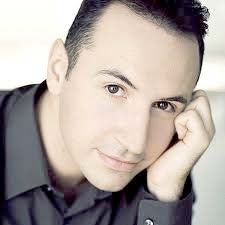 This week at Severance Hall, Robin Ticciati will lead The Cleveland Orchestra in concerts that feature Liadov’s Enhanted Lake and Sibelius’s Symphony No. 2. The program also includes one of the most popular piano concertos in the repertoire, the Concerto No. 2 by Sergei Rachmaninoff, with Macedonian pianist Simon Trpčeski as soloist.
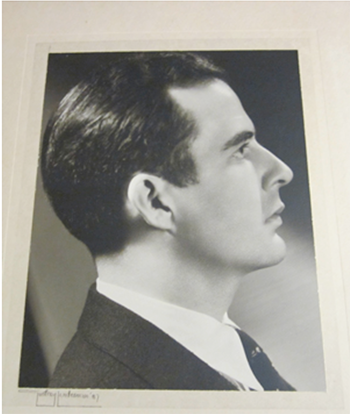 Marin Alsop will make her Severance Hall debut on December 8, 9 and 10 with Barber’s Symphony No. 1, Bernstein’s Serenade with Peter Otto as soloist, and Saint-Saëns’ Symphony No. 3 (“Organ”) featuring Joela Jones. Barber’s symphony received its American premiere in 1937 by The Cleveland Orchestra at Severance Hall, an event that inspired us to take a look in the Cleveland Orchestra Archives to see what critics had to say about the work and composer.
 Preparing for interviews and the writing of features is interesting as well as fun, in that through the internet and social media sources such as Facebook, Twitter, and YouTube, one can usually discover at least some “human interest” facts about most artists.
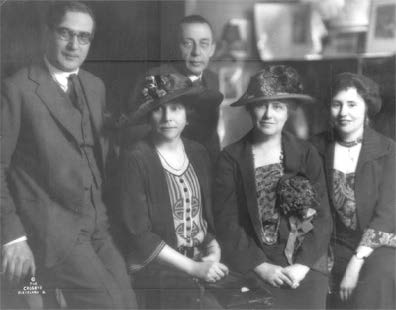 Rachmaninoff first came to Cleveland in 1923 to perform his second piano concerto at Masonic Auditorium on March 29 and 31, an event that coincided with the 25th anniversary of Adella Prentiss Hughes’ reign as Cleveland’s musical impresario. He returned in 1932 just after the Orchestra moved to Severance Hall, and four more personal appearances followed: November, 1937 (the Rhapsody on a Theme of Paganini), October, 1939 (Piano Concerto No. 1), March, 1941 (Beethoven Concerto No. 1 & the Paganini Rhapsody) and January, 1942 (Piano Concerto No. 2). The 1923 and 1932 engagements were led by Nikolai Sokoloff, the rest by Artur Rodzinski. (Above, photo of Sokoloff and Rachmaninoff, Mrs. Rachmaninoff, Adella Prentice Hugues & Lyda Sokoloff, 1923 photographer unidentified, courtesy of The Cleveland Orchestra Archives).