

by Daniel Hathaway
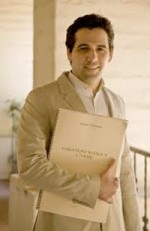 “I always knew that Bach was my favorite composer,” said CityMusic artistic director Avner Dorman, “but these days I think it’s Schubert. That’s how much I like this piece!”
The work Dorman was referring to in a recent telephone conversation is Franz Schubert’s Mass in E-flat, written in 1828, the last summer of the composer’s life, on commission from the choirmaster of the Alserkirche in Alsergrund, a suburb just north of Vienna’s Innere Stadt. That church was the venue for Beethoven’s funeral the year before (Schubert served as a torch-bearer).
Alas, the composer didn’t live long enough to hear the last of his six masses performed; its premiere ultimately took place in October of 1829 under the direction of his brother, Ferdinand. This week, Avner Dorman will lead CityMusic and Quire Cleveland in five performances of the E-flat Mass around the metropolitan area, beginning on Wednesday, May 14. [Read more…]
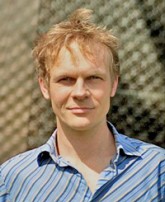 The Composer is Dead, a funny musical whodunit by children’s author Lemony Snicket and composer Nathaniel Stookey (left) that “investigates” every section of the orchestra, returns to Severance Hall on Friday, May 16 beginning at 7:30 pm when Brett Mitchell will lead The Cleveland Orchestra in a special Family Concert. The concert features the composer as narrator.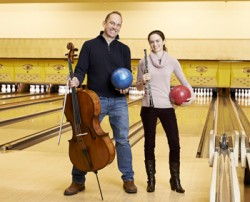
 As The Cleveland Orchestra makes the final preparations for its second annual Northeast Ohio neighborhood residency from May 17-24 in Lakewood, (a complete listing of dates and times can be found
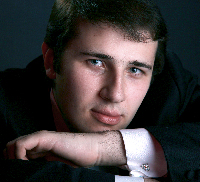 Has winning the 2013 Cleveland International Piano Competition changed Stanislav Khristenko’s life? “It definitely has,” the 29-year-old Khristenko said en-thusiastically during a recent telephone conversation. “At this point I feel very happy that I am able to do what I always wanted to do — and that is to play concerts.”
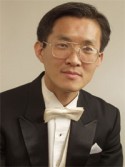 Welsh composer Karl Jenkins’s The Armed Man: A Mass for Peace has been on Hae-Jong Lee’s mind for a decade. Lee, who is director of choral activities at the Dana School of Music at Youngstown State University, first came across the work at a convention of the American Choral Directors Association.
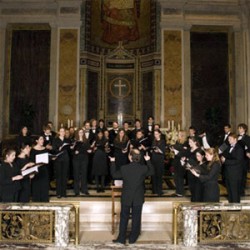 “England is one of our rather frequent places to visit. In part it has to do with the richness of the sound that the repertory offers,” Oberlin Collegium director Steven Plank told us during a recent telephone conversation. “Almost everything that we are singing on this program is very richly scored so it suits the ensemble well. It’s also the kind of music that revels in glorious sound and the combination of those two things make it rather inviting.”
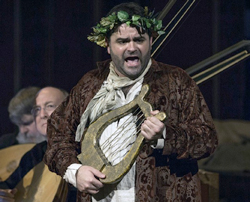 Inspired by one of the 18th century’s most famous tenors, Pierre Jélyotte, Les Délices’s new program The Leading Man includes operatic excerpts of musical heroism, absurdist comedy, and ravishing beautythat were central to Jélyotte’s repertoire. In her program notes, Les Délices’s founder and director Debra Nagy writes: “Jelyotte appears to have cultivated nothing but admirers. [His] contemporaries remarked on his range, volume, and the velveteen beauty of his tone. … He had only to sing, and those who listened were intoxicated. All the women went mad.”
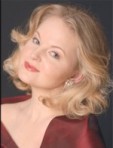 Composed in Vienna in 1791, Mozart’s Requiem Mass in D minor, K. 626 was left unfinished by the composer at the time of his death. Although mystery surrounds the work (who was the mysterious messenger who ordered Mozart to compose a requiem?), the Mass has become one of Mozart’s most beloved works.