


by Timothy Robson
 In the penultimate concert of their 2018 season, ChamberFest Cleveland offered the program “Behind Bars” on Friday, June 29 in Reinberger Chamber Music Hall at Severance Hall. The title was a reference to twentieth-century composer, organist and teacher Olivier Messiaen, who was being held in a German POW camp in 1940 when he composed his Quartet for the End of Time. That work received a searingly intense performance on the second half of the program, rendering the music that preceded it almost trivial by comparison.
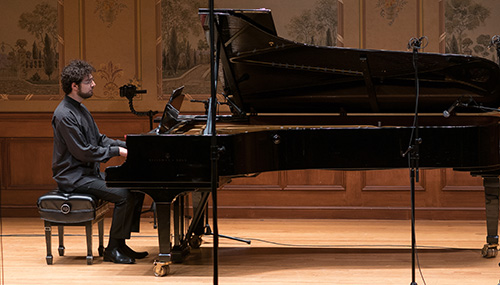
Pianist Roman Rabinovich opened with the ubiquitous Prelude and Fugue in C from Bach’s The Well-Tempered Clavier, Book 1. Surely most piano students have played at least the prelude (or heard Charles Gounod’s arrangement with an “Ave Maria” countermelody above it). Eschewing the damper pedal, and playing with clear articulation, Rabinovich clarified Bach’s harmonic underpinnings by slightly stressing and lengthening bass notes. He deftly wove the fugue’s upward scale subject into the contrapuntal texture. Even well-known music can sound new under masterful fingers.
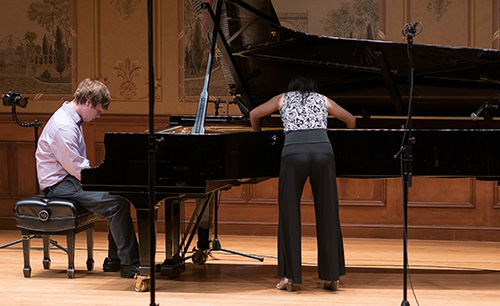 Pianist Sonia Xinyaun Hu played Henry Cowell’s landmark The Banshee (1925), a piece more often read about in music history texts than performed. The pianist is required to strum and pluck the strings, while leaning into the grand piano’s large case. The title is apt: whispers of sound are ethereal, ghostly, and at times elicit the legendary sound of the titular Irish ghost. Eric Farnan assisted by holding down the damper pedal from beginning to end. He seemed nonplussed to be taking bows with Hu, but his contribution was essential to the success of the performance.
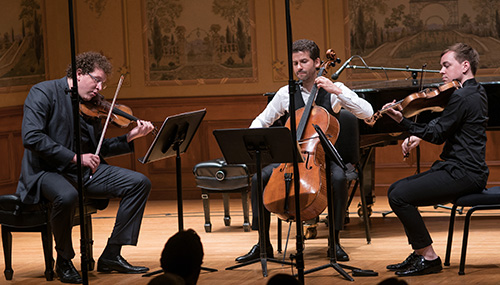
The four short movements of Franz Schubert’s Trio for Violin, Viola and Cello in B-flat, D.581 are not among Schubert’s most profound musical utterances, but on a warm summer evening they created a melodious divertissement. Violinist Noah Geller, violist Matthew Lipman, and cellist Nicholas Canellakis showed alert communication and tight ensemble throughout. Lipman’s long viola solo in the third movement Menuetto: Allegretto was particularly fine, and the closing Rondo was enjoyably lively.
 Before the concert began, Festival Speaker Patrick Castillo gave a concise introduction to the historical and theological context of Messiaen’s Quartet for the End of Time, with violinist Noah Bendix-Balgley, cellist Julie Albers, clarinetist Franklin Cohen, and pianist Roman Rabinovich demonstrating short passages. It was a helpful introduction for those not familiar with Messiaen’s compositional methods and sound world, which lean heavily on South Indian scales and rhythms as well as transcriptions of bird songs.
The quartet was premiered on January 15, 1941 at Stalag VIIIA in Görlitz, Silesia (now part of Poland) by the composer as pianist and three other inmates. As this performance progressed through the work’s eight movements, the listener was constantly reminded of the miracles that aided the work’s composition, rehearsal, and first performance. The quartet is a supreme landmark of twentieth-century chamber music.
Each movement has an individual character: harshly dissonant chords contrast with long, sustained melodies played against shimmering piano chords. The third movement, “Abyss of the Birds” for solo clarinet, features quick, ornamental phrases simulating birdsongs and long notes held for what seemed like an eternity, with controlled massive crescendo and diminuendo. It requires the utmost skill of the player, and Franklin Cohen was not only brilliant technically, he caught every bit of the music’s despair.
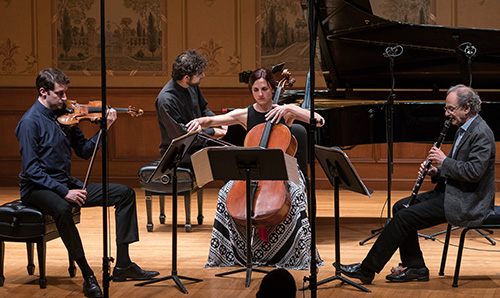 The fourth movement, “Interlude,” is almost whimsical, incorporating musical fragments heard elsewhere in the work. The fifth, “Praise to the Eternity of Jesus” for solo cello and piano is a long lyrical line above repeated soft piano chords that builds to a climax, then suddenly turns very quiet before fading away. The sixth, “Dance of fury, for the seven trumpets,” uses the four instruments in unison. The ensemble demands were fierce, but the quartet stayed completely together. The lengthy seventh movement, “Cluster of rainbows for the Angel who announces the end of time,” contains two contrasting passages of music, alternating and developing as the movement progresses. One is serene, the other dissonant and violent.
The final movement, “Praise to the Immortality of Jesus,” resembles the fifth, but here the solo is for violin. Extremely slow, its harmonies and melody are always ascending. Bendix-Balgley and Rabinovich found profound clarity at the end, where the violin plays a long note with a diminuendo that seems to stretch into eternity. The audience was spellbound after the movement ended, and hesitated before applauding. This performance will be remembered for its outstanding level of musicianship, but perhaps more so for its strong communication of Messiaen’s religious and philosophical views.
Photos by Gary Adams.
Published on ClevelandClassical.com July 3, 2018.
Click here for a printable copy of this article
