by Jacob Strauss

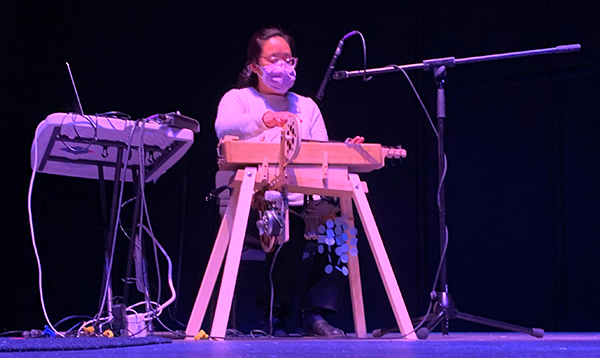
Each piece was individually introduced by the artist. After telling us a little bit about what we were about to hear, the environment changed: colorful washes of light fell over us, and we became surrounded by music. [Read more…]
by Jacob Strauss

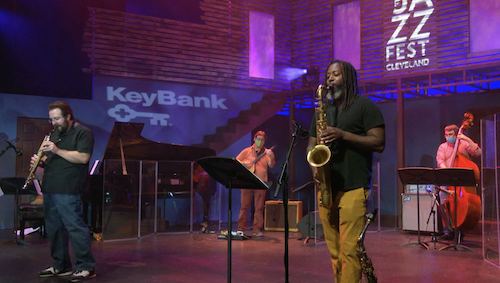
Each piece was individually introduced by the artist. After telling us a little bit about what we were about to hear, the environment changed: colorful washes of light fell over us, and we became surrounded by music. [Read more…]
by Max Shain
The COVID-19 pandemic has changed the shape of the live music industry, impacting musicians, audiences, curators, managers, venue owners, festival directors, and recording engineers. Not only have revenue streams shifted, but it has caused many to rethink their definition of live music.
I spoke with six people from different sectors of the music industry to find out how their perception and experience of live music — as well as their expectations for its future — have changed over the past year. I also spoke to a few of my friends who served as proxy “Jane and Joe” audience members.
by Jarrett Hoffman

“It was kind of spooky,” Andrew Tripp said during a recent conversation. Tripp is co-director of the Recording Arts and Production program at Oberlin Conservatory, as well as the associate director of Audio Services.
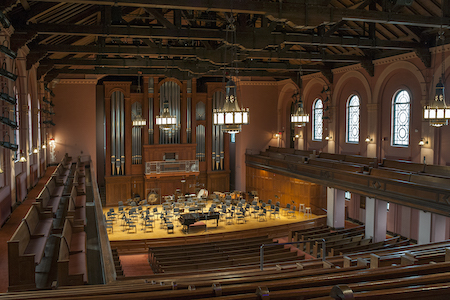
In early April, he made his way from one performance venue to the next on the mostly vacant campus. Armed with a two-way speaker, omnidirectional microphones, and a portable recorder, his goal was to “sonically document” each space, which involved the playing and recording of both music and a 30-second frequency sweep.
It was an idea Tripp had been cultivating for a few years, but one that was now more relevant than ever: with students unable to visit Oberlin’s halls, the halls could come to the students.
by Mike Telin
by Mike Telin

“Olly Wilson taught the first electronic music course in 1969 and John Clough taught the first computer music class in the spring of 1970,” associate professor of computer music and digital arts Tom Lopez said during an interview. “We thought that 50 years was cause to celebrate.”
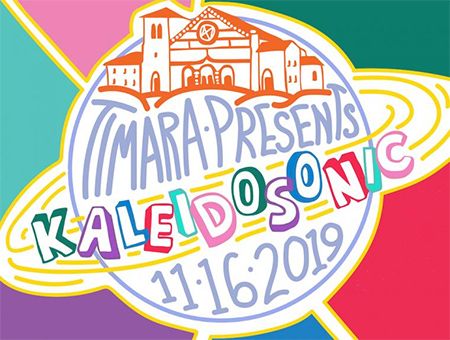
Organized by Lopez, the free Kaleidosonic Music Festival will feature nearly 500 musicians performing a variety of styles — gospel, classical, rock and roll, jazz, early music, marching band, serious, funny, and avant-garde.
“Kaleidosonic will be an epic celebration of music at Oberlin. It includes musicians and ensembles from the Conservatory, the College, and the community,” Lopez said. “We’re calling it a festival because it is more than a concert. It will be many hours long and the music will be non-stop — one big, long, sonic collage of ensembles, groups, and individual musicians. People can come and go as they wish and there will be food trucks available from 7:00 until 10:00.” [Read more…]