by Daniel Hathaway
 PAND — Performers and Artists for Nuclear Disarmament — was formed in 1984 during the height of the U.S.-Soviet arms race, which threatened, even in the case of a limited nuclear war, to destroy human civilization and much of life on the Earth.
“Today,” the organization states, “our goal is to work for the abolition of nuclear weapons. Our willingness to devote our time, talents and reputations to achieve this springs from our belief that art can contribute not only to aesthetics, but to ethics; not only to beauty, but to peace.”
The local chapter of PAND, which is part of Cleveland Peace Action, annually presents a concert in early August to commemorate the bombing of Hiroshima and Nagasaki. This year, which marks the 69th anniversary of an event that changed the course of human history, members of The Cleveland Orchestra and friends will perform at Nighttown, 12387 Cedar Road in Cleveland Heights, on August 6 at 7:30 pm. [Read more…]

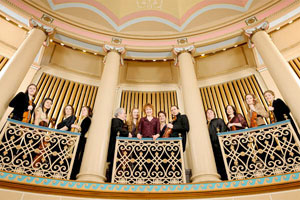 Apollo’s Fire will present seven local subscription programs totaling thirty concerts during its 23rd season in 2014-2015. Additionally, Cleveland’s baroque orchestra will make its debut at New York’s Metropolitan Museum of Art in December and at London’s BBC Proms next August, undertake a national tour of Monteverdi’s 1610 Vespers in November, and appear on the Pittsburgh Renaissance & Baroque Society series in April.
  For most people, the name Antonio Salieri denotes mediocrity envious of genius, and is inextricably (and unfavorably) associated with Mozart. In Pushkin’s play Mozart and Salieri, Rimsky-Korsakov’s opera of the same name, Peter Shaffer’s play Amadeus and its film adaptation, Salieri is depicted as a jealous composer who poisons Mozart after being upstaged by him.
 The environment in which you hear music has a potent influence on a concert experience. Obviously, the acoustics and size of a hall impact the sound, but physical surroundings can also intrude upon the music or affect the way you perceive a work. This is especially true at outdoor venues like Blossom Music Center, where nature decided to take a role in the music on July 26, when the Kent/Blossom Chamber Orchestra, The Cleveland Orchestra, pianist Stephen Hough, and conductors Brett Mitchell and John Storgårds presented a three-part concert there.
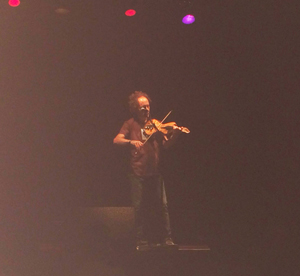 Tracy Silverman became one of the first adopters of the electric violin in the eighties when he built a six-string, amplified instrument of his own. He faces the challenge of pitching himself to a potentially diverse audience.