By Mike Telin and Daniel Hautzinger
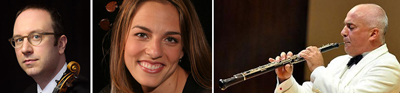
After four concerts and a family program, ChamberFest Cleveland now moves into its second and final week with five more concerts. One of those includes a performance of Chinese composer Tan Dun’s Ghost Opera with world premiere choreography. As part of our continuing coverage of ChamberFest, we spoke with three participants.
Noah Bendix-Balgley
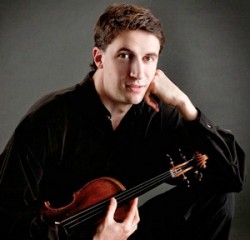 Sometime in the next year, Noah Bendix-Balgley will leave his position as concertmaster of the Pittsburgh Symphony Orchestra, which he won when he was 27 in 2011. Why leave such a desirable chair, especially when he was appointed at such a young age? To become first concertmaster of the Berlin Philharmonic, one of the most prestigious orchestras in the world.
But before he leaves for Berlin, Bendix-Balgley will come to Cleveland to join “a really wonderful cast of some of the best young musicians around,” as he described his fellow ChamberFest participants in a phone interview. Needless to say, Bendix-Balgley is a worthy addition to that cast.
He joins ChamberFest to play some Romantic masterworks, “some of the best chamber music out there and some of my favorite pieces to play:” Brahms’s piano Quintet, Dvořák’s E-flat piano quartet, and Tchaikovsky’s “Souvenir de Florence” sextet. Beyond those pieces, he’ll also perform two pieces for the first time. “I’m very much looking forward to working with [pianist] Orion Weiss on the Janáček violin sonata, it’s a really wonderful piece,” he said. Osvaldo Golijov’s Last Round for double string quartet and bass, on ChamberFest’s final concert, is also new to him. [Read more…]
 Chamber music is an intimate experience, for musicians and audience alike (you can only fit so many people into a “chamber”). And what’s more intimate than a living room as a practice space? According to ChamberFest Speaker Patrick Castillo, “the primary rehearsal space for ChamberFest Cleveland is Frank Cohen’s living room, which already creates this sense of homey-ness. It’s a very warm experience for all the artists involved and myself, and hopefully for the audience as well.”
 Erich Wolfgang Korngold isn’t exactly a household name, but you’ve probably heard music by him or imitating him. Korngold, an Austrian composer active in the first half of the twentieth century, is best known in the US for his scores of such Hollywood films as The Adventures of Robin Hood and The Prince and the Pauper in the ‘30s and ‘40s. As the distinguished music journalist Donald Rosenberg said in a phone interview, “He really changed the whole trajectory of film scores by writing very lushly for the orchestra, using it almost as a character in the drama, and by writing scores that were essentially operatic, with themes for different characters.”
 The
The 
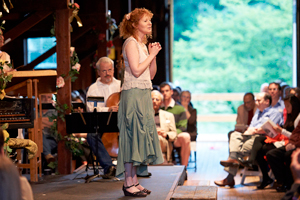 “I’m excited because I feel like it might be one of the better things that I’ve put together,” Apollo’s Fire artistic director Jeanette Sorrell exclaimed about her new program during a recent interview. While putting together her previous Appalachian-inspired program, “Come to the River,” Sorrell said, “I was pretty much a newcomer to the field. This time I feel I’m starting from a deeper place.”
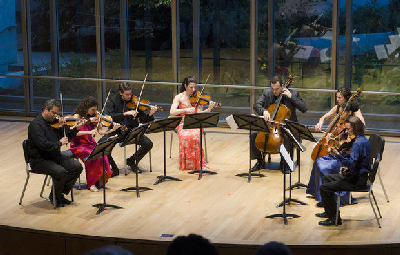 In their “Message from The Directors”, ChamberFest Cleveland artist directors Diana and Franklin Cohen write, “According to the Greek philosopher and mathematician, Pythagoras, the number three is the ‘noblest of digits’ because it is the only number that equals the sum of its parts. Like that noble number, ChamberFest Cleveland’s third anniversary season, THREE!, is possible because of what has come before.”
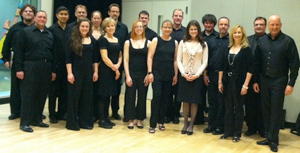 on’t be surprised if the second concert by Cleveland’s new choral ensemble, Contrapunctus, at St. John’s Cathedral in downtown Cleveland on Friday, June 6 at 7:30 pm, is missing a few voice parts — tenors and basses, in fact. British countertenor David Acres, who founded and conducts the ensemble, planned it that way.