by Daniel Hathaway

You know it’s going to be an odd evening when the “dissonant” introduction to Mozart’s K. 465 quartet goes by without much of a ripple but the happy-sunny musical events that follow raise multiple eyebrows. [Read more…]
by Daniel Hathaway

You know it’s going to be an odd evening when the “dissonant” introduction to Mozart’s K. 465 quartet goes by without much of a ripple but the happy-sunny musical events that follow raise multiple eyebrows. [Read more…]
by Mike Telin

Watching other people’s dysfunctional families unravel before your eyes has been a source of entertainment since, well probably since there have been people. And in opera, while there is plenty of dysfunction to go around, the family of deceased Buoso Donati, could easily rival, if not outdo the Kardashians in their unbridled attempt to secure their share of the family fortune. A fortune which Buoso Donati has left to the monastery. [Read more…]
by Mike Telin

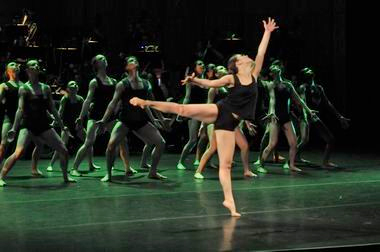
During the past few years The Akron Symphony has presented some outstanding performances resulting from community-based projects (think Porgy and Bess) and Saturday’s performance did not disappoint. Stravinsky said, “What I was trying to convey in The Rite was the surge of spring, the magnificent upsurge of nature re-born,” and GroundWorks’s artistic director David Shimotahakara’s imaginative choreography brilliantly served the composer’s wishes. And a cast of dancers that included GroundWorks’ five members, three other professionals and an ensemble of 15 Akron area students performed with style and conviction. [Read more…]
by Tom Wachunas

In retrospect, Smillie’s directive to the audience on how to best embrace the first work of the evening, Prelude and Liebestod from Tristan und Isolde, and the third selection, Brünnhilde’s Immolation scene from Götterdämmerung (Twilight of the Gods), seems somewhat curious if not counterintuitive. Smillie posited that the dramatic thrust of these works cannot be wholly appreciated via the inadequate (and perhaps even silly) words in the libretto, but rather through the cascading orchestral surges he compared to musical orgasms. While we hear the singer with our ears and see her with our eyes, he explained further, we must listen to the orchestra with our hearts to experience what words on their own could never impart. [Read more…]
by Timothy Robson

Louis Vierne, born nearly blind in 1870, studied organ at the Paris Conservatory, then served as assistant to his teacher Charles-Marie Widor at Saint-Sulpice. He became the organist at Notre Dame Cathedral in 1900, a post he held until his death in 1937. [Read more…]
by Daniel Hathaway

In February, Daniel R. Lewis Young Composer Fellow Sean Shepherd completed his impressions of three Yosemite National Park scenes captured by American photographer Ansel Adams, the final commission of Shepherd’s two-year residency with the orchestra. The composer is quick to point out that the piece is not a musical representation of the Adams images but “a kind of response to that set of three black-and-white photographs… a meditation on and celebration of both the place and the images” — exactly what the French Impressionists had in mind a century ago. [Read more…]
by Nicholas Jones

The centerpiece of the program was a substantial cantata titled L’Hyver (Winter), one of a cycle of four cantatas on the seasons by the early-18th-century composer Joseph Bodin de Boismortier. With appropriate Baroque word-painting, Boismortier depicts winter’s horrors—bare trees, mountain storms, and frost-stricken buds—then shifts to winter’s pleasures—dances, feasts, and plays. Winter’s destructive fury turns out to be a foil to the delights of a Parisian salon, well heated and well stocked with wine and music.
The presiding muse of those delights was the masterful soprano Clara Rottsolk, who was featured on Les Délices’ recent CD, Myths and Allegories. [Read more…]
by Daniel Hathaway

Bach — that great recycler — turned several wind concertos from his days as court composer at Köthen into harpsichord concertos for his coffee house concerts with the Leipzig University Collegium Musicum between 1729 and 1741. Though the originals have been lost, they can be reconstructed by clever musicologists, as an uncredited arranger did for BWV 1055.
James Feddeck, stepping in for Franz Welser-Möst last weekend, led a string section pared down to eight first violins, six seconds, five violas, four cellos and two double basses, creating an admirable balance between soloist and orchestra [Read more…]
by Robert Rollin

Scheherazade is a marvelous programmatic piece with four episodes in the Sultana’s succession of a thousand and one tales which enthrall the Sultan so much that he forgets to execute her as he had all other wives after their wedding nights. Through her guile and storytelling skill, Scheherazade survives and becomes his permanent bride. The composer used the concertmaster’s solo violin to portray Scheherazade’s story-telling ability and as a means of uniting all four movements, not only with musical timbre, but also with Scheherazade’s theme. [Read more…]
by Daniel Hathaway

Stambaugh has launched an organ series to celebrate the restoration of its distinguished 58-rank organ, which is divided behind the proscenium on both sides of the stage and speaks with a fine presence through grillwork into the hall. Canadian-born organist Ken Cowan, who now teaches at Rice University in Houston, played an eclectic program of Wagner, J.S. Bach, John Ireland, Rachel Laurin, Healey Willan, Saint-Saëns and Sowerby on Sunday afternoon, April 7 which brilliantly showed off the Skinner’s many capabilities. [Read more…]