

by Daniel Hathaway
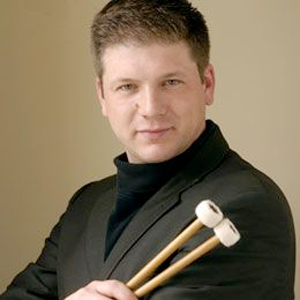 Most pre-concert lectures are delivered by musicologists or feature interviews with conductors. But when Apollo’s Fire gives five local performances of Handel’s Messiah beginning on Thursday, timpanist Matthew Bassett will talk about that most famous of oratorios from the point of view of the musician who has the least to do during the 2-1/2 hour work. “I don’t have that many notes to think about, but I think about them a lot,” he said in a phone conversation from Buffalo, where he serves as principal timpani with the Buffalo Philharmonic.
Bassett has had the opportunity to perform Messiah frequently with Cleveland’s baroque orchestra in the twenty years since it first presented the work. “In fact, I believe I’m the only person — and that includes Jeannette Sorrell — to have played in every Messiah that Apollo’s Fire has done.” (One set of performances the ensemble gave was led by a guest conductor.)
“You never have as much time to spend in a pre-concert talk than you think,” Bassett said, who has filled this role once before for Apollo’s Fire, “but I plan to talk about the entry of timpani into Western music and how the instruments became such an integral part of high baroque music. [Read more…]
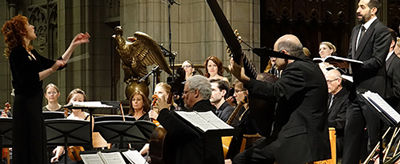 Ornate, exotic, and opulent, Claudio Monterverdi’s Vespers of 1610 defines the meaning of “Baroque” — and as a religious work, it just might be a Puritan’s worst nightmare. On Friday evening, the 37 singers and instrumentalists of Apollo’s Fire gave the large audience in St. Paul’s Episcopal Church in Akron a dazzling guided tour of its many and varied attractions.
 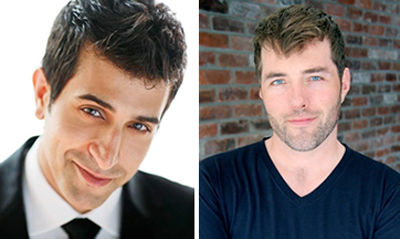 “The first time I heard the Monteverdi Vespers, I was absolutely floored,” said tenor Oliver Mercer in a phone conversation. “It was unlike anything I had ever heard and I became obsessed with it. It wasn’t just a quirky piece of early music, but a work that belongs in the upper echelons along with Beethoven’s ninth symphony.”
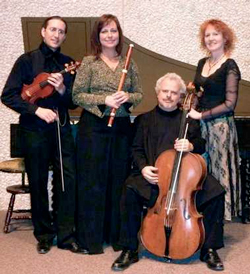 J. S. Bach would be astounded to find his 330th birthday celebrated with such fervor as it is this season in Northeast Ohio. Next weekend, the Cleveland Orchestra is marking the occasion with performances of the B-Minor Mass, and this past weekend Apollo’s Fire baked a scrumptious cake for the not-always-sweet cantor of Leipzig. Though the actual birthday isn’t until next March 21st, we got a sneak peek at the birthday presents early when music director Jeannette Sorrell presided over Apollo’s Fire’s program of Bach’s virtuosic instrumental music.
  Although it seems odd for an ensemble who have performed together for over two decades, Apollo’s Fire is beginning its season with some first-time performances of well-known works by Johann Sebastian Bach — at least in their best-known versions.
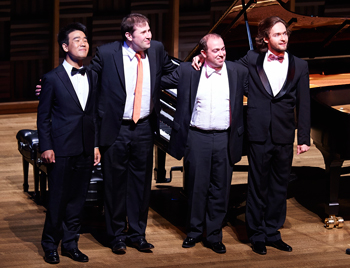 The laureates of most international piano competitions vanish into the ether once the medals are bestowed and prizes awarded. Not so with the Cleveland International Piano Competition, whose leadership has sought new ways to keep its prizewinners in the local public eye and ear.
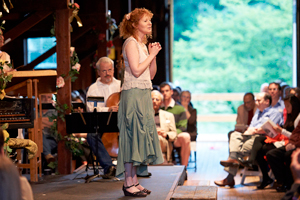 Apollo Fire’s Sunday evening performance at the Baroque Music Barn in Hunting Valley shows why the early music/Baroque ensemble can and should make forays outside of classical and into the heart of American folk music. Their latest program “Glory on the Mountain,” is a follow-up to their highly successful “Come to the River” tour and CD, and is now in the midst of a 10 performance tour of the Cleveland area. “Glory on the Mountain” is an exploration into the music and culture of 18th and 19th century Appalachia, a place populated by British settlers. It combines haunting melodies, foot-stomping jigs and reels, stories, and a healthy dose of comedy, all with musicianship of the highest order. The audience sang, clapped, shed a few tears, and laughed, ultimately enjoying a taste of the good times that our mountain forebears must have had.
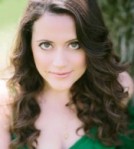 This weekend Apollo’s Fire, directed by Jeannette Sorrell, gave four performances of their latest program, The Power of Love: Passions of Handel and Vivaldi. The featured soloist was the brilliant young soprano Amanda Forsythe. I heard the Friday night concert at St. Paul’s Episcopal Church in Cleveland Heights, with its newly renovated acoustics which livened up the sound considerably. The music was mostly Handel and Vivaldi, but Jean-Philippe Rameau made a couple of cameo appearances as well.