by J.D. Goddard

by J.D. Goddard

by Nicholas Jones
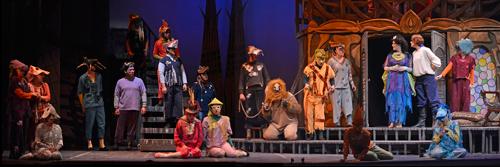
To enter the world of Baroque opera is to abandon realism, especially with Handel’s magical Alcina, his 1735 recasting of the bizarre inventions of Italian chivalric romance. Almost every one in the opera is disguised, transformed, or betrayed — Bradamante, a young maiden dressed in her brother’s armor, pursues her fiancé Ruggiero, whom she discovers snuggling with the sorceress Alcina; Astolfo, a hapless warrior of whom we learn little except that his son Oberto very much misses him, has been turned into a lion quite reminiscent of Bert Lahr in The Wizard of Oz; a second sorceress (Morgana, sister to Alcina, it turns out) happily betrays her lover Oronte in the very first scene as she falls in love with Bradamante . . . and I could go on. [Read more…]
by Daniel Hathaway

Cleveland Institute of Music Opera Theater director David Bamberger was definitely enticed, but for different reasons. “Every title we pick is based on the question, ‘What would be a great show for our students?’ The result is that I get to program some very interesting works that I probably would not have chosen when I was with Cleveland Opera.” [Read more…]
by Mike Telin

In his director’s notes David Bamberger pointed out that both operas center on a powerful woman and in each case, that woman self-identifies through a man – in one case a mother, in another as a lover. And in each opera the woman loses the man to rival forces that she can neither control nor totally understand. But without a doubt, the pairing of these two titles made for a fun, enjoyable and thought-provoking evening. Enjoyable because of the outstanding performances given by the young and talented CIM cast. Thought-provoking due to an ingenious take on an all too-familiar tale. I attended the Thursday, February 27 performance. [Read more…]
by Mike Telin

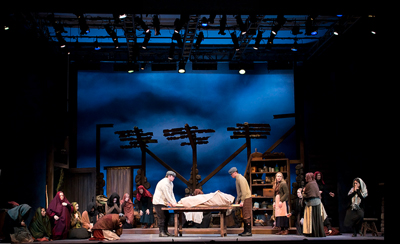
Ralph Vaughan Williams’s Riders to the Sea is set in the Aran Islands, off Ireland’s west coast. Before the opera opens, Maurya has lost her husband, father-in-law, and four of her six sons at sea. Mezzo soprano Lyndsay Moy (left), who performs the role of Maurya, says all one needs to do to perceive the difficulties of daily life the opera’s characters are forced to endure is to look at the geographic location where the opera is set.
“It’s easy to understand just how dangerous the ocean can be. And Maurya is someone who has experienced a lot of pain caused by the ocean. She has lost her husband, her father-in-law and four sons and at the beginning of the opera she presumes that her fifth son, Michael, is also dead. [Read more…]
by Daniel Hathaway

Weighed down by enough symbolism to give Dan Brown material for a thick new book, Flute also calls for a stratospheric (and scary) soprano to play the Queen of the Night, a basso profundo to play Sarastro and a charismatic baritone to play the birdcatcher, Papageno. We reached David Bamberger by telephone last week to talk about the production. He began by musing about the character of the evil sorcerer, Sarastro.
David Bamberger: I have a big problem with Sarastro. I know that Shaw said his music sounds the way God ought to sound, but everything he actually says, if you go by the words rather than the tunes, is actually untrue. Or inept. [Read more…]
by Daniel Hathaway
The opera
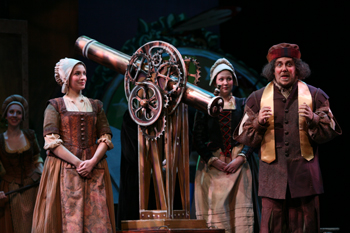
Stage directors Jonathon Field (Oberlin) and David Bamberger (CIM) had both aesthetic and practical reasons for choosing the Fall opera titles. “Il matrimonio is a wonderful, delightful piece that I directed once before for Cleveland Opera”, Bamberger told us in a phone conversation, “and it showcases our students well”. Field made his choice in conversation with his colleagues: “Last year the voice faculty became enthused about Il mondo della luna because there are a lot of roles for women. There’s a huge number of sopranos in the department and then an equal number of mezzos, tenors and basses. You need to be sure that you are educating as many students as possible.” [Read more…]