

by J.D. Goddard

by J.D. Goddard

by Mike Telin

Beginning on Wednesday, February 25 at 7:30 pm in the Cleveland Institute of Music’s Kulas Hall, CIM Opera Theatre will present La clemenza di Tito. The fully staged production is directed by David Bamberger, and Harry Davidson will lead the CIM orchestra. Performances run through Saturday, February 28.
This past weekend I spoke to three of the cast members, all of whom shared insightful thoughts about their complex characters. They also gave high marks to Bamberger for his directing of this “modern” production as well as crediting Davidson for his helpful musical advice. [Read more…]
by Nicholas Jones
To enter the world of Baroque opera is to abandon realism, especially with Handel’s magical Alcina, his 1735 recasting of the bizarre inventions of Italian chivalric romance. Almost every one in the opera is disguised, transformed, or betrayed — Bradamante, a young maiden dressed in her brother’s armor, pursues her fiancé Ruggiero, whom she discovers snuggling with the sorceress Alcina; Astolfo, a hapless warrior of whom we learn little except that his son Oberto very much misses him, has been turned into a lion quite reminiscent of Bert Lahr in The Wizard of Oz; a second sorceress (Morgana, sister to Alcina, it turns out) happily betrays her lover Oronte in the very first scene as she falls in love with Bradamante . . . and I could go on. [Read more…]
by Daniel Hathaway

Cleveland Institute of Music Opera Theater director David Bamberger was definitely enticed, but for different reasons. “Every title we pick is based on the question, ‘What would be a great show for our students?’ The result is that I get to program some very interesting works that I probably would not have chosen when I was with Cleveland Opera.” [Read more…]
by Mike Telin

In his director’s notes David Bamberger pointed out that both operas center on a powerful woman and in each case, that woman self-identifies through a man – in one case a mother, in another as a lover. And in each opera the woman loses the man to rival forces that she can neither control nor totally understand. But without a doubt, the pairing of these two titles made for a fun, enjoyable and thought-provoking evening. Enjoyable because of the outstanding performances given by the young and talented CIM cast. Thought-provoking due to an ingenious take on an all too-familiar tale. I attended the Thursday, February 27 performance. [Read more…]
by Mike Telin

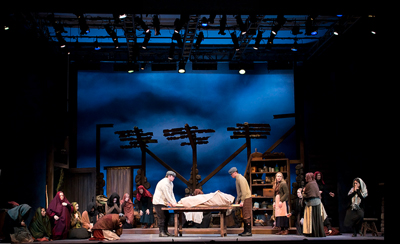
Ralph Vaughan Williams’s Riders to the Sea is set in the Aran Islands, off Ireland’s west coast. Before the opera opens, Maurya has lost her husband, father-in-law, and four of her six sons at sea. Mezzo soprano Lyndsay Moy (left), who performs the role of Maurya, says all one needs to do to perceive the difficulties of daily life the opera’s characters are forced to endure is to look at the geographic location where the opera is set.
“It’s easy to understand just how dangerous the ocean can be. And Maurya is someone who has experienced a lot of pain caused by the ocean. She has lost her husband, her father-in-law and four sons and at the beginning of the opera she presumes that her fifth son, Michael, is also dead. [Read more…]
by Robert Rollin

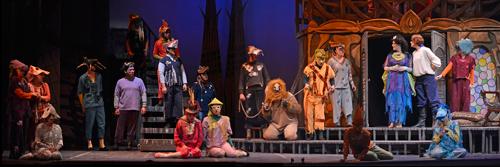
Tamino, a foreign prince tries to fight a menacing dragon, but faints after loosing all his arrows. Three ladies appear and save him by killing the dragon with their spears. [Read more…]
by Daniel Hathaway

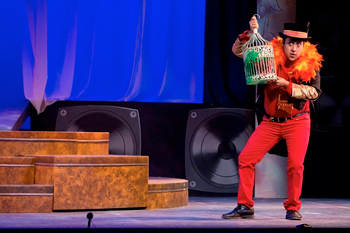
Weighed down by enough symbolism to give Dan Brown material for a thick new book, Flute also calls for a stratospheric (and scary) soprano to play the Queen of the Night, a basso profundo to play Sarastro and a charismatic baritone to play the birdcatcher, Papageno. We reached David Bamberger by telephone last week to talk about the production. He began by musing about the character of the evil sorcerer, Sarastro.
David Bamberger: I have a big problem with Sarastro. I know that Shaw said his music sounds the way God ought to sound, but everything he actually says, if you go by the words rather than the tunes, is actually untrue. Or inept. [Read more…]
by Timothy Robson
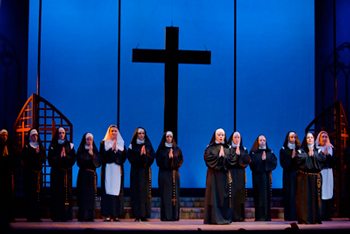
The historical frame around Francis Poulenc’s 1957 opera Dialogues des Carmelites is the French revolution, and the historically-based story revolves around a convent of Carmelite nuns near Paris during the Reign of Terror who were rounded up and executed at the guillotine for their religious beliefs.
The real subject of the opera is, however, the faith journey of one young nun, Blanche de la Force, daughter of a French aristocrat, who joins the convent to escape the real world. Her doubts cause her to abandon her sister nuns, yet she is redeemed at the end of the opera when she returns to join them in their final sacrifice.
The Cleveland Institute of Music opera department presented four performances (two performances each with double casting of the principals) from February 27-March 2, in Kulas Hall at CIM. David Bamberger was the stage director, and Harry Davidson was the guest conductor of the CIM orchestra. This report is based on the Thursday evening performance. [Read more…]
by Mike Telin
Francis
Dialogues of the Carmelites tells the true story of an order of Carmelite nuns during the French Revolution whose monastery is seized and its members executed. The plot centers around the spiritual journey of Blanche de la Force, the daughter of a wealthy nobleman. “What I think is particularly interesting is that the events are completely historical,” says CIM Opera Theater director David Bamberger. “The famous last scene where the nuns are guillotined and their voices drop out one at a time is exactly what happened.” He adds that while the character of Blanche de la Force and her family are invented, with a quick Google search you can read the story of the Carmelites and the Reign of Terror. [Read more…]