


 We’ve compiled a thirty-page pdf archive of all of our coverage of the 2009 Cleveland International Piano Competition, including interviews with the four finalists. Download it and enjoy!
WCLV Re-broadcasts CIPC Final Four this week
We asked for details a bit late, but wanted our readers to know that WCLV, 104.9 FM, will be re-broadcasting the concerto performances of the Final Four this week on the station’s Big Work at One series. Here’s the schedule:
Tuesday, August 11 at 1 pm: fourth-place winner Evgeny Brakhman in Rachmaninoff’s third concerto.
Wednesday, August 12 at 1 pm: third-place winner William Youn in Brahms’ first concerto.
Thursday, August 13 at 1 pm: second place winner Dmitri Levkovich in Rachmaninoff’s second concerto.
Friday, August 14 at 1 pm: first-place winner Martina Filjak in Rachmaninoff’s second concerto.
Any remaining time before two p.m. each day will feature Martina Filjak in solo performances from earlier rounds of the competition.
Filjak and Youn in the last Concertos at Severance: Final Round, Part II
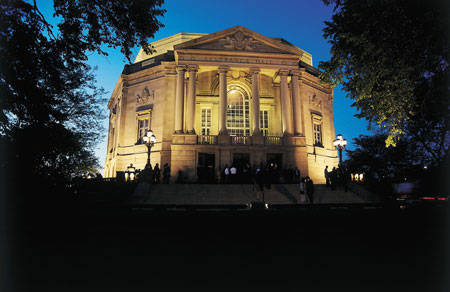 Inevitable comparisons: in a competition, you want to listen to every performance as if you’re hearing both the piece and the performer for the first time, but with two versions of Rachmaninoff’s second concerto scheduled on two adjacent nights, what’s a listener to do but think about each of them in relation to the other. Both are still ringing in the ears.
Croatian pianist Martina Filjak made an immediate impression with her carefully wrought crescendo and intensifying coloration of the famous opening chords and bass punctuation that begin Rach 2. Same conductor, same orchestra, but when the other hundred or so musicians on the stage joined Filjak in her musical odessey through this engaging score, it was clear that the soloist was seeing it through a different lens.
Levkovich and Brakhman go head to head with Rachmaninoff: Final Round, Part I

It’s a dream come true for Rachmaninoff fans: three concertos (well, two different ones) performed on two adjacent evenings at Severance Hall — followed by a Brahms chaser.
Dmitri Levkovich (30, Canada) and Evgeny Brakhman (28, Russia) both speak Russian not only linguistically but musically. The first round of the CIPC Finals gave these fine young pianists the opportunity to show off their interpretive skills in collaboration with Jahja Ling and the Cleveland Orchestra.
In the orchestral hierarchy, concertos don’t get much rehearsal time compared to symphonic works. In this case, there was even less time to be had: each of the two soloists spent about an hour with the orchestra earlier in the day, after a seance with Maestro Ling on Thursday to talk things through. Every detail can’t have been worked out under those circumstances, but there are hundreds of recordings in circulation that have nothing on what we heard from these two pianists, who were obviously pumped for the occasion. It was quite an evening.
A Korean Finale: Semi-Final Round, Session 4
William Youn and Soo-Yeon Ham played the last notes in the Semi-finals on Wednesday evening — lots of them — and contrasts abounded.
Now on to the Asians: Semi-finals, Session 3
A random draw and a jury decision has produced the statistical improbability that two Chinese pianists are playing in the Semi-finals this afternoon, and two Koreans this evening.
Wednesday afternoon’s session could be called the Triumph of Pianism. Yunquing Zhou and Kuok-Wai Lio are both 20 years old, both study at the Curtis Institute in Philadelphia, and both display astonishing technical skill. Playing thousands of notes in the right places is not a problem for either of them. The maturity to plumb the depths of the music they play so skillfully may still be a few years out.
Ladies’ Night: Semi-finals, Session 2
Tuesday afternoon with Levkovich and Brakhman was a guy’s session featuring two very fine, comparable performances. Tuesday evening was the women’s turn, but what a contrast between the equally excellent pianists Pallavi Mahidhara (USA/India) and Martina Filjak (Croatia).
And then there were eight: Semi-Final Round, Session 1
The field is getting smaller, the audiences are getting larger and the performances are getting longer this week at the Bolton Theatre as we move into the four semi-final rounds.
In this leg of the competition, the requirements become simpler, with only two imperatives. Competitors must include a work or group of works by a French impressionist composer and a Romantic composer, then they can choose to play any other work of their choice. The French requirement is a vestige of CIPC’s ancestor, the Casadesus Competition, and it brings an entirely new challenge into play.
As the original order of the draw is being preserved in the Semi-finals, Dmitri Levkovich of Canada and Evgeny Brakhman of Russia were the featured acts on Tuesday afternoon. Each player crammed as much music as possible into his 55-60 minute allotment.
32 up and 32 down: Round 2, Session 6
The first and last of the final five competitors to be heard for the second time on Sunday evening thoughtfully chose very interesting repertory, a boon for ears that were about to get a bit weary.
Marina Radiushina (USA) began with a bravura performance of Leighton’s impassioned ‘Fantasia Contrappuntistica (Homage to Bach)’, went on to a beautiful and shamelessly pianistic reading of Handel’s Chaconne in G and ended with a finely paced version of Schumann’s austere Variations on a Theme of Clara Wieck. Elegant, graceful and demonstrating an excellent sense of style and technique, Radiushina made a fine impression.
Confirmations: Round 2, Session 5
Sangyoung Kim, Kristhyan Benitez, Martin Labazevitch, Anna Bulkina & Edward Neeman returned to the Bolton Theatre stage on Sunday afternoon for a second hearing. Although we can’t say that we learned anything radically new about these five highly competent pianists, many of our first impressions were confirmed by hearing them in fresh repertory.
Sangyoung Kim (Korea) impressed us on Thursday afternoon with her Dutilleaux Sonata. She presented only two works on Sunday: a Prelude & Fugue from Bach’s Well Tempered Clavier (f-sharp, Book II) and Schumann’s Carnaval. Her Bach was nicely shaped, building to its harmonic climax with a long crescendo and announcing harmonic arrivals. As in the Dutilleaux, Kim brought fine colors out of the Hamburg Steinway, taming its bright treble register and producing a performance of stylish beauty, reactive to quick changes of mood and bright with humor. She caught the grandeur of Schumann’s piano writing in a way that has eluded previous contestants and brought the first set of the afternoon to a highly agreeable conclusion. Never mind a few klinkers.