by Jarrett Hoffman

by Jarrett Hoffman

by Jarrett Hoffman

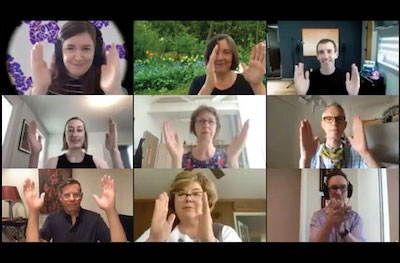
Singing. Latency. Those are two words that have gotten more stressful since March of 2020. Tonight at 7:30 on Oberlin Stage Left, vocal ensembles director Gregory Ristow and voice professor Kendra Colton will discuss those topics, and will demonstrate “real-time musical collaboration over the internet” during So You Think You’re in Sync? – Latency Solutions for Real-Time Virtual Performance.
At noon, WCLV’s “Lunchtime with The Cleveland Orchestra” features Mozart’s 17th Piano Concerto and selections from Wagner’s Tristan und Isolde. And if the opera bug catches you there, you can stream a ‘90s performance of Verdi’s Un Ballo in Maschera tonight from the Met.
Staying in New York, but going back to the 6th century, Benjamin Bagby evokes the ancient world of Beowulf with his voice and a six-string harp. The one-man performance was recorded in January, and is streamed tonight as part of 92nd St. Y’s Summer Concerts.
More details about all of those events here.
TODAY’S ALMANAC:
Tomas Luis de Victoria — the most well-known composer in Spain during the 1500s, and considered one of the greatest composers of the 16th century as a whole — died on this day in 1611 in Madrid.
There’s been a revival of interest in Victoria’s work over the past hundred years, and his name is no stranger to the program booklets — and YouTube channels — of Northeast Ohio’s ensembles.
His Christmas motet O magnum mysterium is quite popular: check out this live performance from Quire Cleveland at Trinity Cathedral in 2009, or this duo version from Mignarda’s 2016 album of Advent and Christmas music for lute and voice.
The Requiem Mass Officium Defunctorum is considered by many to be Victoria’s masterpiece. Hear Contrapunctus Early Music sing that work’s “Taedet animam meam” during a live performance at Mary Queen of Peace in 2015.
by Jarrett Hoffman

It was also, as she told me in April, the “sea” of invites to live concerts streamed from living rooms. It was overwhelming. One thing she found nourishing was programming potential concerts, planning for a future where artists could once again “collaborate in meaningful ways.”
Looking back now, it’s clear that Nagy was always going to find her own unique way to approach music-making in the time of COVID. Enter SalonEra, a free series that begins August 24 and represents one half of Les Délices’ 2020-21 season.
by Jarrett Hoffman
MUSIC — AND ANIMALS — WITH THE ASO:

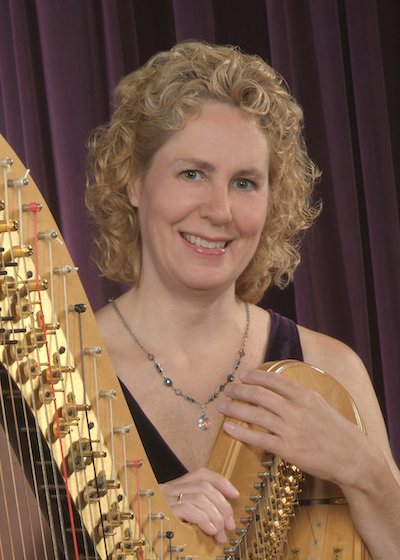
Guinn will play from 11 am to 1 pm as part of Farm Friday, an educational program whose focus that day will be a very solemn matter — baby farm animals. That segment starts at 10:30.
One special adult will also be celebrating an important milestone. Rudy, one of the border collies with a talent for herding sheep there on Mutton Hill in Akron, is turning 13 (that’s in human years). Expect cake, a singalong birthday number with Guinn accompanying on harp, and even a herding demonstration led by shepherdess (and music therapist) Edie Steiner.
Bring a mask, your best social distancing, and a blanket or chair for the lawn.
TODAY ON THE WEB AND AIRWAVES:
At noon from WCLV and The Cleveland Orchestra, hear a pairing of Haydn and Debussy with the Austrian’s 100th Symphony in G (“Military”) and the Frenchman’s La Mer. And tonight at 7:30, the Met Opera offers a 2017 performance of Tchaikovksy’s Eugene Onegin. Check our Concert Listings for details.
TODAY’S ALMANAC:

Hear “The Fiddler” from Enescu’s Impressions d’enfance in a solo recital by violinist Yura Lee at Transformer Station in 2016 as part of ChamberFest Cleveland. Marvel at the music, her playing, the dramatic canvases behind her, and the sight of a crowd of people packed into a building, happily.
by Jarrett Hoffman

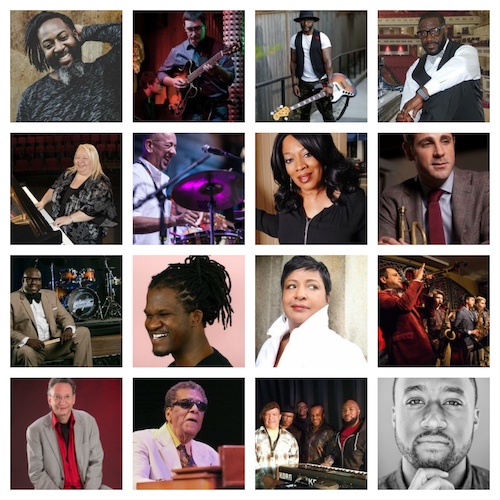
Of course, precautions around COVID-19 played a large part in how it all came together. “If we were going to try to honor our local musicians and our local scene, we needed to make something that would be as safe as possible,” director Terri Pontremoli said by Zoom.
During the month of July, one band per day recorded a short set inside the 600-seat Simon and Rose Mandel Theater on the eastern campus of Cuyahoga Community College. “Because we’re part of a big institution, the COVID safety guidelines were very serious, and the musicians felt really good,” Pontremoli said. “We got them in and out, and kept it all as clean as possible.”
Those sessions proved to be a powerful experience for everyone involved. “I have to tell you, it was so heartwarming to see the musicians play together, because it had been such a long time, and they were so grateful.” She recalled one message that bassist Kip Reed delivered backstage. “He said, ‘Playing means so much to me that I literally dream about it these days.’”
by Jarrett Hoffman
TODAY’S ALMANAC:

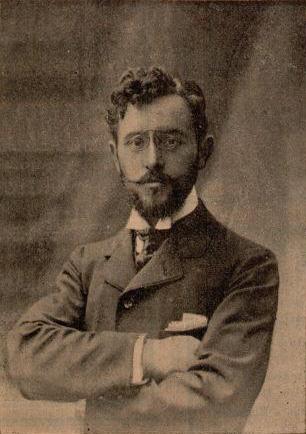
Gabel told me in an interview that the composer was once as famous as Debussy or Ravel. “Today I think we must rediscover Florent Schmitt because his music is truly genius. He was independent — his language sounds obviously French, but it’s completely different from Ravel or Debussy.”
Bringuier hears an interesting mix of influences in Schmitt’s music. In an interview with ClevelandClassical’s Mike Telin, he recalled his first encounter with La Tragédie de Salomé as a student during a musical analysis course.
“The teacher would spend part of each class playing a piece of music, and we had to figure out who the composer was. One day he played a piece that nobody knew. First we all thought that maybe it was Stravinsky. Then, because we didn’t know the full ballet of Ravel’s Daphnis, we thought it might be part of that because there are many similarities in the writing. That made sense because both Stravinsky and Ravel admired Schmitt.”
Still, as Gabel himself noted, the composer’s legacy is complicated. In an article for the New York Stage Review, Michael Feingold covers different instances of Schmitt’s Nazi sympathy, and relates it to more recent events.
And on this day in 1981, composer and arranger Robert Russell Bennett died in New York City, also at age 87. He’s best known for orchestrating a slew of high-profile musicals by composers like Irving Berlin, George Gershwin, and Richard Rodgers. [Read more…]
by Jarrett Hoffman
TODAY ON THE WEB AND AIRWAVES:

For another way to spend lunch, at 12:15 carillonneur George Leggiero plays a drive-in concert whose program spans from the 1770s to this very year, with a particular emphasis on the late 20th century. Healing Bells for Carillon, written by Pamela Ruiter-Feenstra and Jet Schouten, was premiered in May as a response to the pandemic. Another potentially healing work: Paul Simon’s Bridge Over Troubled Water. Also expect to hear music by Matthias Van den Gheyn, Jurriaan Andriessen, Ronald Barnes, and Wim Mennes. More info here.
And at 7:30 pm, the Met Opera continues to explore its HD archives with a performance from March 2008 of Wagner’s Tristan und Isolde, starring Deborah Voigt, Michelle DeYoung, Robert Dean Smith, and Matti Salminen, conducted by James Levine.
For details on catching all of these performances, head to our Concert Listings.
ON-DEMAND FROM THE CLEVELAND ORCHESTRA:
Principal horn Nathaniel Silberschlag performs Bernhard Krol’s prayerful Laudatio, and first associate concertmaster Peter Otto pays homage to the late Krzysztof Penderecki with “La Follia.” (Both are excellent, but Otto seems to only mildly impress his visible audience: his dog.)
TODAY’S ALMANAC:
On August 14, 1987, American composer Vincent Persichetti died in Philadelphia at age 72. He is known for a wide output that included nine symphonies, over a dozen keyboard sonatas, and many works for chorus and wind ensemble. One of the strongest aspects of his legacy is represented in those latter two genres, where his music often acts as an introduction for young people to classical music from the second half of the 20th century.
At least two of his works are known to have been premiered in Northeast Ohio: the Masquerade, Op. 102 (in a 1966 performance by the Baldwin Wallace Conservatory Band with Persichetti conducting), and the Second Harpsichord Sonata, Op. 146 (performed by Elaine Comparone in Cleveland in 1982).
Hear the Singing Men of Ohio present Persichetti’s Song of Peace in 2018 in Athens.
by Jarrett Hoffman
NEWS FROM THE CLEVELAND ORCHESTRA:

As the Orchestra’s president and CEO André Gremillet wrote by email on Wednesday, the newly designed season will occur in two phases: fall and winter-spring.
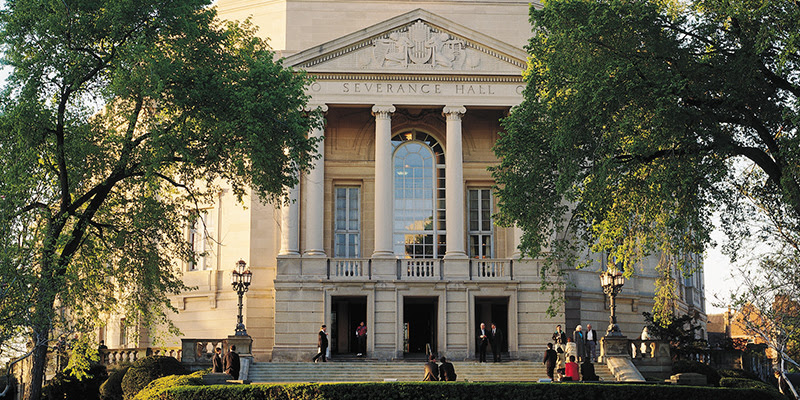
Fall concerts, beginning in October, will take place without audiences at Severance Hall. Five different concert programs will be recorded and digitally-streamed, free for subscribers and donors of $300 and more, and otherwise available for purchase. The musicians will be spaced apart onstage at Severance, performing chamber orchestra works by composers such as Mozart, Haydn, and John Adams — more details about repertoire, guest artists, and broadcasting to come in September.
There is optimism that the winter-spring schedule, starting in January of 2021, will allow for concerts at Severance to be attended in person, by subscribers only. That will begin with “socially-distanced audiences in limited numbers,” with the potential for larger audiences as safety guidelines permit. Meanwhile, the streaming of concerts will continue throughout the season.
Gremillet also offers a frank assessment of how COVID-19 is impacting The Cleveland Orchestra as an institution. “This is, without question, the most significant crisis in the Orchestra’s 100-plus year history.”
In a separate news release Wednesday, the Orchestra announced the cancellation of its 2021 Miami residency at the Adrienne Arsht Center for the Performing Arts of Miami-Dade County. The ensemble plans to return to Miami in January 2022.
TODAY ON THE WEB AND AIRWAVES:
At noon, have lunch with The Cleveland Orchestra over WCLV 104.9 Ideastream and on the web. Franz Welser-Möst leads the ensemble in two works by Beethoven: the Symphony No. 8, and the Adagio from Symphony No. 9.
Oberlin Stage Left honors the class of 2020 with a virtual performance of Julius Eastman’s Stay On It at 7:30 pm. Preceding that: a discussion on the making of the video — both “highs and lows” — and what the concept of ensemble means in 2020.
At 2:00 from New York City’s 92ndt Street Y, pianist Robert Levin plays popular works by Mozart in a way that promises to be particularly up that composer’s alley — with embellishments, flights of fancy, and improvisations on themes submitted by the audience.
Staying in New York for the evening, and moving to a more serious topic, Lincoln Center and WQXR present “Mostly Mozart: Black Experience in the Concert Hall” at 7:00. Host Terrance McKnight is joined by violinist Sanford Allen, vocalist Julia Bullock, tenor Lawrence Brownlee, cellist Alvin McCall, and vocalist Bobby McFerrin.
At 7:30, the Met Opera flips through its archives back to December 15, 1981 for a performance of Puccini’s Turandot, starring Nina Stemme, Anita Hartig, Marco Berti, and Alexander Tsymbalyuk, conducted by Paolo Carignani.
And moving up the coast to Maine, the Portland Chamber Music Festival presents “Songs & Stories” at 7:00, featuring baritone Thomas Meglioranza and pianist Shai Wosner in songs by Schubert.
For more details of these performances, check our Concert Listings.
TODAY’S ALMANAC:
by Jarrett Hoffman

by Jarrett Hoffman

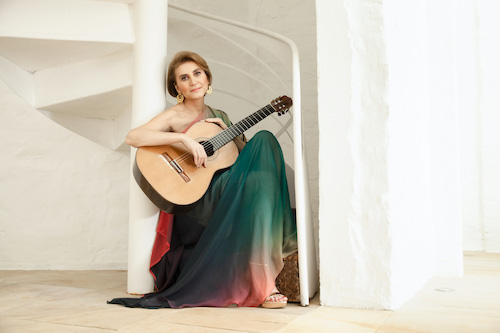
Now, Rojas and the Guitar Society have worked out an alternative. On Saturday, August 15 at 7:30 pm, she’ll give a free, pre-recorded online concert, broadcast on YouTube and entirely devoted to the music of Agustín Barrios Mangoré, a fellow Paraguayan who lived from 1885 to 1944.
That programming choice shouldn’t surprise anyone who was looking forward to her concert in March, which would have been all-Barrios during its second half. It also shouldn’t surprise anyone who’s followed Rojas’ career, from her 2008 album Intimate Barrios to her four-year tour, “In the Footsteps of Mangoré,” with clarinetist and saxophonist Paquito D’Rivera.