by Kevin McLaughlin

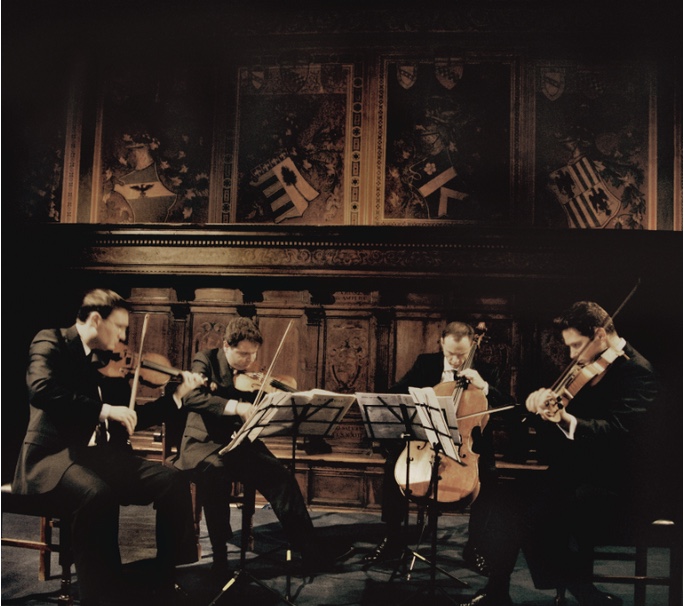
Founded in 2009, Omni Quartet members Amy Lee and Alicia Koelz (violins), Joanna Zakany (viola), and Tanya Ell (cello), all members of The Cleveland Orchestra, were convivial hosts, guiding the audience with verbal introductions to each work and brief excerpts by way of guideposts. While this can be overdone, here it was just enough to help the listener stay on the path. The commentaries and demonstrations worked out ahead of time were the most effective.
In her remarks about Haydn’s Quartet in F, Op. 77, No. 2, violinist Alicia Koelz emphasized the humor and elements of surprise present in the work. Sure enough, Haydn made us laugh, even when we knew the comedy was coming. Whether in the harmonic meanderings, the startling unison tremolo in the first movement, the rhythmic hijinks in the Minuet (a 2/4 march embedded in 3/4), or similar tugs of two against three in the final Vivace, the Omni told every joke with perfect timing and drollery. Koelz, playing first violin, amazed in the Rossini-like barnburner of a finale. Speed and rhythm were kept exact in both soft and loud passages. And is it possible that after the last chord I smelled smoke?
Violist Joanna Zakany’s introduction to Caroline Shaw’s Entr’acte (2011) included this composer note: “Entr’acte is an homage to the second movement (minuet) of Haydn’s Op. 77, No. 2, but in a kind of absurd, subtle, technicolor transition…[taking] you to the other side of Alice’s looking glass.”


Sometimes it can be easy to forget just how much classical music is loved worldwide. Thousands of miles away from the classical music strongholds in Europe and North America, musicians of all backgrounds compose and perform with passion — even at times in the face of difficult circumstances. But as Akron Symphony music director Christopher Wilkins reminded his audience on Saturday, this love is often unrequited, leaving works from places like the Middle East underrepresented on American stages.
There are few music directors who know Beethoven better than Herbert Blomstedt. Now 95 years old, the Swedish-American conductor has a lifetime of serious study and performing experience to draw on, but this isn’t to say his interpretations are set in stone.
Every once in a while, a concertgoer is treated to an evening where all of the hoped-for elements are in place: the playing is first-rate, the performers exude warmth and ease, the audience is engaged, the program is a mix of familiar and unusual — in other words, a concert with Carnegie Hall electricity but summer festival
Since it made its impressive debut in 2015, Scott MacPherson’s Cleveland Chamber Choir has enlivened the choral music scene in Northeast Ohio with superb performances of carefully curated, interestingly-themed programs that so far have added more than 32 new commissioned works to the repertoire.
Playing in an established chamber group is all about routine and slow, gradual progress. There’s something comforting about playing with the same people over and over again, familiarizing yourself with their style and quirks. But sometimes, temporary chamber groups — perhaps formed for one concert only — can inject some extra fun and excitement. On Sunday, February 19, two generations of musicians shared the stage at St. Wendelin Church as Arts Renaissance Tremont presented a program of Schumann and Brahms.
Soprano Jennifer Rowley and pianist Jason Aquila brought an unmistakable love for bel canto singing to Gamble Auditorium at Baldwin Wallace the evening of February 13. In a recital entitled “Inspirazione,” Rowley acknowledged her indebtedness to the mostly bel canto composers on the program and to the conductors and collaborators who have thus far aided her career. She hoped to repay the debt in kind to the excited BW voice students listening from the balcony.
The program synopsis of the new opera Alice Tierney — which received its world premiere performances on January 27 through 29 at Oberlin’s Finney Chapel (I attended on the 29th) — consists of one brief paragraph.
Cleveland has become something of a hotbed for chamber music, with a winter season sponsored by the Cleveland Chamber Music Society, two summer series curated by ChamberFest Cleveland and Encore Chamber Music Institute, and an orchestra famous for playing with the precision and nuance of a 90-piece string quartet.
On February 9, concertgoers approaching Severance Music Center likely noticed the dramatic lighting choices — the building had been lit up in a deep red. With Mahler’s Fifth Symphony on the program, it felt fitting. The composer’s intense and passionate works are popular with both musicians and audiences, and an unsurprisingly crowded house packed Mandel Concert Hall for the occasion. Not only was the music guaranteed to generate interest, but so was the conductor: young Finnish phenom Klaus Mäkelä, in his second consecutive week this season with The Cleveland Orchestra.