

by Daniel Hathaway

by Daniel Hathaway

by Daniel Hathaway

Credit Pablo Casals, who bought a second-hand score of the pieces in Barcelona in 1890 at the age of 13, and worked on them for a dozen years before daring to play them in public. He preserved his performances between 1936 and 1939 in a recording that the Library of Congress chose earlier this year for inclusion in the National Recording Registry.
Performances of the six suites have become something of an Everest for cellists. The Cleveland Orchestra’s Dane Johansen hiked the 600-mile Camino de Santiago in 2014, recording the suites in 36 churches along the pilgrimage route. More conventionally but no less impressively, Yo-Yo Ma played all six in one evening at Blossom in August of 2018.
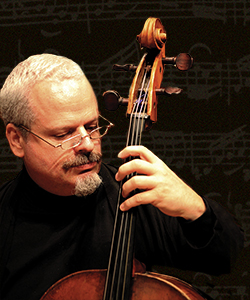
Now, Apollo’s Fire principal cello René Schiffer has decided to take the suites on, but in a different format and from a special point of view. He’ll perform and record them two at a time beginning this weekend. [Read more…]
by Daniel Hathaway

Probably more than a few audience members attending Apollo’s Fire’s “Echoes of Venice” performances this week were first introduced to Gabrieli’s opulent music through a famous old recording by organist E. Power Biggs, the Gregg Smith Singers, the Texas Boys Choir, and the Edward Tarr Brass Ensemble — who performed on modern trumpets and trombones.
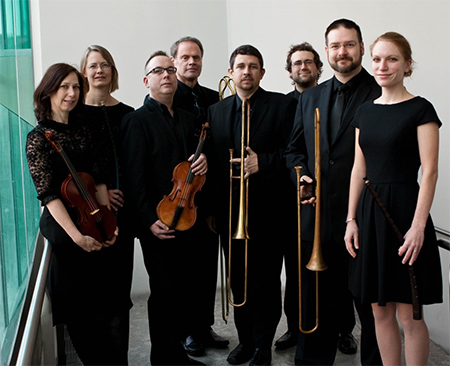
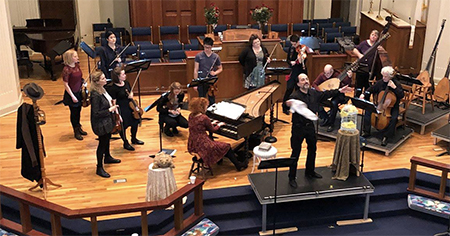
In four concerts this week, Apollo’s Fire and Apollo’s Singers will join the Dark Horse Consort, a Boston-based ensemble comprising period strings, cornetti, and sackbuts, to recreate the sounds that might actually have bounced back and forth under the seven domes of St. Mark’s in 1615. That was the year Gabrieli published his 14-part motet for three choirs, In Ecclesiis. [Read more…]
by Daniel Hathaway

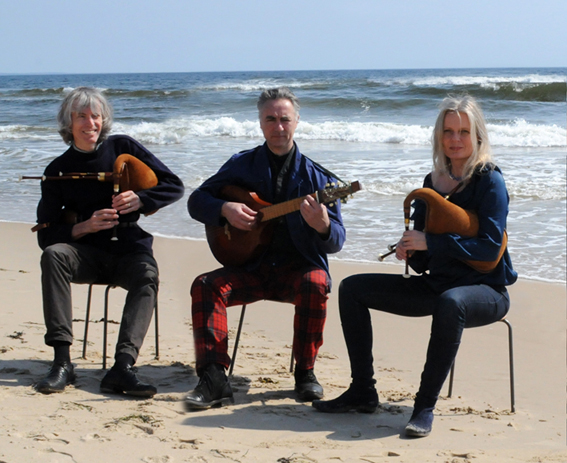
“Jeannette Sorrell is one of our greatest fans, and we’ve been trying to get this sort of thing together for six or seven years,” Harrison and Bänfer said in a tag-team Skype conversation from Freiburg, Germany. “Either we weren’t free or they weren’t free, or we couldn’t decide how to do it, but we’re very happy that it’s now working.” [Read more…]
by Daniel Hathaway

by Daniel Hathaway

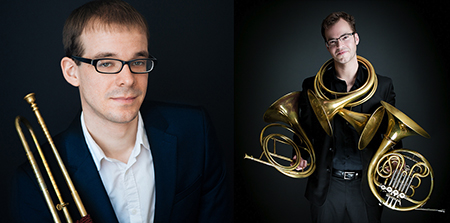
Marquardt and his colleagues Perry Sutton and Stanley Curtis will be doing a lot of trumpeting during the Mass. “The Bach is really quite demanding. We play in eleven of the 27 movements, compared to only five in Handel’s Messiah — and two of those are back to back, so it’s more like four,” he said in a telephone conversation.
Williams, on the other hand, will be making a true cameo appearance, playing only in the “Quoniam” of the “Gloria,” an unusual bass aria supported by solo horn and a pair of bassoons. “The ‘Quoniam’ is not as stratospheric as the trumpet parts, though it has its own challenges,” he said in a separate conversation. “You sit there for 45 minutes, then you have to play a very difficult and quite famous solo. It’s sort of a wild movement, with a mood change that’s a bit shocking after what came just before. [Read more…]
by Daniel Hathaway

“There are two or three changes this year. We’ve added a Thursday evening concert specifically to celebrate our new orchestra conductor, Soo Han. He’s just been here a year, but he’s making a big splash. He’s a wonderful musician, and the students love him.” That opening concert on Thursday, April 11 at 7:00 pm in Gamble Auditorium includes Leopold Stokowski’s arrangement of Bach’s Air on the G String from the third orchestral suite, Mozart’s Symphony No. 31 in D, and Christopher Theofanidis’ Rainbow Body.
“The Stokowski arrangement ties into what I think is so cool about this year’s Festival,” Garner said. “It shows the many faces of Bach in the 21st century. [Read more…]
by Timothy Robson

by Daniel Hathaway

The affliction that sidelined him for six months came as a complete surprise. After singing the ensemble’s Baroque Music Barn concerts last June, Strauss took to bed for a week with a fever that persisted, eventually sending him to his doctor in Chicago for tests. “A blood culture finally identified it as a serious but not that uncommon bacterial infection,” he said in a telephone conversation. After five days in hospital, Strauss was sent home with five weeks’ worth of intravenous antibiotics and an appointment with a cardiologist — the bacteria had damaged a valve in his heart that needed to be replaced.
“I had a wonderful surgeon,” Strauss said. “When he found out I was a singer, he immediately said, ‘I’ll tell the anesthesiologist to put a smaller tube down your windpipe.’ [Read more…]
by Daniel Hathaway