

The following is posted with the permission of ChamberFest Cleveland and the author.
By Donald Rosenberg
 What a difference a year can make. In 2022, we were still overwhelmed by the effects of the coronavirus pandemic, which had an impact on every phase of life. Arts organizations responded by programming with an ear toward symbolism, inclusivity, and hope. ChamberFest Cleveland was among the groups that reflected the times with a spectrum of enlightening repertoire if not solemn, then often serious in expression.
ChamberFest’s 2023 season has a markedly different thrust.
“We wanted this season to be lighter and more upbeat,” says co-director Diana Cohen. “Last year was the fog of Covid. There were a lot of dark pieces.”
The season’s theme began to come into focus after co-director Roman Rabinovich reread Milan Kundera’s The Unbearable Lightness of Being. The 1984 novel’s musings about the human condition and music, Rabinovich sensed, would be a big help in inspiring a compelling selection of works, which they clearly did, without rigidly dictating the season’s content. “We didn’t want it to be a literal translation in musical terms, but to give birth to the imagination,” Rabinovich says. “It gives us a frame. That’s what we’re after — that telescope to look through, a certain lens of ideas, and then we can be free with it.”
 ChamberFest Cleveland’s Season X — Roman numeral, not unknown quantity — got underway on Thursday, June 16 when a crowd of masked fans filled every seat in Mixon Hall at the Cleveland Institute of Music for “Exquisite Beginnings,” an opening salvo of works by Mozart/Grieg, George Walker, and Brahms.
 This essay was written as an overview of ChamberFest’s tenth season. It is reposted with the permission of the author and

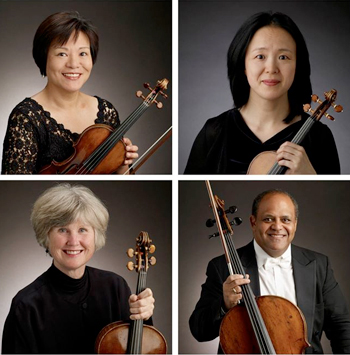 This month’s Arts Renaissance Tremont concert brought the Amici String Quartet to the auditorium of Pilgrim UCC Church on Sunday afternoon, February 15, for the second performance in the group’s complete cycle of Beethoven quartets. A quick calculation suggests that this project will play out over five or six seasons (16 quartets, average of three quartets per performance), depending on how the Große Fuge figures in.
 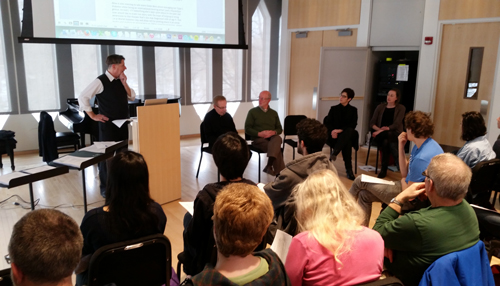 January has been all about chamber music at Oberlin. On Friday, January 23 in Stull Recital Hall, the school gave a taste of the media side of the field with the help of three Cleveland-based music critics, also Oberlin faculty members: Mike Telin and Daniel Hathaway serve as editors of ClevelandClassical.com, while Donald Rosenberg is editor of Early Music America magazine and former chief music critic at The Plain Dealer.
  Erich Wolfgang Korngold isn’t exactly a household name, but you’ve probably heard music by him or imitating him. Korngold, an Austrian composer active in the first half of the twentieth century, is best known in the US for his scores of such Hollywood films as The Adventures of Robin Hood and The Prince and the Pauper in the ‘30s and ‘40s. As the distinguished music journalist Donald Rosenberg said in a phone interview, “He really changed the whole trajectory of film scores by writing very lushly for the orchestra, using it almost as a character in the drama, and by writing scores that were essentially operatic, with themes for different characters.”
 On March 13, Early Music America, the advocacy organization for performers, scholars, students and audiences, announced the selection of Donald Rosenberg as the next editor of Early Music America magazine. Founded in 1985 and now based in Pittsburgh, Early Music America (EMA) provides its membership with publications, advocacy, and technical support, in addition to publishing the quarterly magazine. (The term “Early music” includes Western music from the Medieval, Renaissance, Baroque, and Classical periods, performed on period instruments in historically-informed styles.