by Daniel Hathaway

by Daniel Hathaway

by Nicholas Jones

by Daniel Hathaway
The word “Baroque” trips so easily off our modern tongues that we forget a few things about its origin. First of all, nobody in the seventeenth and eighteenth centuries thought they were writing “Baroque” music. Later critics used the term (which plausibly derives from the Portuguese word for “a pearl of irregular shape”) in a pejorative sense to describe art that was too ornate, busy or emotional.
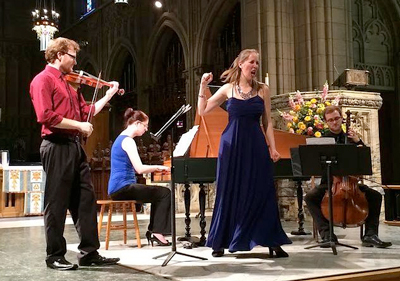
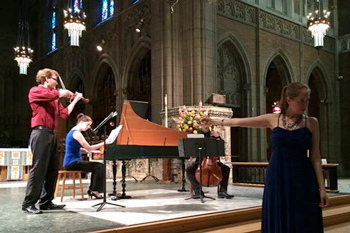
What we also forget is that the music and art of that period was meant to be inordinately decorative and hyper-expressive, pushing as it did against the cool, rational conventions of the Renaissance. To be reminded of those values, all you need to do is to check out a performance by the enterprising — and surprising — musicians of Burning River Baroque. [Read more…]
by Daniel Hathaway

“It’s about a broken-hearted shepherd who falls hopelessly in love with a nymph,” added Burning River Baroque soprano and executive director Malina Rauschenfels. “He takes himself way too seriously and writes his own epitaph on a tree.”
According to Lekx and Rauschenfels, who collaborate to plan BRB’s programs and finish each other’s sentences when they talk about that process, the rest of the program of Italian baroque cantatas and instrumental sonatas that the ensemble will perform three times this weekend began to fall neatly into place. “Giovanni Bononcini’s Alle sue pene intorno and Domenico Scarlatti’s No, non fuggire o Nice spoke to uswith their energy, and in the second case, with its Spanish flair. A very dramatic Porpora cello sonata and violin sonatas by Veracini and Scarlatti fill out the program.” [Read more…]
by J.D. Goddard

The program opened with Lenti at the organ performing the Prelude and Fugue in A minor, BWV 543. With confidence and agility, Lenti laid down an exacting performance filled with interpretive nuance and style befitting the brilliance of Bach’s compositional genius. Infused with rambling melismatic lines, the Prelude was straightforward yet exacting in articulateness. With sensitive control and solid bravura, Lenti discharged the difficult Fugue with poignant clarity and acute definition. It was a majestic and awe-inspiring opening for Bach’s birthday celebration 2014.
by Nicholas Jones

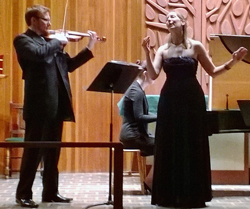
I heard Rauschenfels in the acoustically vibrant sanctuary of Lakewood Presbyterian Church, with Peter Lekx on baroque violin, David Ellis on gamba, and Paula Maust on harpsichord (a second performance was to be the next night at St. Alban’s in Cleveland Heights). The program was presented jointly by Burning River Baroque and by a group named hūmAnómali (the name was not explained in the otherwise very informative program materials). Rauschenfels has played beautifully on the baroque cello in previous Burning River concerts, but her decision to perform as a vocalist gives these programs an extra focus and intensity.
One of Purcell’s talents was to elevate relatively undistinguished poetry—by, for example, Nahum Tate, who is known mostly for giving Shakespeare’s King Lear a happy ending. Purcell’s daring song settings are astonishingly modern: he is the true precursor to Benjamin Britten, of whom we are hearing a great deal this centennial year. [Read more…]