by Neil McCalmont

by Neil McCalmont

by Neil McCalmont

by Daniel Hathaway

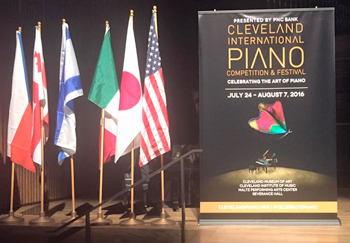
This year, the same has been true for the nearly 330 pianists, ages 18-30, who applied to compete in the 2016 Cleveland International Piano Competition, to be held from July 24 through August 7. Of those hopefuls, 35 recently received the “fat” letter inviting them to Cleveland — an acceptance rate of 10.6%, which is roughly equivalent to that of last year’s admissions to Dartmouth, Duke, or Vanderbilt.
The successful candidates emerged a few weeks ago after a marathon, three-day session of video viewing by a selection jury made up of Kathryn Brown and Paul Schenly (Cleveland Institute of Music), Lei Weng (University of Colorado), Caroline Oltmanns (Youngstown State University), and CIPC president and CEO Pierre van der Westhuizen. The 35 who were invited have now formally accepted. [Read more…]
by Daniel Hathaway

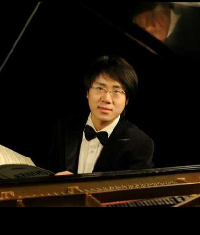
Ruoyu Huang (24, China, left) was first to perform on Tuesday afternoon, beginning with French music — two Debussy Preludes and Ravel’s La Valse — then went on to Schumann’s Davidsbündertänze and Balakirev’s Islamey. Debussy’s Minstrels and Ce qu’a vu le vent d’ouest presented Huang with the opportunity to paint two different impressionistic scenes that might have been even more vivid had he brought out color and rhythm in the first and played with more sweep and legato in the second. His gloriously virtuosic reading of La Valse was suitably decadent with dramatic ebb and flow and his Schumann visited every emotional level from the dreamy to the passionate. His pianissimo playing was lovely. Festive and characteristic, Huang’s performance of the Balakirev — an unabashed showpiece without a lot of musical content — was a flight of sheer pianism. [Read more…]
by Daniel Hathaway
Time for second impressions! Ryoyu Huang stepped up first in the second round with Haydn, Britten and the last half of Chopin’s Op. 28 Preludes (he had played the first dozen in the opening round). Huang’s breezy excursion through Haydn’s E Major sonata (Hob. XVI:31) didn’t leave him much room to sniff out details. He played with an agreeably hefty tone, and many of his lines had a good sense of direction. Britten composed his gloomy Notturno for just such a competition as this one (Leeds), giving pianists a catalogue of nuanced effects to tackle, and Huang did a fine job with that. The Chopin set was at times expressive, and at others could have benefited from a bit more emotion (No. 15).
Two Scarlatti sonatas in f minor (K. 387 and K. 519) allowed Pavel Yeletskly to vary his articulation in striking ways and make them into true piano pieces rather than just transcriptions from the harpsichord. [Read more…]
by Daniel Hathaway

26-year-old Wenbin Jin from China brought the two sides of Robert Schumann’s personality — the passionate represented by Florestan, the poetic by Eusebius — to life with an evocative performance of the Fantasiestücke, op. 12. His admirable playing (both poetic and passionate) was mitigated by his tendency to play repeated material in exactly the same way — lingering on the first notes of phrases, pausing before the last, applying rubato in identical spots — so that his expressiveness sounded formulaic rather than spontaneous. His grand conception of Ende vom Lied was appropriately valedictory. [Read more…]
by Daniel Hathaway

24-year old Ruoyu Huang from China was the lucky recipient of spot number one in the draw. He led off with nuanced performances of two Scarlatti sonatas (K. 45 and K. 17) that showed off his fleet passage work and clarity of touch. A Chopin set (the first 12 Preludes, Etude in e, op. 25/5 and Ballade in G, op. 23/1) had both fine and uneven moments. Some of the preludes fluctuated in tempo beyond an expressive rubato, and Chopin’s interesting harmonic progressions sometimes went unheralded. The Ballade, though exciting, became episodic and nearly Lisztian in scale. [Read more…]