


by Daniel Hathaway
 As busy as they are at Severance Hall, members of The Cleveland Orchestra still find time to form a number of chamber music ensembles to perform around the region. One of the newest groups is the Cleveland Wind Octet, who played their inaugural concert on the Rocky River Chamber Music Series last spring. They’ll play their second engagement on Friday, March 20 at 7:30 pm on the Chagrin Arts Series at Chagrin Falls Methodist Church (tickets available here.)
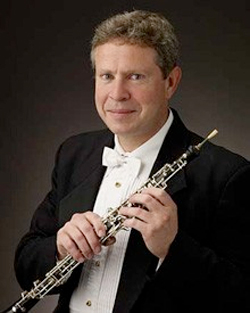
The Octet includes Cleveland Orchestra members Alan DeMattia & Richard King, horns, Daniel McKelway, clarinet, Jeffrey Rathbun, oboe, & Barrick Stees & Jonathan Sherwin, bassoons, together with friends Richard Hawkins (clarinet professor at Oberlin) and Michele Smith (who plays oboe in the Toledo Symphony.) The March 20 program will feature Rathbun’s Rocky River Music, in addition to Edvard Grieg’s Four Lyrical Pieces, arranged by the late Chicago Symphony bassoonist Willard Elliot, and Wolfgang Amadè Mozart’s Serenade in c, K. 388. [Read more…]
 On Friday, March 20 and Saturday, March 21at 7:30 pm,
 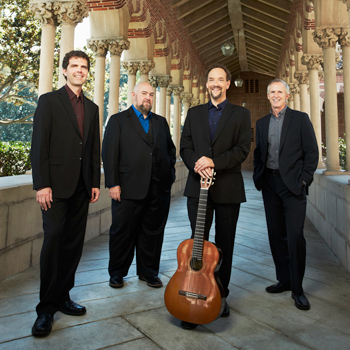 Launched more than thirty years ago, the Grammy Award-winning Los Angeles Guitar Quartet (LAGQ) plays everything from Bach to Bluegrass. But for their visit to the International Series of the Cleveland Classical Guitar Society, John Darman, Matthew Greif, William Kanengiser and Scott Tennant will concentrate on early Spanish music before moving on to modern pieces and Kanengiser’s arrangement of Manuel de Falla’s “El Amor Brujo.” The concert takes place on Saturday, March 21 at 7:30 at Plymouth Church in Shaker Heights.
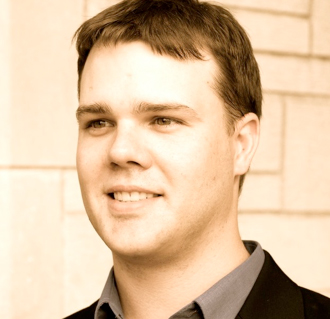 “I’ve always been fascinated by dance,” said composer Clint Needham. “In my pieces I think about motion and movement, even if it’s just the performer moving. Between the two of us — myself and the choreographer, Sara Whale — we’ve created something a lot bigger than we each imagined, which I think is a really cool thing. I’m so thrilled that with Verb Ballets we’ve been able to make these Imaginary Dances less imaginary and more tangible, so to speak.”
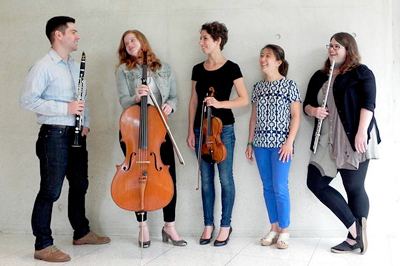 On Ars Futura’s upcoming program, one of the pieces, entitled Broccoli September, received its premiere last month, but Shuai Wang said she didn’t go — composer Jeremy Allen told her she wasn’t allowed. “The piece specifically instructs the performers not to talk or meet or practice together for it. So when we play it on the 23rd, it will be the first time for all of us. I love the concept of it because it’s all about trust. Our trusting Jeremy, his trusting us, our trusting each other as performers, and trusting the audience as listeners.”
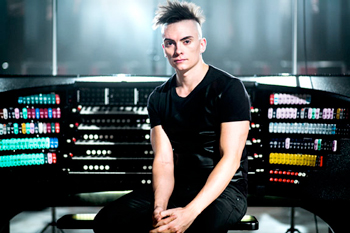 The brilliant and iconoclastic organist Cameron Carpenter performed at E.J. Thomas Hall in Akron on Friday evening. It was his first local concert using his self-designed digital instrument known as the International Touring Organ, built by Marshall and Ogletree of Needham, Massachusetts. The builders digitally sampled and stored sounds from a variety of pipe organs that are then reproduced on an array of speakers. At E.J. Thomas Hall, the speakers occupied most of the stage.
  Themed symphony orchestra programs — often cooked up by marketing departments — can be gimmicky. But Akron Symphony music director Christopher Wilkins’s “Four Rivers” program at E.J. Thomas Hall on Saturday, March 14 took three European rivers and one American one that lives only in the realm of metaphor, and made them tributaries that flowed beautifully together into a larger stream.
 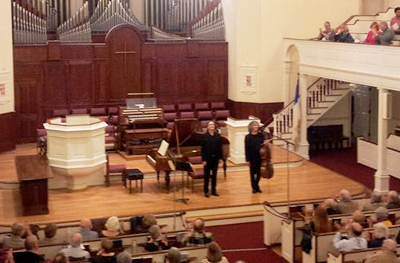 Those who thought they knew the Beethoven cello sonatas probably had to think again after last Tuesday’s recital by Steven Isserlis and Robert Levin on the Cleveland Chamber Music Society series at Plymouth Church in Shaker Heights. Over the last decade, the two performers have turned these pieces inside out and explored every crevice in their musical narrative. Heard in a performance like that on Tuesday evening, the results of that joint inquiry are a revelation.
 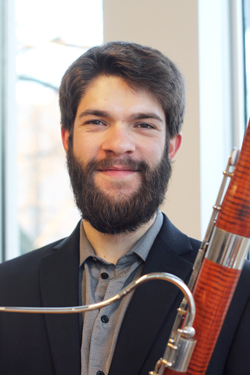 A gripping bassoon concerto from 1975, the world premiere of a cantata on a chilling subject, and a Buddist-inspired essay in instrumental colors written in 1997 provided Timothy Weiss and his Oberlin Contemporary Music Ensemble with plenty of opportunities to shine on Saturday afternoon, March 7, when they presented their fourth concert of the season in Gartner Auditorium at the Cleveland Museum of Art.
 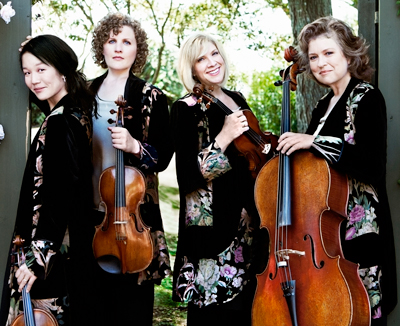 The Cavani Quartet isn’t easing up after thirty years as an ensemble. Its faculty recital on Wednesday evening, March 4 in Kulas Hall at the Cleveland Institute of Music with guest musicians Donald Weilerstein and Vivian Hornik Weilerstein featured exciting and disciplined performances of two very different Shostakovich works, followed by an exuberant reading of a Mendelssohn quartet.