

by Daniel Hathaway
 Now that winter has finally arrived and the excitement of the holidays has subsided, it’s tempting to burrow in and hibernate for a few weeks. But there’s plenty to do during January. Let’s have a look at some of what the month has to offer, beginning with orchestra concerts.
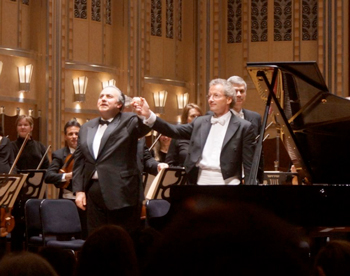
Franz Welser-Möst and The Cleveland Orchestra are back at work early in the month with a round of all-Beethoven concerts from January 7-9 featuring pianist Yefim Bronfman (left) in the third piano concerto, and Bronfman and the Cleveland Orchestra Chorus in the Choral Fantasy. Soprano Barbara Hannigan will be featured in the U.S. premiere of Hans Abrahamsen’s let me tell you on January 14 and 15, sharing a program with Dmitri Shostakovich’s fourth symphony. On Saturday the 16th, Robert Porco will lead the annual Martin Luther King Jr Celebration, followed by a Severance Hall Open House on Monday the 17th from 12 Noon to 5 pm. Community ensemble performances will be bracketed by the Cleveland Orchestra Youth Chorus (12:30) and Youth Orchestra (4:15). The Cleveland Philharmonic will host its own MLK Observance at Tri-C Metro Auditorium on Sunday, January 17. [Read more…]
 The truism holds that French aristocrats before the Revolution danced time away in utter complacency, refusing to change in the face of the inevitable. The image is probably true with respect to most things that would have mattered to those who stormed the Bastille. But in the world of music, things were changing decades before the Revolution. Writing within a framework of courtly elegance that would have pleased Marie Antoinette, composers were also pushing the boundaries of their music with wit, irony, turmoil, and glimmers of Romantic self-consciousness.
 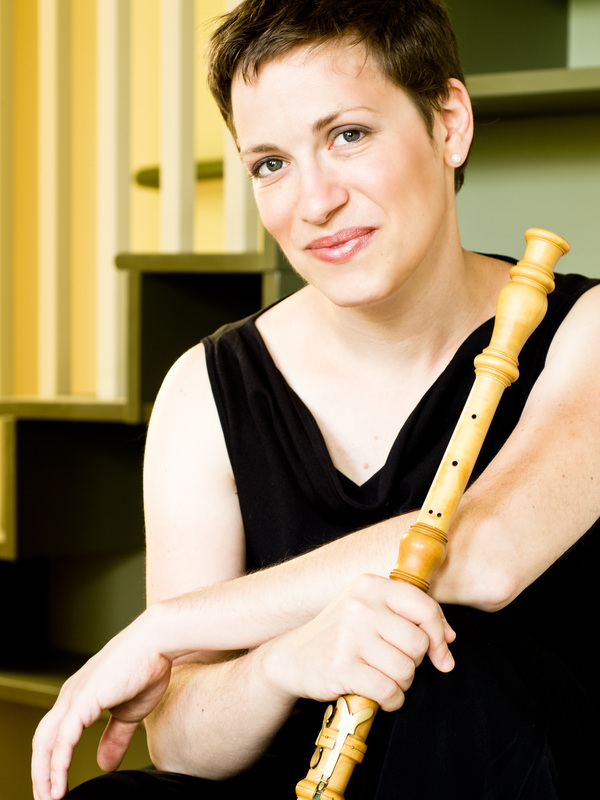 The mid-1700s was a time when French aristocrats viewed leisure as an occupation, furnishing extravagant houses with the latest trends in art and design. They also perused their fancies as patrons of the arts.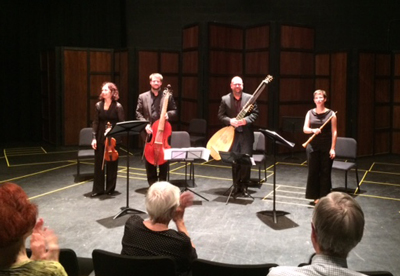
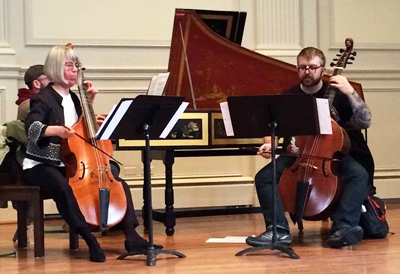 The provocative title of Les Délices’ final program of the season alludes to two composers of the seventeenth-century: the “angelic” Marin Marais (read: pleasant and generous) and the “diabolical” Antoine Forqueray (read: self-centered and cantankerous). With all their differences, the angel and the devil can be strangely allied: both men were virtuosos on, and champions of the seven-string viol, the richly expressive bass instrument that characterizes much of early French baroque music.
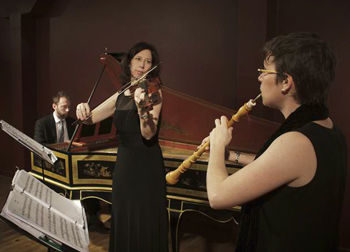
 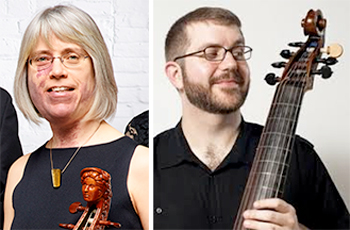 This week Les Délices, Cleveland’s French baroque music specialists, will present “The Angel and the Devil.” The program showcases music by the most famous pair of viola da gamba players of the eighteenth century, Marin Marais and Antoine Forqueray. Referred to respectively as The Angel and The Devil, their musical personalities will be brought to life by two modern-day gambists, Josh Lee and Emily Walhout. Oboists and recorder players Debra Nagy and Kathryn Montoya, baroque violinists Scott Metcalfe and Ingrid Matthews will join harpsichordist Michael Sponseller and the dueling gambists in music by Jean-Féry Rebel, François Couperin and Marc-Antoine Charpentier.
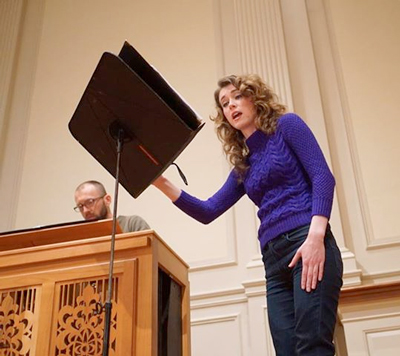 Now that the sun is finally beginning to melt some of Cleveland’s snow piles, the Cleveland-based band Les Délices reminds us of the wintry darkness from which we earnestly hope soon to emerge. In a departure from their usual repertoire — the secular music of the French baroque — the group served up a rich and satisfying feast of Lenten fare, a concert of sacred music for the Christian season of penitence and reflection. (This concert repeats on Saturday, March 7, at St. Peter’s Church, Cleveland (7:30 pm) and Sunday, March 8, at Plymouth Church UCC, Shaker Heights (4:00 pm).
 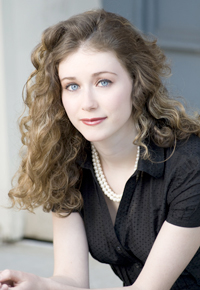 This weekend, Les Délices will present “Cantiques Spirituels — Music for Lent,” a concert that straddles the worlds of private devotion and the public sphere. “What I think is wonderful about this program is the interesting juxtaposition of the texts with the music,” guest soprano Nola Richardson said during a recent telephone conversation. “The texts are quite somber, but the music of Couperin and Charpentier is so elaborate and beautiful.”
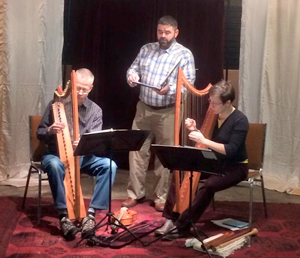 The fourteenth century was a strange time in the history of Europe, as those who have read Barbara W. Tuchman’s 1978 book, A Distant Mirror, already know. Amid all its tumult, that period also became a fertile era for musical experimentation, a subject Les Délices explored in two concerts last weekend presented in collaboration with the Boston ensemble Blue Heron.