by Daniel Hathaway

by Daniel Hathaway

by Daniel Hautzinger

by Daniel Hathaway
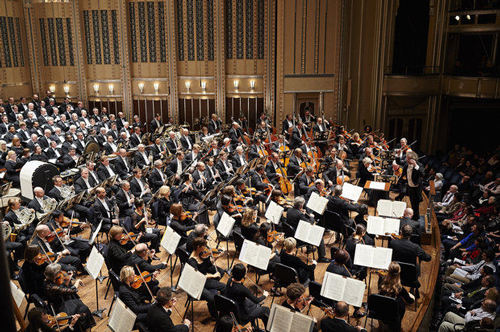
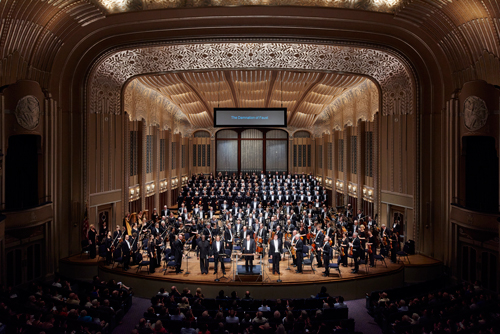
Pierre Boulez first treated Cleveland Orchestra audiences to Maurice Ravel’s complete ballet music for Daphnis et Chloé in 1970. As part of the orchestra’s 90th birthday tribute to the French composer and conductor who has maintained a long-term relationship with the ensemble, Franz Welser-Möst revisited Ravel’s wonderful score on Thursday evening for the first of three concerts in Severance Hall. Though — as the song goes — the weather outside was frightful, The Cleveland Orchestra and Chorus lit a delightful indoor fire full of sensual warmth and ecstasy. [Read more…]
by Daniel Hathaway
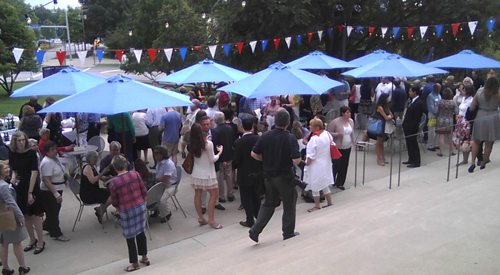
The Cleveland Orchestra’s new concert series, Summers@Severance, offers a one-hour-or-so performance by the orchestra on three Friday evenings at 7:00 pm, bracketed by a party with drinks and small plates served on the Front Terrace. The concept seems to have caught on quickly, and judging from the number of audience members snapping cell phone pictures of the Severance Hall interior, brought many first-time listeners to hear the Orchestra on opening night, August 1. [Read more…]
by Mike Telin

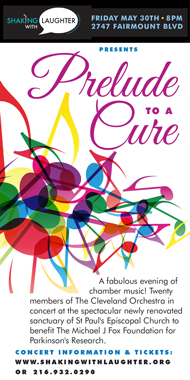
Among the works to be performed are J.S. Bach’s Sonata in e minor for Oboe D’amore and Harpsichord, Beethoven’s String Quartet op. 135, Mozart’s Oboe Quartet, Ravel’s Adagio from Piano Concerto in G, Thea Musgrave’s Impromptu no. 1 for Flute and Oboe, Bernard Garfield’s Quartet for Bassoon and Strings, and the world premiere of Jeffrey Rathbun’s Voyage for English Horn and Strings.
Shaking With Laughter was founded by Cleveland obstetrician and gynecologist Karen Jaffe and her husband Marc, a comedian and writer, after she was diagnosed with Parkinson’s Disease, a chronic, degenerative neurological disorder. The foundation presents humor-related events that have already raised over $460,000 for the Michael J. Fox Foundation for Parkinson’s Research. [Read more…]
by Daniel Hathaway

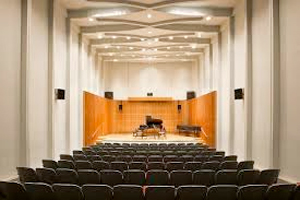
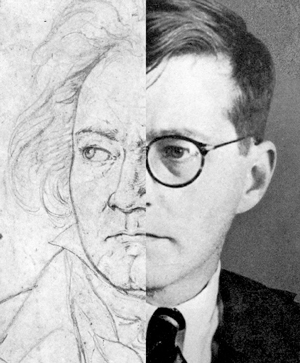
In a pre-concert chat in Reinberger Chamber Music Hall with director of artistic planning Mark Williams, Welser-Möst noted that he had been looking for a new way to program a Vienna Musikverein Beethoven cycle and credited the Takács Quartet with the idea of pairing Beethoven and Shostakovich on the same program. (The orchestra will repeat this three-concert cycle in the Austrian capital from November 20-22.)
Whether you care to go deeply into the philosophical and political similarities and contrasts between the two composers, as Welser-Möst did in his program book essay, or simply enjoy hearing a pair of their symphonies in close succession, there was a lot to stimulate the mind and the ear last weekend. Thursday evening’s short performance coupled Beethoven’s third symphony with Shostakovich’s sixth — each written during the composers’ thirty-third year. [Read more…]
by Daniel Hathaway

Although it goes by the name of Symphony No. 60, Haydn’s six-movement work is really a suite recycled from the incidental music to Die Zerstreute, the German reworking of a comedy by Jean-François Regnard staged at the Esterházy Court. The plot concerns an unfocused daydreamer, Leander, who is pushed into a romance with Isabelle by her Parisian mother — but, of course, Isabelle has her eyes on someone else.
You can count on Haydn to be witty, but Il distratto finds him reveling both in sophisticated humor and low-hanging jokes (e.g. subtle musical references to Leander’s distractedness, and a sudden, noisy tuning session by the violins in the finale that had the audience giggling.) [Read more…]
by Daniel Hathaway

Conducting with his bare hands, Sinaisky, who is music director of Moscow’s Bolshoi Theatre, painted perfect little scenes for each of Anatoly Liadov’s Eight Russian Folk Songs to open the program. English horn and bassoon solos (Robert Walters and Barrick Stees) set a solemn mood for the “Religious Chant,” an affect that first assistant principal cellist Richard Weiss recaptured later in the “Plaintive Song.” “Dance of the Gnat” created a buzz both in the strings and an amused audience. Mary Kay Fink’s piccolo soared out over pizzicato strings in the “Round Dance,” and a vivacious orchestral tutti brought the set of tiny pieces to a celebratory ending in the “Village Dance Song.” [Read more…]
by Mike Telin

The concert also includes two Cleveland Orchestra firsts, a performance of J.S. Bach’s Concerto in A major, BWV 1055 for oboe d’amore and orchestra featuring Cleveland Orchestra English horn player Robert Walters. The concerts also mark the first time that any oboe d’amore concerto has been performed by the orchestra. [Read more…]
by Brittany Brahn
Brittany Brahn is an Oberlin student who participated in the Winter Term course in Digital Musical Journalism co-sponsored by ClevelandClassical.

The Cleveland Orchestra’s latest return to Oberlin was on the evening of Friday, February 25th in Finney Chapel under the direction of Russian conductor Andrey Boreyko. The program, Boreyko’s debut with the Cleveland Orchestra, showcased a refreshing array of Eastern European works that complemented each other well, including Stravinsky’s Divertimento from the ballet Le Baiser de la fée, Peteris Vasks’s English horn Concerto, and Prokofiev’s Symphony No. 5 in B-flat Major. The sweetness of the Divertimento provided an enjoyable juxtaposition to the full-bodied, fiery drama of the Symphony.
Vasks is a Latvian composer who is less familiar to Western audiences than Stravinsky or Prokofiev, yet his English horn concerto proved to be an ambitious and highly successful addition to the repertoire. By the time Vasks had written the piece in 1989, he had spent the majority of his compositional life overshadowed by the rigid policies of the Soviet Union. Two years prior to Latvia’s independence, the English horn concerto was commissioned by the American musician Thomas Stacy and the Stamford Chamber Orchestra. [Read more…]