
by Cait Winston

Pianist Shuai Wang began the program with Debussy’s “Arabesque No. 1” (from Deux Arabesques) and Jardins sous la pluie (“Gardens in the Rain”), capturing a mood inspired by nature with a hint of the ethereal. [Read more…]
by Cait Winston

Pianist Shuai Wang began the program with Debussy’s “Arabesque No. 1” (from Deux Arabesques) and Jardins sous la pluie (“Gardens in the Rain”), capturing a mood inspired by nature with a hint of the ethereal. [Read more…]
by Daniel Hathaway

Composer Hale Smith was born in Cleveland on this date in 1929. A precocious musician whose talents were recognized early on by Duke Ellington, after service in the U.S. Army, he earned bachelor’s and master’s degrees from the Cleveland Institute of Music in 1950 and 1952. Smith went on to enjoy a widely varied career in New York, where he moved easily between classical styles (including serial music), and jazz. He died in New York in 2009 at the age of 84.
As Dennis Dooley wrote when Smith won the Cleveland Arts Prize for Music in 1973,
His prolific output includes everything from TV advertising jingles to incidental music for stage productions of Lysistrata and Lorca’s Blood Wedding. His “Castle House Rag” was used in the documentary The Making of Citizen Kane. Smith has, nevertheless, always found time to lend his prodigious energies to such important undertakings as the Detroit Symphony’s annual Symposium on Black American Composers. He gladly served as an advisor to the Chicago-based Center for Black Music Research, but “bristled at the designation [Black composer],” The New York Times noted in its lengthy obituary, “He wanted his work, and that of his black peers, to appear on programs with that of Beethoven, Mozart and Copland” and to be judged simply as music.
A list of Hale Smith’s works (click the link to “Hale’s Music”) suggests that Cleveland should rediscover one of its hometown composers. Sample some of his music here,.
Among the better-served composers born on this date are Leroy Anderson (1908, beloved Boston creator of light classical music), Frank Loesser (1910, Broadway tunesmith), and Bernard Herrmann (1911, popularly known for his collaborations with Alfred Hitchcock, but a fine composer in his own right).
On June 29, 1934, radio station W2XR, a “noncommercial high fidelity experiment,” began broadcasting in New York City, soon to become WQXR when it was granted a commercial license in 1936. Always at the forefront of experimental broadcasting, in 1952, the station devised a way to broadcast in stereo, using two microphones placed six feet apart. Listeners could enjoy the stereo effect by similarly positioning two radios, one tuned to the station’s AM feed, the other to its FM feed.
And on this date in 1941, Polish piano virtuoso Ignacy Jan Paderewski died in New York at the age of 80. Also a diplomat and statesman, the pianist had served as the newly independent Poland’s prime minister and foreign minister in 1919 when he participated in the signing of the Treaty of Versailles that ended World War I.
Paderewski’s dual career led to a curious situation after his demise in a New York hotel room while on a concert tour. Because of his diplomatic service and the exigencies of the Second World War, President Roosevelt granted permission for his body to be temporarily laid to rest in Arlington National Cemetery. But there it stayed in the vault of the U.S.S. Maine Mast Memorial until the fall of communism in 1992 when his remains were transferred to Warsaw Cathedral. With the exception of his heart, which is preserved in a bronze sculpture in the National Shrine of Our Lady of Czestochowa near Doylestown, Pennsylvania. Read about that strange saga in detail here.
by Mike Telin
by Mike Telin

“The program is titled ‘An American Celebration,’ and while I’m certain there have been countless Fourth of July concerts over the decades with the same name, for me, this program feels truly American,”Mitchell said during a telephone conversation. “We’re certainly not going to ignore the holiday, so there will be the pieces that are associated with it — the 1812 Overture and Stars and Stripes Forever — but there was a desire to have the program be reflective of times that we are living in and that we have lived through since the Orchestra and audiences were last together.”
The playlist will also include Leonard Bernstein’s “Overture” to Candide, Mary D. Watkins’ Soul of Remembrance, Florence Price’s Concerto in One Movement with pianist Michelle Cann, Adolphus Hailstork’s An American Fanfare, and Aaron Copland’s “Suite” from Appalachian Spring. Tickets are available online. [Read more…]
by Jarrett Hoffman
FREDERIC RZEWSKI, 83:
American composer and pianist Frederic Rzewski passed away at the age of 83 on Saturday after suffering cardiac arrest. Political themes have been at the center of much of his stylistically varied music, including his well-known set of piano variations The People United Will Never Be Defeated!, considered a classic of the modern era.
ClevelandClassical.com’s Daniel Hathaway had a fascinating interview with Rzewski in 2010, discussing his path to new music and improvisation, and more. Read that here, and read William Robin’s obituary in The New York Times here.
RE:SOUND PLAYLIST:
The Re:Sound New Music Festival continues through this Wednesday, June 30. Register if you haven’t already, then check out the final weekly playlist, “Persistence.”
GUITAR SOCIETY:
The latest video in the Creative Fusion series from the Cleveland Classical Guitar Society, in collaboration with the Mexican Committee of Cleveland, brings us Hermelindo Ruiz’s To Soar Beyond for guitar and string quintet. It’s inspired by the Puerto Rican genre of danza, and “reflects the composer’s thoughts on how music can provide solace in difficult times…” Hermelindo is joined by five Cleveland Orchestra musicians. Watch here.
TODAY’S ALMANAC:
Look past the long series of discarded marriages — more than one ending with a beheading — and you might find interest in the musical side of Henry VIII (born on this date in 1491). BBC Music Magazine explored his impact on the music scene (both harm and help), and his own musical contributions in an article from 2016.
Another historical figure who had a keen interest in music, but who is more famous for his contributions to other disciplines, is Jean-Jacques Rousseau (born today in 1712). That writer and philosopher was also a composer, with seven operas to his name, including the one-act Village Soothsayer. Watch a 38-minute video production dating from 1962, featuring the Orchestre de la Suisse Romande, led by Samuel Baud-Bovy.
Rousseau was also a music theorist, developing a system of musical notation that would be compatible with typography: it would use a single line, with numbers expressing different intervals, and periods and commas indicating rhythm. He presented it to the Academie Des Sciences and was rejected, though they seem to have been impressed, and even requested that he have another go at it.
Moving onto names most famous for their music-making, we continue with Hungarian violinist, composer, and conductor Joseph Joachim, born on this date in 1831. One of the great violinists of the 19th century, he was a close collaborator of Brahms, premiering the composer’s Violin Concerto in 1879 with Brahms himself on the podium. Even much earlier, at age 13, his performance of Beethoven’s Violin Concerto (with Felix Mendelssohn conducting) helped bring that work into greater esteem.
In 1903, Joachim became one of the earliest violinists to be recorded: hear him in fuzzy but fascinating renditions of Brahms’ Hungarian Dances Nos. 1 and 2.
And finally, composer Richard Rodgers was born on this date in 1902 in New York City. He’s most famous for his work in musical theater, particularly in collaboration with Lorenz Hart and Oscar Hammerstein II — the latter partnership became the most successful in the history of American musical theater.
And though the EGOT was not such a historic concept at the time, Grammy Awards still being in their infancy, Rodgers became the first person to ever receive Emmy, Grammy, Oscar, and Tony Awards. (He also received a Pulitzer — only he and Marvin Hamlisch have ever taken in all five awards.)
The Sound of Music — the last musical by Rodgers and Hammerstein together — not only won five Tonys, but its film version won five Oscars. Watch a clip from the movie, where Julie Andrews memorably sings the title track.
by Daniel Hathaway

On Saturday evening, ChamberFest Cleveland ends its season with a Festival Finale at St. Pascal Baylon Church in Highland Heights. The ticketed event includes a champagne toast. On Sunday, organist Karel Paukert plays Music from Prague at St. Paul’s in Cleveland Heights, and members of the Akron Symphony perform at the Bridgestone Senior Players Championship.
ONLINE EVENTS:
On Saturday and Sunday, Local 4 Music Fund continues its three-part series “She Scores,” and on Saturday, Burning River Baroque presents a one-time only, climate-based program, “Elements Worth Fighting For.” Details in our Concert Listings.
NEWS BRIEF:
Earlier this week, fire destroyed the Dobson Pipe Organ Builders Ltd. workshop in Lake City, Iowa, including an instrument being built for an Anglican Church in Australia. The firm, founded by Lynn A. Dobson, has built distinguished instruments for such venues as Verizon Hall in Philadelphia, and St. Thomas Church Fifth Avenue in New York. Read a New York Times story here.
INTERESTING READ:
This week, British oboist Nicholas Daniel will premiere one of the late John Tavener’s last works, eight years after the composer’s death. He explains the delay in a Guardian article, and writes about the complex web that frustrates musical creativity in the U.K.
THIS WEEKEND’S ALMANAC
On June 26, we note the birth of American pianist and conductor Antonia Brico in 1902 in Rotterdam, the Netherlands, and the death of Dutch composer Henk Badings in Maarheeze, a well as the birth of Finnish composer Magnus Lindberg in Helsinki in 1958.
On June 27 in music history, French composer and claveciniste Elizabeth-Claude Jacquet de La Guerre died in Paris in 1729, and several 20th century composers were born: George T. Walker (1922, in Washington D.C.), Jack Gallagher (1947, in New York), Daniel Asia (1953, in Seattle), and Magnus Lindberg (1958 in Helsinki).
We wrote in some detail about Jacquet de la Guerre, Walker, Gallagher, and Asia in the Diary for June 27, 2020, so today we’ll throw a bit of light on the more obscure composers.
Born to a Dutch single mother, Brico emigrated to California with her foster parents in 1908, where she studied at Berkeley and worked as assistant to the director of San Francisco Opera. She returned to Europe for conducting studies in Berlin and made her debut with the Berlin Philharmonic in 1930. Back in the States, she was the first woman to conduct the New York Philharmonic, and after settling in Denver, became conductor of what was eventually named the Denver Philharmonic.
Brico’s life and career are dramatized in the Shooting Star Filmcompany’s The Conductor. Watch a trailer here (the R-rated full-length film can be rented on YouTube). There are also some poor-quality documentaries about the conductor, but you can listen here to her interview with Northwest Public Radio.
Like a number of his fellow Netherlanders, Henk Badings was born in Indonesia during the Dutch colonial period, but was orphaned early on and returned to the Netherlands to study mining and palaeontology in Delft and worked as a mining engineer before turning to a career in music. His fifteen numbered symphonies and other orchestral works were championed by such conductors as van Beinum and Mengelberg, and his catalogue of 1,000 works includes various experimental pieces.
For a taste of Badings’ music, listen to his 1954 symphony Louisville, dedicated to the Louisville Orchestra and performed by the Janacek Philharmonic under David Porcelijn.
Not that Magnus Lindberg is all that obscure, having served as composer in residence with the New York Philharmonic at the invitation of incoming music director Alan Gilbert, and having commissioned works performed by The Cleveland Orchestra, but his larger works haven’t been heard locally for several years now. The composer has passed through various stylistic episodes, with side excursions into Japanese drumming and German punk rock. One of his works that has gained popularity is his Clarinet Concerto, performed here by Emil Jonason at Concertgebouw Brugge.
by Stephanie Manning

As for where Asher sees herself on the spectrum of determinacy, she said the answer is somewhere in the middle. “I have a practice of developing ideas, either with certain techniques or certain sound worlds, and then picking a few of those to ruminate on during improvisation.” This approach makes for a mixture of planned and spontaneous elements, allowing her to both make decisions beforehand and create form in the moment.
by Jarrett Hoffman

The centerpiece of Davin’s program was Leo Brouwer’s Sonata No. 2 for guitar, also known as Sonata del Caminante or “The Wanderer’s Sonata.” Not only does it explore different regions of Brazil, but it also shifts in style frequently, moving among spare beauty, a violent and extended tonality, and bluesy reflectiveness — together, a fascinating world of sound.
by Stephanie Manning

by Jarrett Hoffman

“I’d never heard of the piece, and I hardly knew her,” Cann said during a recent telephone conversation. “I thought, I’m not going to just agree to this — I need to see the music.” She remembers when the orchestra sent it to her like it was yesterday. “I sight-read through it, called my friend, and said, ‘This piece is amazing.’ I was like, wait a second — how is it so good, and no one’s ever played it, at least recently?”
After giving the New York premiere five years ago with Dream Unfinished, and debuting it with The Philadelphia Orchestra earlier this year, Cann will play Price’s Concerto in One Movement with The Cleveland Orchestra and conductor Brett Mitchell on Saturday and Sunday, July 3-4 at 8:00 pm at Blossom Music Center.
The program, “An American Celebration,” also includes works by Bernstein, Watkins, Hailstork, Copland, Tchaikovsky, and Sousa, and will open the Orchestra’s Blossom season. Tickets and more information are available here.
by Jarrett Hoffman
TODAY ONLINE:
At 8:00 pm, WCLV’s “Ovations” will feature the Cleveland Chamber Choir in a rebroadcast of the ensemble’s “Madrigals of All Seasons” concert from May and selections from their recent CD, I Sing to Use the Waiting.
More details about that and many other events from around the globe can be found in our Concert Listings.
NEW SEASON FROM LD:
Les Délices has announced its 2021-22 Concert Series, Until Sky Above. Of the five programs, the first three will be available exclusively in the virtual realm — on the streaming service Marquee TV — while the final two will receive in-person performances followed by virtual releases. Plus, the SalonEra series will continue with twelve episodes (details coming later this summer).
Subscriptions will go on sale here starting August 15. Single tickets for all virtual concerts will be available via Marquee TV, while single tickets for local, live performances in February and April 2022 will go on sale in the fall.
Click here for dates and details about the Concert Series, from “Song of Orpheus” (music by Rameau, Courbois, and a new work by Jonathan Woody) to “Winds of Change” (music from the Revolutionary Age and a new work by Sydney Guillaume), “The Highland Lassie” (music from 18th-century Scotland), “Of Gods & Heroes” (Medieval song), and “The White Cat” (a fairytale Baroque opera pastiche).
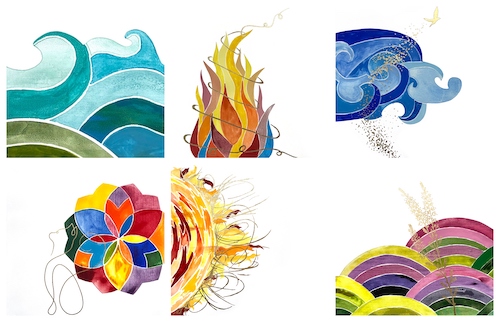
Curious about the beautiful images above? They’re silkscreen monoprints that Les Délices commissioned from Cleveland-based artist Jen Craun to capture the series’ overarching theme (top left) and each successive program (continuing clockwise).
CCGS CREATIVE FUSION:
Over 100 people from Cleveland and Mexico participated in the next video in the Cleveland Classical Guitar Society’s Creative Fusion series: Anastasia Sonaranda’s arrangement of the traditional Mexican song La Llorana. The arrangement includes original poetry by Irma Pineda Santiago written in the indigenous Zapoteco language, recited by the poet and sung by Martha Toledo Mar. Watch here.
TODAY’S ALMANAC:
A quartet of Ohioans and a premiere in Cleveland provide a fitting place to begin on this date in music history.
Those four musicians are all blowing out candles. The first two, both conductors, do so from the grave: John Finley Williamson (born in Canton in 1887), who founded the Westminster Choir School, and James Levine (Cincinnati, 1943), who served as longtime music director of the Metropolitan Opera until being terminated over sexual misconduct allegations.
The other two are both vocalists with operatic credits at renowned stages worldwide, and are still with us: Heldentenor William Cochran (Columbus, 1943) and two-time Grammy-winning soprano Sylvia McNair (Mansfield, 1956), who it should be noted has also successfully transitioned into Broadway and jazz over the past twenty years.
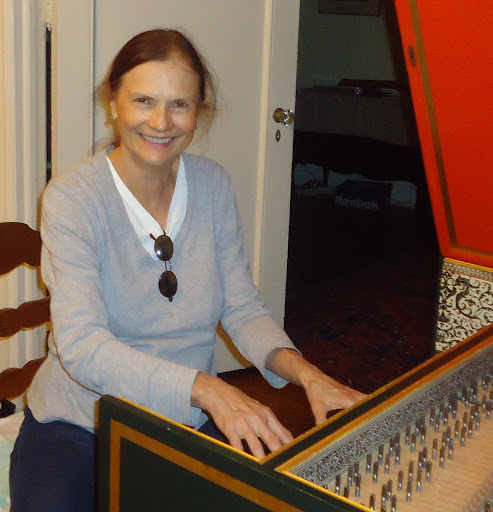
And harpsichordist Elaine Comparone (above) gave the premiere of Vincent Persichetti’s Harpsichord Sonata No. 2 on this date in 1982 in Cleveland. Further documentation about that performance doesn’t seem to exist, but some combination of that piece and that performer seems to have kicked off a spur of enthusiasm for the harpsichord from Persichetti.
He focused his energies around that instrument for the remainder of his life: seven more sonatas followed (the third one written for Comparone), as well as four other works for harpsichord. (The First Sonata is a total outlier, having arrived in 1951.)
Modern works for this “old” instrument — basically left for dead in the 19th century with the development of the fortepiano and piano before experiencing a resurgence — can be absolutely fascinating, and Persichetti’s Second Sonata is no exception. Listen to Comparone’s recording of it here.
Other notable names who grace this date in history include German composer Carl Reinecke (born June 23, 1984), American singer and actress Geraldine Ulmar (born on June 23, 1862), who was known for her Gilbert & Sullivan performances, English folk music and dance collector Cecil Sharp (died on this date in 1924), and Seattle-based pop-classical-crossover composer, pianist, and violinist Jennifer Thomas, who turns 44 today.
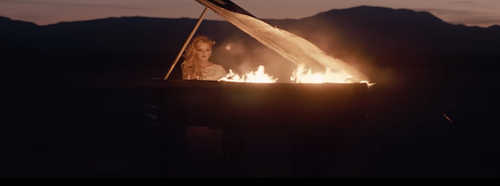
Watch the music video for Thomas’s piece The Fire Within, where she faces off with Kimberly StarKey (a.k.a. “The Rogue Pianist”) on a pair of Yamahas. Concerned about the instrument that’s seen engulfed in flames in the desert, whether out of principle, or for the sake of Thomas’s Yamaha sponsorship? No need.
“The piano that was burned was my old Behr Brothers grand piano that I used in three of my other music videos,” Thomas writes in the caption to the video. “It was terribly damaged and had seen its day…A lot of people asked me if I was going to turn it into a table piece, or a garden ornament. I said, ‘No, I think I’m going to set it on fire.’”