
by Daniel Hathaway
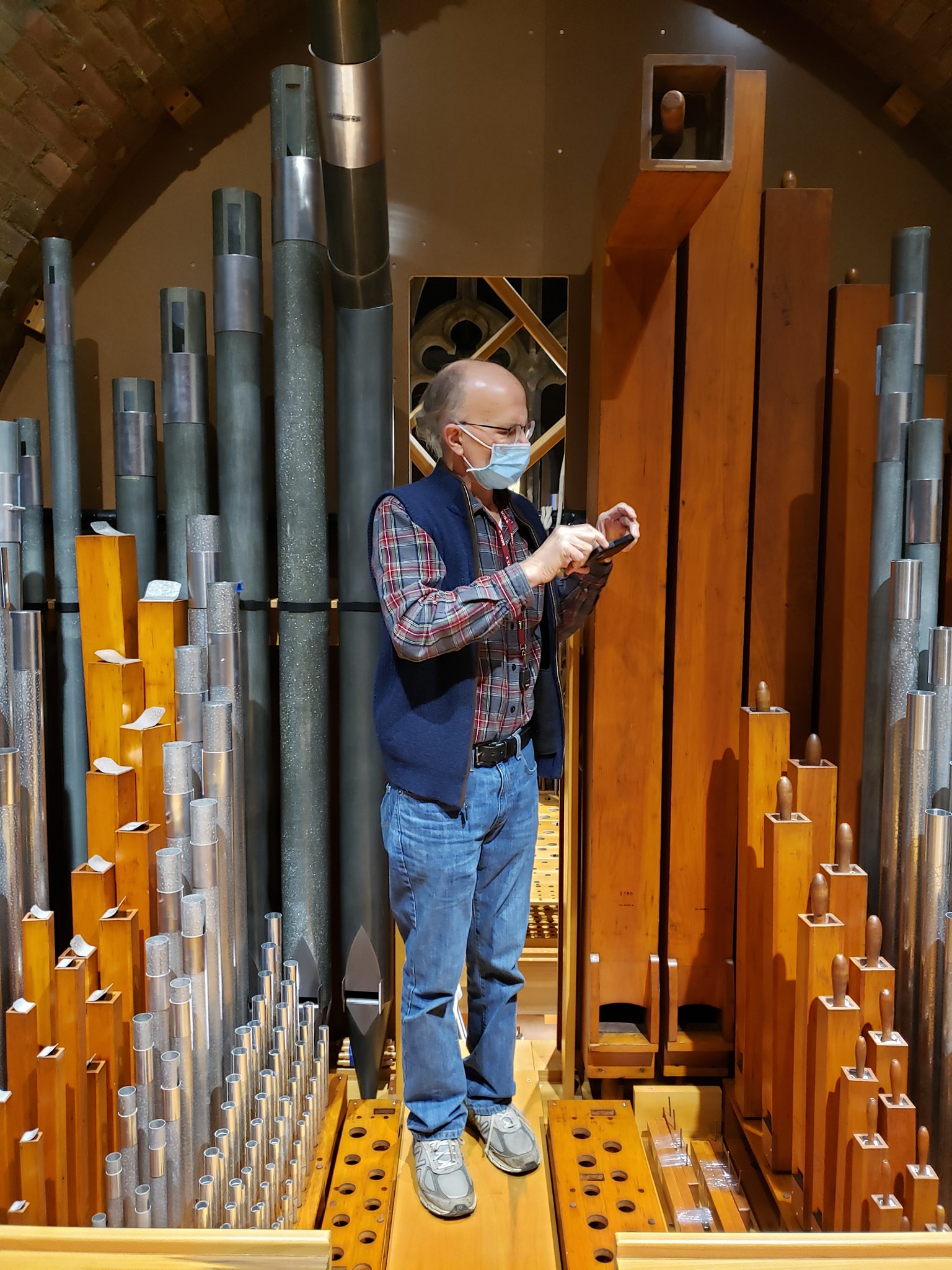 When three trucks from Croton, Ohio’s Muller Organ Company pulled up to Trinity Cathedral in downtown Cleveland on January 11, the Cathedral’s history of distinguished pipe organs opened a new chapter.
Those vehicles were delivering renovated parts of several E.M. Skinner organs, to be installed in chambers above the Cathedral chancel, where Trinity’s first instrument had been located when the building was consecrated in 1907.
“We’re very close to hearing some sounds,” Trinity music director Todd Wilson (left, among the pipes) said today in a Zoom conversation. “They’ll be doing rough tuning for several days, then start real voicing.”
 That 1907 organ, Skinner’s Opus 140, served the Cathedral and its organist-choirmaster, Edwin Arthur Kraft (right), until the 1970s, when its outdated mechanism had deteriorated beyond the point of renovation.
After a long process, contracts were signed with Flentrop Orgelbouw in Zaandam, the Netherlands, for two mechanical action instruments in the Dutch 18th-century style — a moveable, two-manual Choir Organ (delivered in 1976 but later sold) and a three-manual Great Organ at the rear of the nave (pictured below, dedicated in December 1977).
The remains of the Skinner were finally removed in advance of the construction of Trinity Commons in 2002, and salvageable pipework was donated to other organ projects. [Read more…]


 In the decade following the First World War, French popular culture was dominated by images of


 If there’s one classical music festival that best represents this particular moment in time, it might be the Sphinx Performance Academy. Not only does it focus on cultural diversity, and not only has it shifted online this summer due to the coronavirus pandemic, but it has also taken on a new dimension amidst the movement for racial justice sparked by the death of George Floyd.