

by Christine Jay
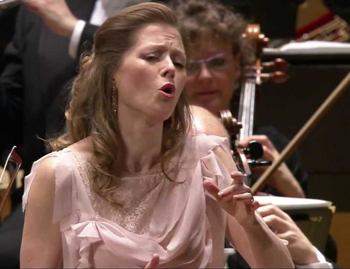 When critically acclaimed soprano and conductor Barbara Hannigan’s surprise birthday plans for her friend and novelist Paul Griffiths fell through, she suggested a gift of even greater implications: a project of Griffiths’ words animated by Hannigan’s liquid sound. The end product will be heard on Thursday and Friday, January 14 and 15 in Severance Hall when Hannigan joins Franz Welser-Möst and The Cleveland Orchestra in the United States premiere of Hans Abrahamsen’s let me tell you.
This situation, indeed, is an example of collaboration at its finest; a soprano, librettist, and composer each separately became enthralled in telling a story. The bonding narrative is Griffiths’ 2008 novel let me tell you, a work utilizing the 481 words appropriated to Ophelia in Shakespeare’s Hamlet. Told from Ophelia’s point of view, Griffiths depicts her life’s maturation, as she is perpetually caught in a web of royalty and patriarchy until her father’s murder and her subsequent, aqueous suicide. [Read more…]
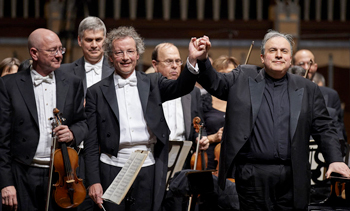
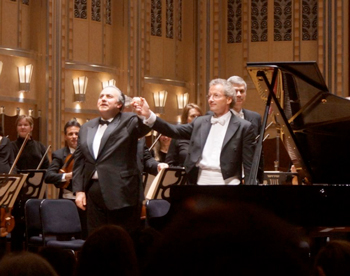
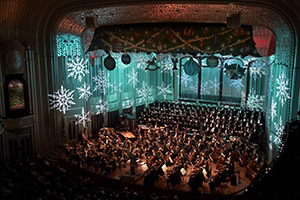 The eighth of ten concerts featuring The Cleveland Orchestra, Cleveland Orchestra Chorus, and Youth Chorus on Saturday evening, December 19 showed no apparent signs of holiday fatigue or repetitive music syndrome. To the obvious delight of a full house, Robert Porco led a wide variety of holiday selections in arrangements by such practiced hands as William Walton, Robert Shaw, Robert Russell Bennett, and John Rutter. The two-hour concert also featured original pieces by Eric Whitacre, Pyotr Tchaikovsky, George Frideric Handel, and Leroy Anderson — and a visit from the Man in the Red Suit.
  Back to the Future (1985) took center-stage at Severance Hall last Thursday evening, December 10, on The Cleveland Orchestra’s “At the Movies” series. Deftly conducted by associate conductor Brett Mitchell, the Orchestra played the score live as the film was shown on a huge screen over the stage. Other than a slight bobble at the outset, the performance sparkled with excellent ensemble and balanced beautifully with the lively soundtrack.
 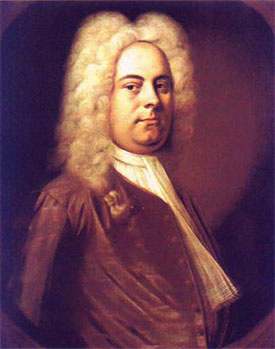 Performing Handel’s most famous oratorio poses a challenge for modern conductors, choruses and orchestras. Even in 1742 when it was being created prior to its debut in Dublin, its composer found himself steering a perilous course between the values of puritans, who wanted it to be religious, and thespians, who saw it as a piece of theater. Nowadays, conductors, orchestras and choruses also find themselves navigating between the values of the historically informed performance movement and the desire to make this hugely popular work accessible to a wide public. Decisions, decisions!
 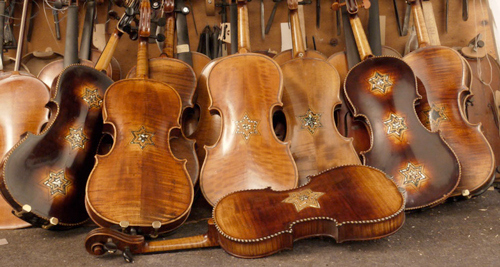 Among the more important activities during the four-month Violins of Hope Cleveland project are the extensive educational activities being offered to schools and students by a number of area institutions. On Wednesday, Thursday, and Friday (December 2 – 4) at 10:10 am and 12:10 noon, associate conductor Brett Mitchell and The Cleveland Orchestra — in conjunction with graduate students from the Case Western Reserve University / Cleveland Play House MFA Program in Acting — presented six engaging, hour-long concerts that unflinchingly presented the events of the Holocaust in music, mime, and words.
 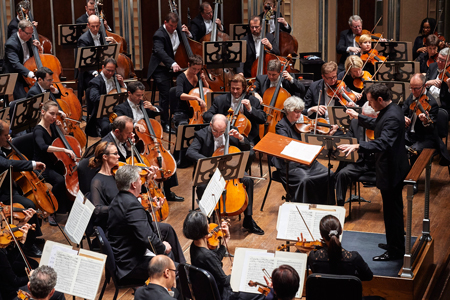 In the closing movements of Hector Berlioz’s Symphonie Fantastique, the full brass section makes a spectacular entrance. In 1830, it must have seemed a sound that had never been heard before. Even in the jaded 21st century, it has a startling sonic complexity — at times as metallic as a locomotive’s firebox, and at others as smooth as the oiled bearings that drive the machine.
 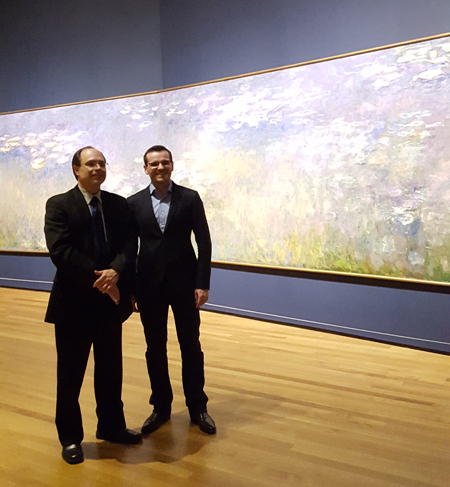 Impressionism provides a unique intersection between visual art and music. You can draw parallels between what composers were writing and artists were painting in other periods — baroque, romantic, modernist — but “aha” moments come with remarkable spontaneity when you put Debussy and Monet side by side. It’s like art you can hear, and music you can see.