


by Mike Telin and Daniel Hathaway
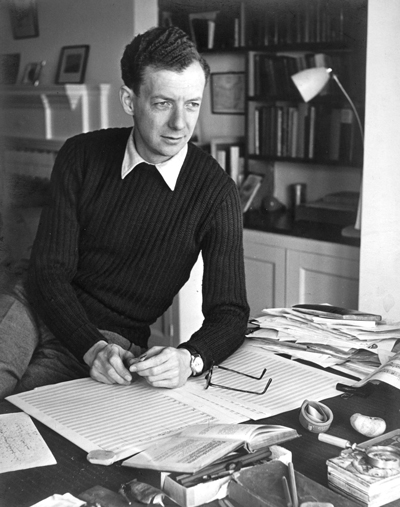 There are a lot of things to consider when choosing an opera that will fit the voices of undergraduate singers. Oberlin Opera Theater director Jonathon Field had both practical and philosophical considerations in mind when he decided to produce Benjamin Britten’s The Rape of Lucretia, which opens for a four-performance run in Hall Auditorium on the Oberlin College campus on Wednesday, November 11.
“If you look at the makeup of any college vocal studies program, most likely 80% of the students are female,” Field said in a telephone conversation. “Lucretia offers a lot of roles and opportunities for female singers. And singing Britten always makes students better performers. I think it’s the way that the words fit the musical lines so completely. It’s quasi-melodic, yet the singers have to get the pitches absolutely right for it to make emotional sense. The music is rhythmically complex, but not impossibly dense. And like a lot of his operas, Lucretia is lightly scored, so that’s perfect for young voices.” [Read more…]
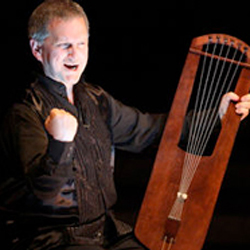 Like many of us, Benjamin Bagby first encountered the epic Anglo-Saxon poem Beowulf during junior high school. A few years later, Bagby became fixated with the sound of medieval music. And as he writes on his website, “The Anglo-Saxons would say that this was simply my wyrd (personal destiny).” This weekend,
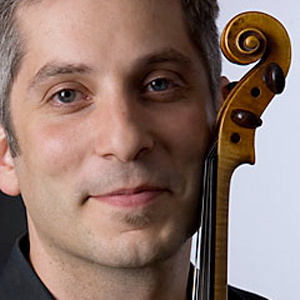 Crossover artist Gabriel Bolkosky, who studied classical violin at the Cleveland Institute of Music, then jazz violin at the University of Michigan, was introduced to the music of Argentine nuevo tango composer Astor Piazzolla by friend and cellist Derek Snyder. “He got me interested in Piazzolla a little over a decade ago,” Bolkosky said in a telephone conversation. “Pretty much from the moment I first heard it, I realized it was music I’d been wanting to play my whole life. His music and its history are so rich, and his musical journey is one that I relate to and admire. Something in the music speaks very deeply to my heart, and because it opens itself up to jazz, it’s the perfect crossover style for classical players.”
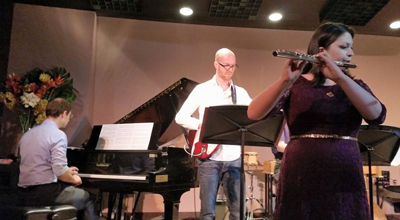 “We’re an ensemble that usually forgoes performing in churches in favor of the less traditional warehouse settings,” FiveOne Experimental Orchestra executive director Jeremy Allen told us during a recent telephone conversation. “When we’re looking for a reverberant Cathedral, we usually look for a post-industrial one like the Screw Factory. But when the opportunity came about to perform this concert, it was a no brainer.” On Friday, November 13 at 8:00 pm at Disciples Christian Church in Cleveland Heights, FiveOne Experimental Orchestra (51XO) will present Sacrum Silentium.
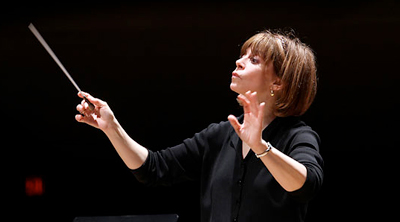 The Akron Symphony Orchestra will continue its Classic Series on Saturday, November 14 at 8:00 pm in E.J. Thomas Hall. The concert, under the direction of celebrated guest conductor JoAnn Falletta, will include works by Roussel, Copland, and Brahms.
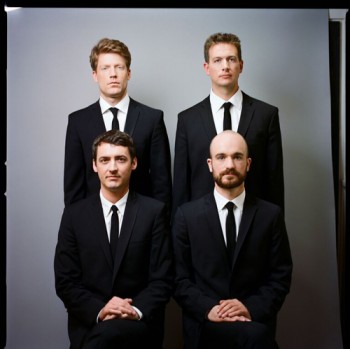 Hailed as “…one of America’s most satisfying — and most enterprising — quartets,” by the Los Angeles Times, the Calder Quartet, Benjamin Jacobson and Andrew Bulbrook, violins, Jonathan Moerschel, viola, and Eric Byers, cello, is an ensemble of distinction. The Quartet returns to the Cleveland Museum of Art’s Performing Arts Series on Monday, November 16 at 7:30 pm with a performance at Transformer Station. The program will include works by Bjarnason, Britten, and Beethoven.
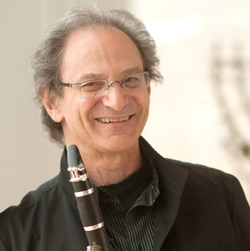 On Sunday afternoon, October 25, Arts Renaissance Tremont presented the third concert of its 25th Season, “Franklin Cohen and Friends,” at Pilgrim Church in Tremont — a delightful autumn afternoon of clarinet and chamber music. Departing from the printed program, the concert opened with Mozart’s Trio in E-flat, K. 498 “Kegelstatt,” featuring pianist Rafael Skorka, clarinetist Franklin Cohen, and violist Kirsten Docter. “Kegelstatt” is German for the location where one would play “skittles,” a lawn game similar to bowling that was popular in Mozart’s era.
 Conjuring the spirit of Halloween for just one more night, the November 1 program by the Canton Symphony Orchestra under the enchanted baton (or magic wand?) of Gerhardt Zimmermann, was frightfully delicious. Not that I favor socializing in the netherworld, but from beginning to end, the evening was a magnificent dance with the devil.
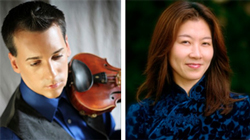 Violinist Andrew Sords and pianist Eriko Izumida performed an audience-pleasing concert on Sunday afternoon, November 1, as part of the Chagrin Concert Series at the Valley Lutheran Church in Chagrin Falls. The program of works by Fauré, Ravel, and Franck included several landmarks of the late Romantic violin repertoire, all expertly performed.
 Anyone who’s a fan of the long-running television sitcom Cheers will undoubtedly remember the show’s catchy theme song which includes the “philosophical” line, ‘sometimes you want to go where everybody knows your name.’ Since the