



by Jeremy Reynolds
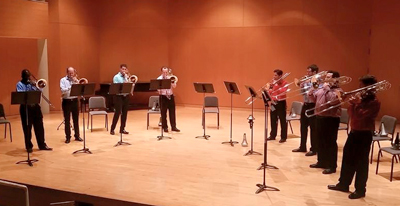 Two trombones led the opening melody of Giovanni Gabrieli’s Jubilate Deo with seven more close at hand to join in the counterpoint. On Tuesday, June 9 the Great Lakes Trombone Ensemble delivered a program of fanfares, folk tunes, film music and more in Drinko Hall at Cleveland State University.
The group comprises members of The Cleveland Orchestra, the Buffalo Philharmonic, the Detroit Symphony, the Pittsburg Symphony, the Rochester Philharmonic, Toledo Symphony, and faculty members from Akron and Cleveland State University. The Ensemble performed during the annual Cleveland Trombone Seminar, which Cleveland assistant principal trombone Shachar Israel initiated in 2011. [Read more…]
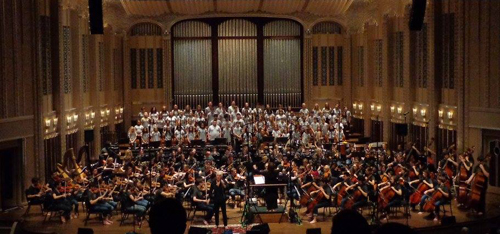
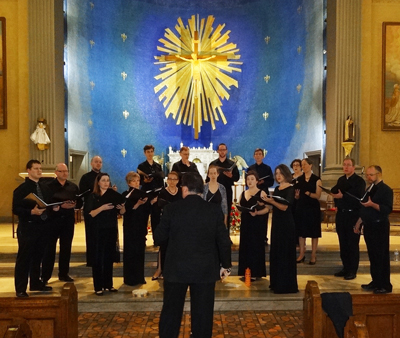 Contrapunctus Early Music is a relatively recent constellation in the Cleveland musical heavens. The a capella chamber ensemble is led by English conductor David Acres and comprises a number of Northeast Ohio’s finest professional and semi-professional singers (17 for this concert). On Sunday in Mary Queen of Peace Church on Pearl Road, Contrapunctus presented an intriguing program of polyphonic music by Spanish composers from the 13th to the 17th century.
 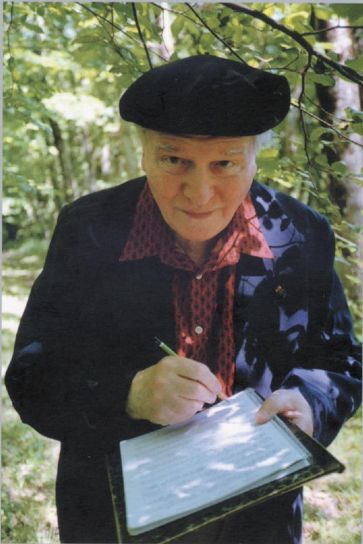 Franz Welser-Möst led the apparently indefatigable musicians of The Cleveland Orchestra in the third of four challenging, all-in-a-row concerts on Friday evening, May 29, major attractions on the agenda for the League of American Orchestras Cleveland meeting. Olivier Messiaen’s dazzling Chronochromie and Antonín Dvořák’s infrequently performed fifth symphony made different but compelling connections to the natural world, while Messiaen’s theologically-infused Hymne opened a portal to the heavenly realms.
 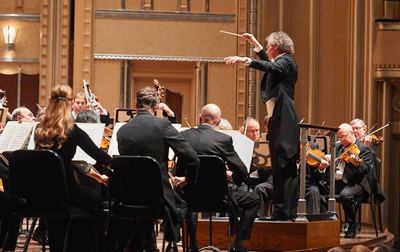 At Severance Hall on Thursday, May 28 on a stage still covered in tarps to protect the artificial grass used in the production of Strauss’s Daphne (May 27 and 30), the Cleveland Orchestra gave a spirited performance of another of the canon’s great nature-inspired works: Beethoven’s Symphony No. 6, “Pastoral.” The second half of the program featured Richard Strauss’s Symphonia Domestica, Opus 53.
 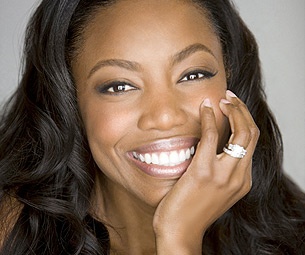 On Thursday, May 28 at Masonic Auditorium, CityMusic Cleveland, under the direction of Avner Dorman, presented the first of two performances featuring a percussion concerto on the first half and a selection of show tunes on the second. What do these two musical styles have in common? Perhaps nothing, but in the words of Duke Ellington, “if it sounds good it IS good,” and from beginning to end, this was one good concert. The performance was presented as part of CityMusic’s “Wishes and Dreams: A Homeless Children Project.”
 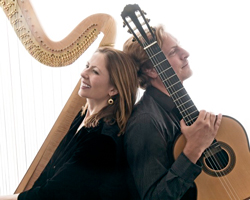 The number of recitals during the fifteenth edition of the Cleveland International Classical Guitar Festival at the Cleveland Institute of Music increased to six. ClevelandClassical correspondents attended the recitals by Jason Vieaux and Yolanda Kondonassis, Ricardo Gallén, Paul Galbraith, and Antonis Hatzinikolaou, all of which attracted large, enthusiastic audiences to Mixon Hall between May 28 and May 31.
 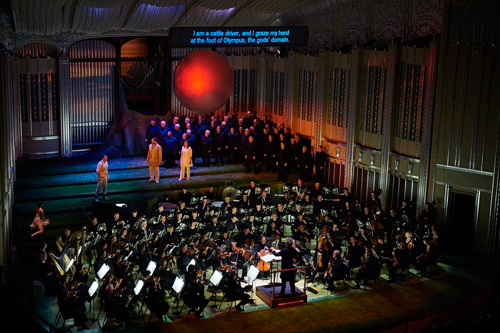 “Daphne” means “Laurel” in Greek, and Ovid’s tale in Metamorphoses of how a river nymph came to be transmogrified into a sacred tree has all the elements that an opera composer could wish for: a sylvan setting, gods meddling in human affairs, passion versus purity, jealousy that leads to murder, a drunken orgy, and an ennobling ending. Jacopo Peri took on the story in 1597 (one of several operas he wrote, now mostly lost), as did Marco da Gagliano (1608), Heinrich Schütz (1627, his only opera, entirely lost), Alessandro Scarlatti (1700) and, most recently, Richard Strauss (1938).
 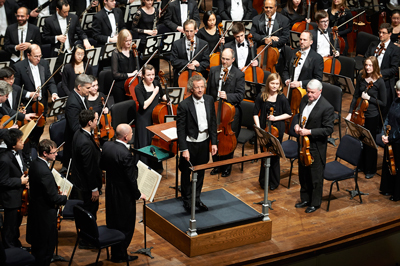 Franz Welser-Möst returned to the Severance Hall podium on Thursday, May 14 to lead The Cleveland Orchestra in a dynamic concert of music by Paul Hindemith, Jörg Widmann and Antonín Dvořák. Though the marketing department successfully advertised Dvořák’s “New World” Symphony as the main attraction (resulting in a large turnout for a Thursday evening), Christian Tetzlaff’s riveting performance of Widmann’s Violin Concerto was the most musically intriguing entry on the program, with The Orchestra’s reading of Hindemith’s Concert Music for Strings and Brass not far behind.