
by Kelly Ferjutz
Special to ClevelandClassical.com

by Kelly Ferjutz
Special to ClevelandClassical.com
by Kelly Ferjutz
Special to ClevelandClassical.com

Oh, no. There are numerous meetings with the other technical staff of the production in addition to Costume Design. Among these are Set and sometimes Prop Design, Lighting Design, more rarely Sound Design, plus the Stage Director, Choreographer, Stage Manager and Conductor. All of these people have an interest in how the production will both look and sound to an audience. Depending on the size of the show, these meetings may begin as much as a year in advance of opening night.
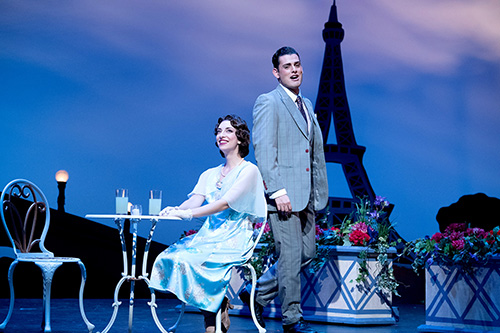
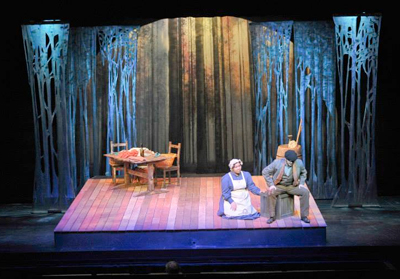
Obviously, I Do! I Do! (the famous two-person, one-set musical of 1966) isn’t nearly as demanding or complex as Phantom of the Opera, but either of them could easily have been ruined by a lack of proper attention to the necessities. For the former, that meant two nightgowns and a huge bed. For the latter, it seemed like half the population of Paris was onstage at times. [Read more…]
by Timothy Robson

by Kelly Ferjutz
Special to ClevelandClassical.com

by Kelly Ferjutz
Special to ClevelandClassical.com

by Kelly Ferjutz, Special to ClevelandClassical

by Kelly Ferjutz, Special to ClevelandClassical

by Daniel Hathaway

It’s a simple tale, but one that was set to complex and sophisticated music by a disciple of Wagner who adopted the technique of Leitmotiv to subliminally suggest characters and themes. The score interested Richard Strauss to the point that he agreed to conduct its premiere in 1893.
It’s a vocally demanding work that calls for experienced singers, but it’s frequently mounted by university and conservatory opera departments who have a bumper crop of women’s voices to cast (Hansel is routinely performed as a trouser role). It calls for a large orchestra — which can cause balance problems against younger singers. [Read more…]
by Daniel Hathaway

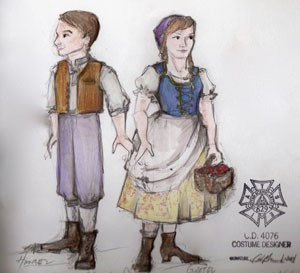
Englebert Humperdinck’s operatic version of the Brothers Grimm fairy tale, Hansel and Gretel can be played in many different ways, but Smith took his cue from the music in conceptualizing Baldwin Wallace’s production of the show, which opens in the John Patrick Theatre at the Kleist Center in Berea on Thursday evening, February 20 and runs through four performances, ending with a matinee on Sunday, February 23.
“The opera is just not as dark as the original story, especially in its portrayal of Hansel and Gretel’s parents. [Read more…]
by Timothy Robson

I saw the Sunday, July 14, matinee performance. As an example of musical theater of the time, Lady, Be Good! can’t really be faulted; however, we can be grateful for the revolutionary changes to the Broadway musical form by Jerome Kern’s Showboat in 1927 and Rodgers and Hammerstein’s Oklahoma in 1943, which much more closely integrate the show’s book, music and lyrics into a unified whole. That evolution of musical theater reached its apotheosis in the works of Stephen Sondheim, in which individual songs melt into the flow of the story.
Lady, Be Good!, on the other hand, has a flimsy and immensely convoluted storyline that requires considerable suspension of disbelief. [Read more…]