by Mike Telin
 As The Cleveland Orchestra gears up to launch its fall Severance Hall season, we caught up with Ross Binnie, the Orchestra’s Chief Marketing Officer, and asked him to give his insights into the array of programs. He described them as “a blend of the curious and the familiar which will be wonderful for the audiences.”
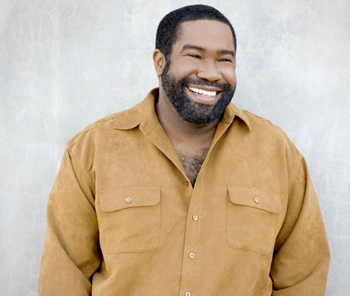
The season kicks off on September 29 and 30 when Franz Welser-Möst leads performances of Ives’s Symphony No. 3 (“The Camp Meeting”) and Sibelius’s Symphony No. 2. And organist Paul Jacobs (below) will make his Cleveland Orchestra debut as soloist in Copland’s Symphony for Organ and Orchestra. [Read more…]
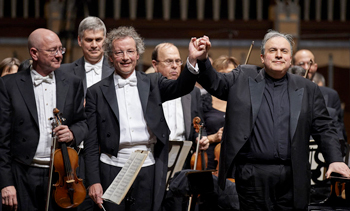
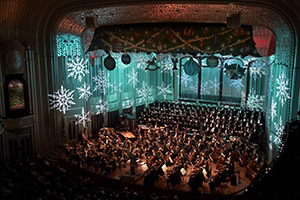 The eighth of ten concerts featuring The Cleveland Orchestra, Cleveland Orchestra Chorus, and Youth Chorus on Saturday evening, December 19 showed no apparent signs of holiday fatigue or repetitive music syndrome. To the obvious delight of a full house, Robert Porco led a wide variety of holiday selections in arrangements by such practiced hands as William Walton, Robert Shaw, Robert Russell Bennett, and John Rutter. The two-hour concert also featured original pieces by Eric Whitacre, Pyotr Tchaikovsky, George Frideric Handel, and Leroy Anderson — and a visit from the Man in the Red Suit.
 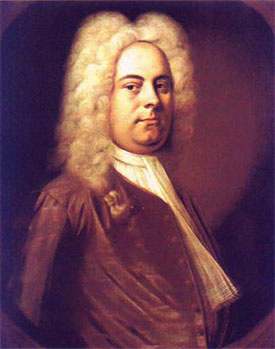 Performing Handel’s most famous oratorio poses a challenge for modern conductors, choruses and orchestras. Even in 1742 when it was being created prior to its debut in Dublin, its composer found himself steering a perilous course between the values of puritans, who wanted it to be religious, and thespians, who saw it as a piece of theater. Nowadays, conductors, orchestras and choruses also find themselves navigating between the values of the historically informed performance movement and the desire to make this hugely popular work accessible to a wide public. Decisions, decisions!
 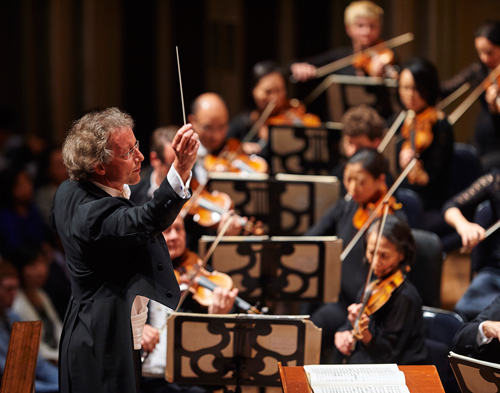 The three programs scheduled by The Cleveland Orchestra last weekend were each colorful in their own right, but the blueprint of works being performed was complicated enough that the program book color-coded each evening to keep patrons apprised about what they were hearing, and in what order. Come to think of it, the orchestra and stage crew probably appreciated those navigational aids as well.
 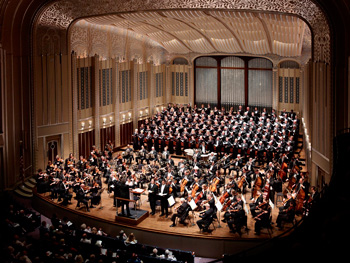 If The Cleveland Orchestra’s recent performance of Gustav Mahler’s third symphony were a restaurant, it would deserve the maximum three stars in the Michelin Guide (“exceptional…worth a special journey”). Franz Welser-Möst, the Orchestra, two of its choruses, and mezzo-soprano Kelley O’Connor took a captivated audience on a 95-minute journey into Mahler’s magic world on Thursday evening, October 5, the first of a pair of performances that weekend at Severance Hall, and an experience audiences in Paris and Vienna can look forward to during the Orchestra’s October tour.
 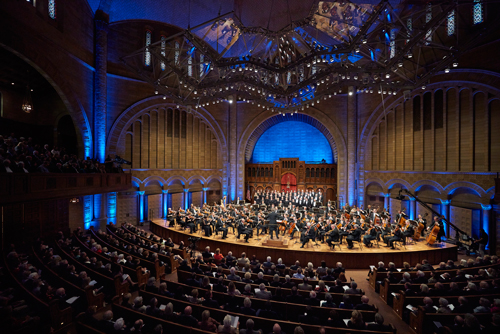 The Cleveland Orchestra crossed Wade Lagoon on Sunday afternoon, September 27 to launch two ships on important missions with a single concert. One order of business was to crack a musical champagne bottle across the bow of the Milton and Tamar Maltz Performing Arts Center at The Temple-Tifereth Israel. The newly renovated University Circle landmark will continue to serve as a space to celebrate major religious holidays and life events while also providing Case Western Reserve University with the first stage in the creation of a long-needed performing arts facility.
 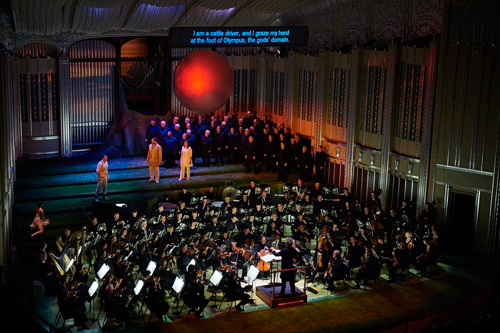 “Daphne” means “Laurel” in Greek, and Ovid’s tale in Metamorphoses of how a river nymph came to be transmogrified into a sacred tree has all the elements that an opera composer could wish for: a sylvan setting, gods meddling in human affairs, passion versus purity, jealousy that leads to murder, a drunken orgy, and an ennobling ending. Jacopo Peri took on the story in 1597 (one of several operas he wrote, now mostly lost), as did Marco da Gagliano (1608), Heinrich Schütz (1627, his only opera, entirely lost), Alessandro Scarlatti (1700) and, most recently, Richard Strauss (1938).