by Daniel Hathaway
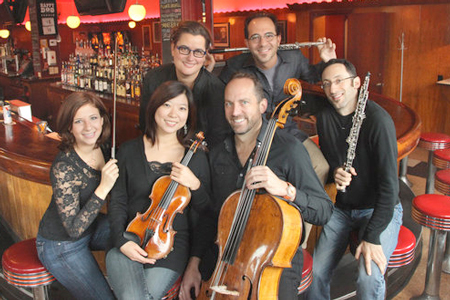 Ensemble HD, a group of Cleveland Orchestra musicians and friends headed up by principal flute Joshua Smith, garnered a lot of publicity a few years ago when the musicians played at Happy Dog in Gordon Square — a tavern famous for its hot dogs with fifty toppings. The ensemble will be featured on the next Rocky River Chamber Music Society concert on Monday, February 1 at 7:30 pm at West Shore Unitarian Universalist Church.
For that free concert, Smith will join fellow Ensemble HD members (oboist Frank Rosenwein, violinist Amy Lee, violist Joanna Patterson, cellist Charles Bernard, and guest pianist Christina Dahl) in music that dates from between the 20th century’s World Wars. We caught up with Joshua Smith in Miami, where the Orchestra was continuing its residency in the sunny south, to ask about Ensemble HD’s forthcoming program. [Read more…]
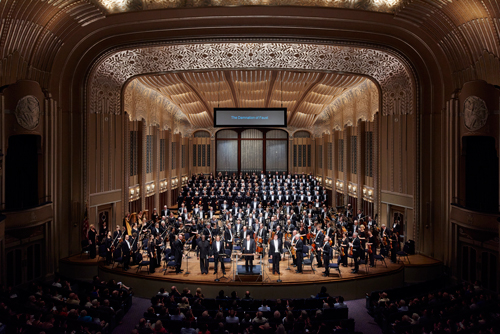
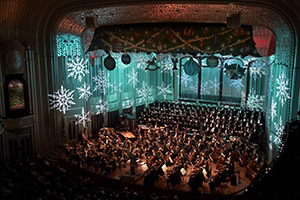 The eighth of ten concerts featuring The Cleveland Orchestra, Cleveland Orchestra Chorus, and Youth Chorus on Saturday evening, December 19 showed no apparent signs of holiday fatigue or repetitive music syndrome. To the obvious delight of a full house, Robert Porco led a wide variety of holiday selections in arrangements by such practiced hands as William Walton, Robert Shaw, Robert Russell Bennett, and John Rutter. The two-hour concert also featured original pieces by Eric Whitacre, Pyotr Tchaikovsky, George Frideric Handel, and Leroy Anderson — and a visit from the Man in the Red Suit.
 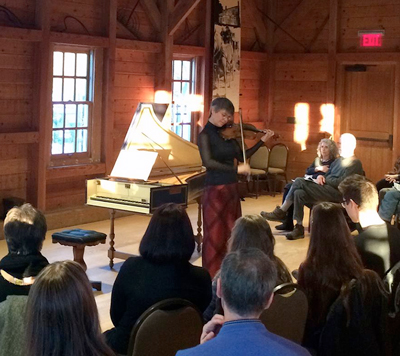 A great thing about chamber music is that it can be performed in any space that can accommodate a small number of musicians while leaving room to comfortably seat an audience. Since 2005, Heights Arts’ Close Encounters Chamber Music Series has found its niche in Cleveland’s vibrant chamber music scene by presenting concerts in intriguing and inviting spaces around the city. The series, coordinated by artistic director Isabel Trautwein, presented its first concert of the season on Sunday afternoon, November 22 at Dunham Tavern Museum in Midtown.
 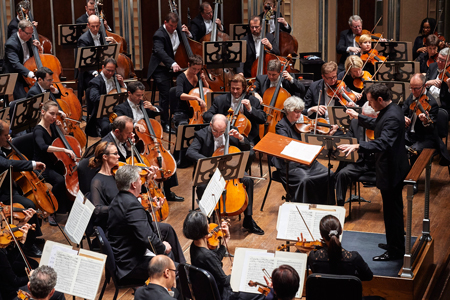 In the closing movements of Hector Berlioz’s Symphonie Fantastique, the full brass section makes a spectacular entrance. In 1830, it must have seemed a sound that had never been heard before. Even in the jaded 21st century, it has a startling sonic complexity — at times as metallic as a locomotive’s firebox, and at others as smooth as the oiled bearings that drive the machine.
 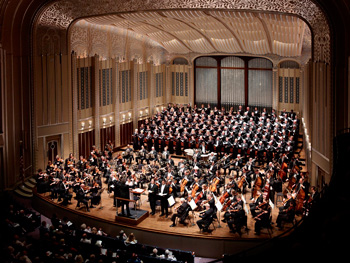 If The Cleveland Orchestra’s recent performance of Gustav Mahler’s third symphony were a restaurant, it would deserve the maximum three stars in the Michelin Guide (“exceptional…worth a special journey”). Franz Welser-Möst, the Orchestra, two of its choruses, and mezzo-soprano Kelley O’Connor took a captivated audience on a 95-minute journey into Mahler’s magic world on Thursday evening, October 5, the first of a pair of performances that weekend at Severance Hall, and an experience audiences in Paris and Vienna can look forward to during the Orchestra’s October tour.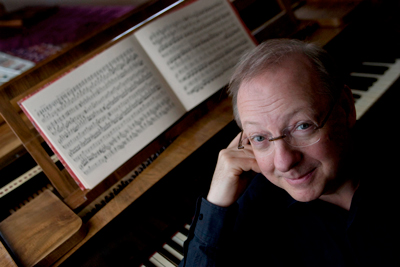
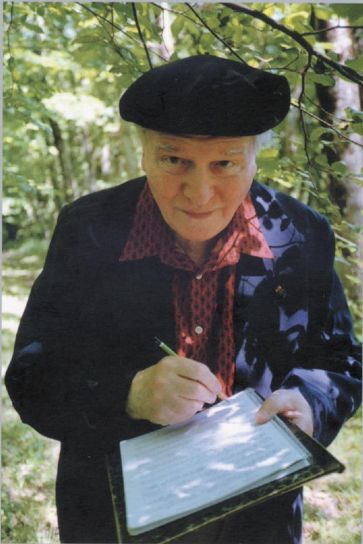 Franz Welser-Möst led the apparently indefatigable musicians of The Cleveland Orchestra in the third of four challenging, all-in-a-row concerts on Friday evening, May 29, major attractions on the agenda for the League of American Orchestras Cleveland meeting. Olivier Messiaen’s dazzling Chronochromie and Antonín Dvořák’s infrequently performed fifth symphony made different but compelling connections to the natural world, while Messiaen’s theologically-infused Hymne opened a portal to the heavenly realms.
 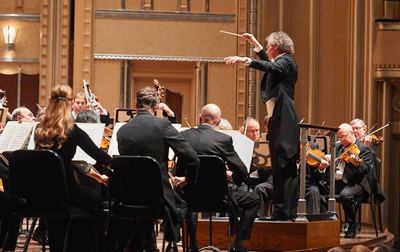 At Severance Hall on Thursday, May 28 on a stage still covered in tarps to protect the artificial grass used in the production of Strauss’s Daphne (May 27 and 30), the Cleveland Orchestra gave a spirited performance of another of the canon’s great nature-inspired works: Beethoven’s Symphony No. 6, “Pastoral.” The second half of the program featured Richard Strauss’s Symphonia Domestica, Opus 53.
 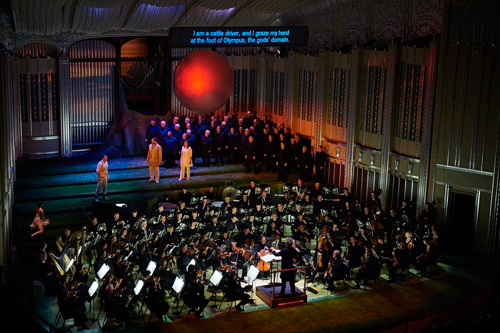 “Daphne” means “Laurel” in Greek, and Ovid’s tale in Metamorphoses of how a river nymph came to be transmogrified into a sacred tree has all the elements that an opera composer could wish for: a sylvan setting, gods meddling in human affairs, passion versus purity, jealousy that leads to murder, a drunken orgy, and an ennobling ending. Jacopo Peri took on the story in 1597 (one of several operas he wrote, now mostly lost), as did Marco da Gagliano (1608), Heinrich Schütz (1627, his only opera, entirely lost), Alessandro Scarlatti (1700) and, most recently, Richard Strauss (1938).